
AEO vs GEO: Detailed Guide on Key Difference and Best Practices (That Actually Move Rankings)

Raman Singh
Raman Singh is a highly skilled marketing professional who serves as the head of marketing at Copyrocket AI
Search results now show direct answers, AI summaries, and cited sources. Users also ask voice assistants and chatbots for quick help. This shift changes how content earns visibility.
AEO helps your page deliver a clean, direct answer. GEO helps your brand appear inside AI-generated responses and citations. This guide explains the key difference between AEO and GEO and gives best practices you can use on your next update.
Key Takeaways
- AEO targets answer boxes, voice answers, and “People also ask” by using clear questions, short answers, and strong page structure.
- GEO targets AI-generated answers by improving entity clarity, topical coverage, citations, and brand credibility signals.
- AEO wins speed and precision. GEO wins breadth and citation likelihood inside generative results.
- Use AEO for pages that solve one problem fast. Use GEO for pages that explain a topic and support many related questions.
- The best strategy uses both: AEO for extractable answers and GEO for context, trust, and entity consistency.
- Measure AEO with featured snippet and PAA wins. Measure GEO with AI visibility checks, citation frequency, and branded demand lift.
What AEO Means and What It Optimizes
AEO means Answer Engine Optimization. AEO helps your content appear as a direct answer in search features. AEO also helps voice assistants read your content. AEO focuses on fast comprehension. AEO also focuses on structured formats that search systems can extract.
What counts as an “answer engine”
- Featured snippets (paragraph, list, table)
- People Also Ask (PAA) questions
- Voice assistant answers
- Search result enhancements that show direct answers
What AEO content looks like
- A clear question in a heading
- A direct answer in the first 40 to 70 words under that heading
- Steps, lists, or tables that summarize the process
- Definitions that use simple nouns and verbs
- Schema markup that matches the page content
When AEO works best
- How-to queries with a clear sequence
- Definition queries (“What is AEO?”)
- Comparison queries (“AEO vs GEO”)
- Pricing model explanations (“How does X pricing work?”)
- Troubleshooting queries (“Why does X fail?”)
What GEO Means and What It Optimizes
GEO means Generative Engine Optimization. GEO helps your brand and content appear in AI-generated answers. GEO focuses on how AI systems select sources, summarize facts, and cite references. GEO also focuses on entity clarity, topic coverage, and trust signals that support citation.
What counts as a “generative engine”
- AI Overviews and similar generative search features
- Chat-based search experiences
- AI assistants that cite web sources
- Enterprise AI tools that use retrieval and citations
What GEO content looks like
- A page that explains a topic with clear subtopics
- Consistent entity naming (brand, product, category, features)
- Evidence support like data, examples, and references
- Internal links that connect related pages in a topic cluster
- Author and brand signals that show real expertise and accountability
When GEO works best
- Broad research queries (“best way to do X”)
- Multi-step decisions (“tools for X with pros and cons”)
- Category comparisons (“best AEO tools”)
- Long-tail questions that require context
- Queries where AI summaries replace multiple clicks
AEO vs GEO: The Key Differences That Matter
AEO and GEO overlap, but they solve different ranking problems. AEO helps extraction. GEO helps selection and citation. Use the differences below to pick the right approach for each page.
Primary goal
- AEO: Get your exact answer pulled into a search feature.
- GEO: Get your brand and page cited or referenced in AI-generated answers.
Best content shape
- AEO: Short, direct, structured, question-led sections.
- GEO: Comprehensive, well-scoped, entity-rich topic coverage with clear subtopics.
Primary ranking signals you influence
- AEO: Clarity, formatting, snippet-ready blocks, schema alignment, fast page performance.
- GEO: Entity consistency, topical authority, citations, brand trust signals, content freshness, internal linking.
How you win visibility
- AEO: You win by being the easiest correct answer to extract.
- GEO: You win by being a reliable source to summarize and cite across many related questions.
What “success” looks like
- AEO: Featured snippet ownership, more PAA placements, more voice answer reads, higher CTR on “answer” queries.
- GEO: Brand mentions in AI answers, citations to your pages, assisted conversions, growth in branded search.
Common failure modes
- AEO failure: The page buries the answer, uses vague language, or lacks structure.
- GEO failure: The page lacks clear entities, lacks unique evidence, or lacks trust signals and references.
How Search Features Changed: Why AEO and GEO Both Matter
Search pages now mix classic links with direct answers and AI summaries. Users also accept “good enough” answers without clicking. This reduces traffic for some queries. It also creates new visibility paths. AEO helps you win the extracted answer. GEO helps you win the cited source and brand recall.
Three user behaviors you must design for
- Instant answer behavior: The user wants one clear sentence or a short list.
- Comparison behavior: The user wants trade-offs, examples, and constraints.
- Decision behavior: The user wants proof, pricing context, and next steps.
What this means for content planning
- Use AEO blocks on pages that target instant answer behavior.
- Use GEO depth on pages that target comparison and decision behavior.
- Use both on high-value pages that sit near purchase intent.
AEO Best Practices: Make Your Content Easy to Extract
AEO rewards pages that answer a question fast and clearly. You can apply AEO to existing pages with simple edits. Use the practices below in order. Each step improves extraction.
1) Use a question-led heading structure
- Write H2 and H3 headings as real questions users ask.
- Match the query wording, but keep grammar correct.
- Keep one main question per section.
2) Put the direct answer first
- Place a 40 to 70 word answer under the question heading.
- Use a subject-verb-object sentence order.
- Use one definition per sentence.
- Avoid hedging words like “might” unless uncertainty is required.
3) Add “snippet blocks” that search systems can lift
- Paragraph snippet: One short definition paragraph.
- List snippet: Steps or key points in 5 to 8 bullets.
- Table snippet: Comparisons like features, pricing tiers, pros and cons.
4) Use consistent terms and simple nouns
- Use one term for one concept. Do not rotate synonyms.
- Repeat the primary keyword where it fits the sentence.
- Define acronyms once, then use the acronym.
5) Add schema that matches the visible content
- Use FAQPage schema for real FAQs on the page.
- Use HowTo schema for step sequences that users can follow.
- Use Article schema with author and date fields.
- Do not add schema for content that the user cannot see.
6) Improve page experience so answers load fast
- Compress images and use modern formats.
- Reduce script bloat.
- Fix layout shift on mobile.
- Keep the first answer section near the top of the page.
7) Build an AEO content checklist (copy and use)
- I placed the question in an H2 or H3.
- I wrote a direct answer in the first 70 words.
- I added a list or table for quick scanning.
- I used consistent terms for the main entities.
- I added schema that matches the page.
- I tested the page on mobile and fixed speed issues.
GEO Best Practices: Make Your Brand Easy to Cite
GEO rewards pages that help AI systems summarize a topic with confidence. AI systems prefer sources that show clear entities, clear scope, and verifiable claims. Use the practices below to increase citation and brand mention rates.
1) Define entities with clear, repeatable language
- State your brand name, product name, and category in plain text.
- Use the same naming across your site, bios, and profiles.
- Explain what the product does in one sentence near the top.
2) Build topic clusters that cover the full question set
- Create one pillar page for the main topic.
- Create supporting pages for subtopics and long-tail questions.
- Link from the pillar to each supporting page with descriptive anchor text.
- Link back from each supporting page to the pillar.
3) Add evidence that AI systems can reuse
- Use numbers, ranges, and constraints where you can support them.
- Include examples, templates, and step-by-step workflows.
- Explain why a step matters with one clear sentence.
- Update facts on a schedule and show the updated date.
4) Strengthen E-E-A-T signals with concrete page elements
- Add an author box with role, experience, and a real profile link.
- Add an editorial policy page and a corrections contact.
- Add references when you cite stats, standards, or research.
- Add a company “About” page with leadership and address details if relevant.
5) Improve citation readiness with clean structure
- Use short paragraphs and clear subheadings.
- Use “definition then details” in each section.
- Use consistent formatting for pros and cons, steps, and comparisons.
6) Use digital PR and third-party mentions
- Earn mentions on relevant industry sites.
- Publish data studies that others can cite.
- Get listed in credible directories if they match your category.
- Keep your brand facts consistent across all profiles.
7) Build a GEO content checklist (copy and use)
- I stated the main entities and definitions near the top.
- I covered key subtopics with separate sections or pages.
- I linked related pages with clear anchor text.
- I added evidence, examples, and constraints.
- I added author, policy, and reference elements.
- I checked brand consistency across the web.
AEO vs GEO in Practice: Which One Should You Use?
You should choose based on query shape and business goal. Many pages need both. Use the guide below to decide fast.
Use AEO when the user wants one clear answer
- Definitions and acronyms
- Quick how-to steps
- Simple comparisons with a short verdict
- Support questions and troubleshooting
Use GEO when the user wants a full explanation
- “Best” and “top” queries that require criteria
- Strategy queries that need context
- Tool selection queries with trade-offs
- Industry topics where trust and sources matter
Use both when revenue depends on the page
- Category pages with high-intent traffic
- Product pages that need clear positioning
- Comparison pages (your product vs alternatives)
- Pricing and implementation pages
Step-by-Step Workflow: Convert One Blog Post into an AEO + GEO Asset
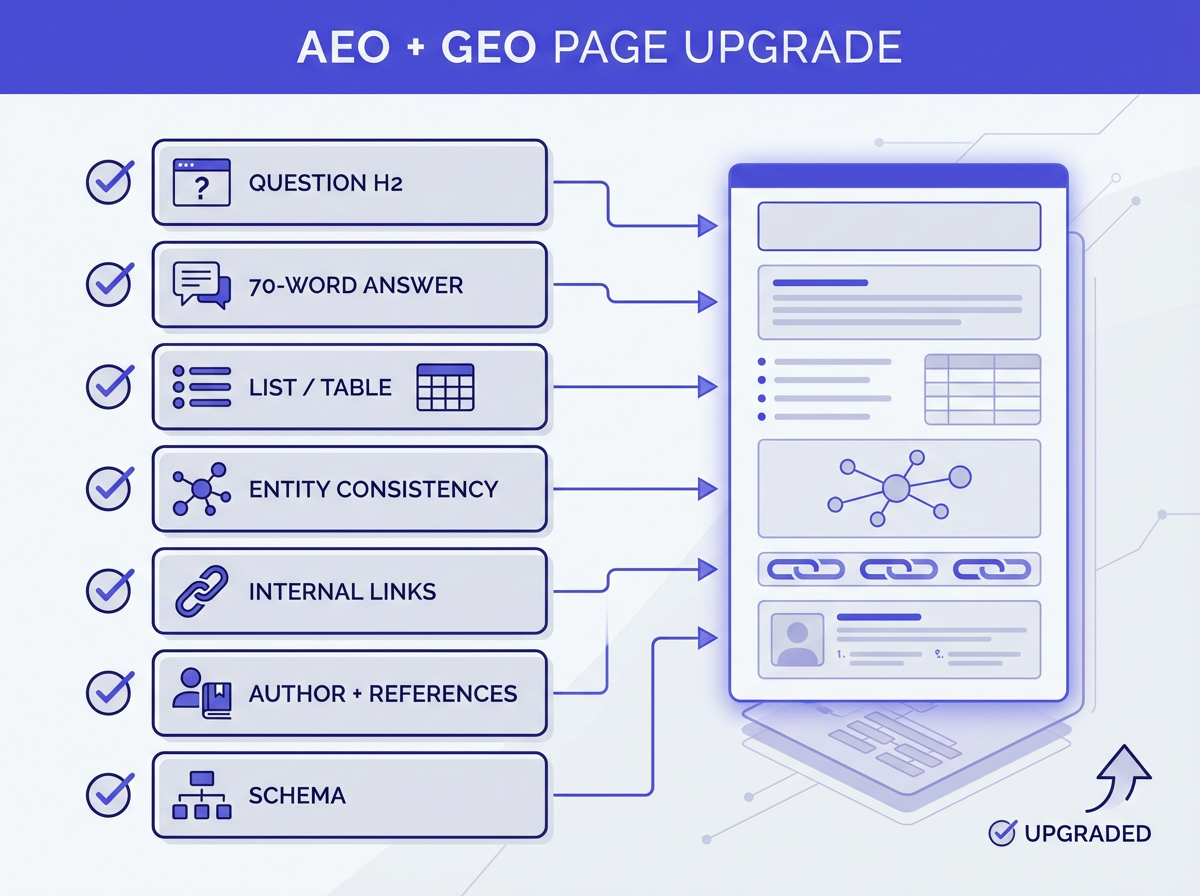
You can upgrade one post without rewriting everything. Follow this workflow. Each step improves extractability and citation value.
Step 1: Pick the target query set
- Choose one primary query and 6 to 12 related questions.
- Group questions by intent: definition, steps, comparison, decision.
Step 2: Add an “answer layer” (AEO layer)
- Add question headings for the top questions.
- Add a short direct answer under each heading.
- Add a list or table where it fits.
Step 3: Add a “context layer” (GEO layer)
- Add subtopics that explain criteria and trade-offs.
- Add examples that show the concept in action.
- Add internal links to supporting pages.
Step 4: Add trust and proof elements
- Add author details and an editorial note if needed.
- Add references for stats and claims.
- Add a short “last updated” line near the top or bottom.
Step 5: Validate structure and performance
- Check heading order (H2 then H3).
- Check that each section starts with a direct answer sentence.
- Test mobile speed and fix large assets.
On-Page Templates You Can Copy (AEO + GEO)
Templates reduce editing time and improve consistency. Use these formats for new pages and updates.
Template 1: Definition section (AEO-first)
- H2: What is [term]?
- Answer (40–70 words): Define the term. State the purpose. State the main outcome.
- Bullets: List 3 to 6 key traits or components.
Template 2: Comparison section (AEO + GEO)
- H2: [A] vs [B]: What is the difference?
- Answer (40–70 words): State the main difference in one sentence. Add one sentence on when to use each.
- Table: Goal, best for, content format, success metrics, risks.
- Context: Add selection criteria and examples.
Template 3: Process section (HowTo-ready)
- H2: How to do [task] step by step
- Answer (40–70 words): State the outcome and the time or effort range.
- Steps: 5 to 9 steps with action verbs.
- Notes: Add constraints, common mistakes, and checks.
Metrics and Tracking: How to Measure AEO vs GEO
You need separate measurement because AEO and GEO create different outcomes. Track both sets so you do not miss wins that do not show as classic clicks.
AEO metrics to track
- Featured snippet ownership for target queries
- PAA placements and growth over time
- Average position changes on question queries
- CTR changes on pages that win snippets
- Engagement after snippet wins (bounce rate and time on page)
GEO metrics to track
- Brand mentions inside AI answers for target prompts
- Citation frequency to your domain in generative results
- Growth in branded search queries
- Assisted conversions from informational pages
- Backlink growth from data and reference assets
Simple testing method for GEO visibility
- Write 20 to 30 prompts that match your buyer questions.
- Run the prompts on the same schedule each month.
- Record whether the AI mentions your brand and cites your pages.
- Record which competitor pages get cited.
- Update your pages based on the citation gaps you find.
Common Mistakes in AEO and GEO (and Fixes)
Many teams miss easy wins because they use vague writing, weak structure, or unsupported claims. Fix the issues below first. These fixes often produce fast gains.
AEO mistakes
- Mistake: The page delays the answer with long context.
Fix: Put the direct answer under the heading in the first 70 words. - Mistake: Headings do not match real questions.
Fix: Use question headings that match search phrasing. - Mistake: The page uses inconsistent terms.
Fix: Use one term per concept and repeat it. - Mistake: The page uses large paragraphs.
Fix: Use short paragraphs, bullets, and tables.
GEO mistakes
- Mistake: The page makes claims without proof.
Fix: Add references, data, and examples. - Mistake: The site lacks topic coverage depth.
Fix: Build a cluster with supporting pages and internal links. - Mistake: The brand facts differ across pages and profiles.
Fix: Standardize names, descriptions, and key facts. - Mistake: The page lacks author and policy signals.
Fix: Add author bios, editorial policy, and update dates.
Best Practices for “AEO vs GEO” Pages That Need to Rank
A page that targets “AEO vs GEO” must satisfy two intents. The user wants a fast difference summary. The user also wants enough detail to choose an approach. Use this section as a page blueprint.
Include a short difference summary near the top (AEO win)
- State one sentence that defines AEO.
- State one sentence that defines GEO.
- State one sentence that explains the key difference.
Add a comparison table (AEO + GEO win)
- Goal
- Best for queries
- Content format
- Primary signals
- Metrics
- Common mistakes
Add decision guidance (GEO win)
- Give “use AEO when” rules.
- Give “use GEO when” rules.
- Give “use both when” rules.
Add a workflow and templates (GEO win)
- Provide a step-by-step upgrade process.
- Provide copy-ready templates.
- Provide checklists that readers can reuse.
Frequently Asked Questions (FAQs)
What is the main difference between AEO and GEO?
AEO helps search systems extract a direct answer from your page. GEO helps AI systems select, summarize, and cite your page inside generative answers.
Do I need AEO if I already do SEO?
Yes. AEO improves how your content appears in featured snippets, PAA, and voice answers. Classic SEO alone often misses these formats.
Do I need GEO if I already rank on page one?
Yes. AI-generated results can reduce clicks even when you rank well. GEO increases the chance that AI answers cite your brand and pages.
What content types work best for AEO?
Definitions, step-by-step guides, troubleshooting pages, and short comparisons work best because they produce clean answer blocks.
What content types work best for GEO?
Pillar pages, buyer guides, research posts, and comparison hubs work best because they provide broad coverage, clear entities, and reusable evidence.
Can one page rank for both AEO and GEO?
Yes. Add short direct answers under question headings for AEO, then add supporting context, internal links, and proof elements for GEO.
Final Thoughts
AEO vs GEO is a strategy choice, not a trend choice. AEO helps you win extractable answers in snippets and voice results. GEO helps you win citations and brand mentions in AI-generated answers. Use AEO blocks for speed and clarity. Use GEO structure for coverage and trust. If you want better visibility across both classic search and AI search, update one high-value page this week with the workflow and checklists in this guide, then track snippet wins and AI citations for 30 days.
Frequently Asked Questions
Written by
Raman Singh
Raman Singh is a highly skilled marketing professional who serves as the head of marketing at Copyrocket AI. With years of experience in the field, Raman has developed a deep understanding of all asp
View all postsYour AI Marketing Agents
Are Ready to Work
Stop spending hours on copywriting. Let AI craft high-converting ads, emails, blog posts & social media content in seconds.
Start Creating for FreeNo credit card required. 50+ AI tools included.
Related Articles
 General
How to Optimize for AI Search in 2026: The Complete Guide
AI search has shifted from experimental feature to primary search method for millions of users. ChatGPT Search, Google AI Overviews, Perplexity, Claude, and Gem...
 General
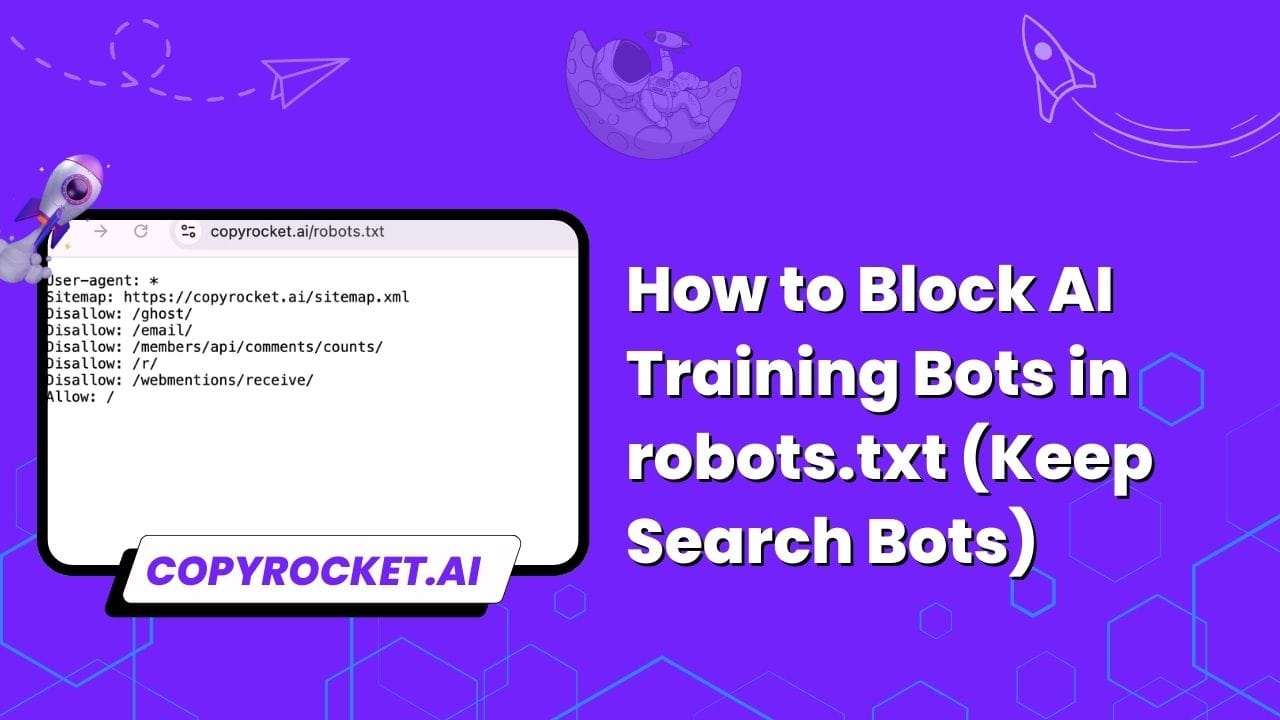
How to Block AI Training Bots in robots.txt (Keep Search Bots)
Configure robots.txt to block AI training bots while keeping Google and Bing crawling. Use safe templates, test rules, and add WAF controls for bots that ignore robots.txt.
 General
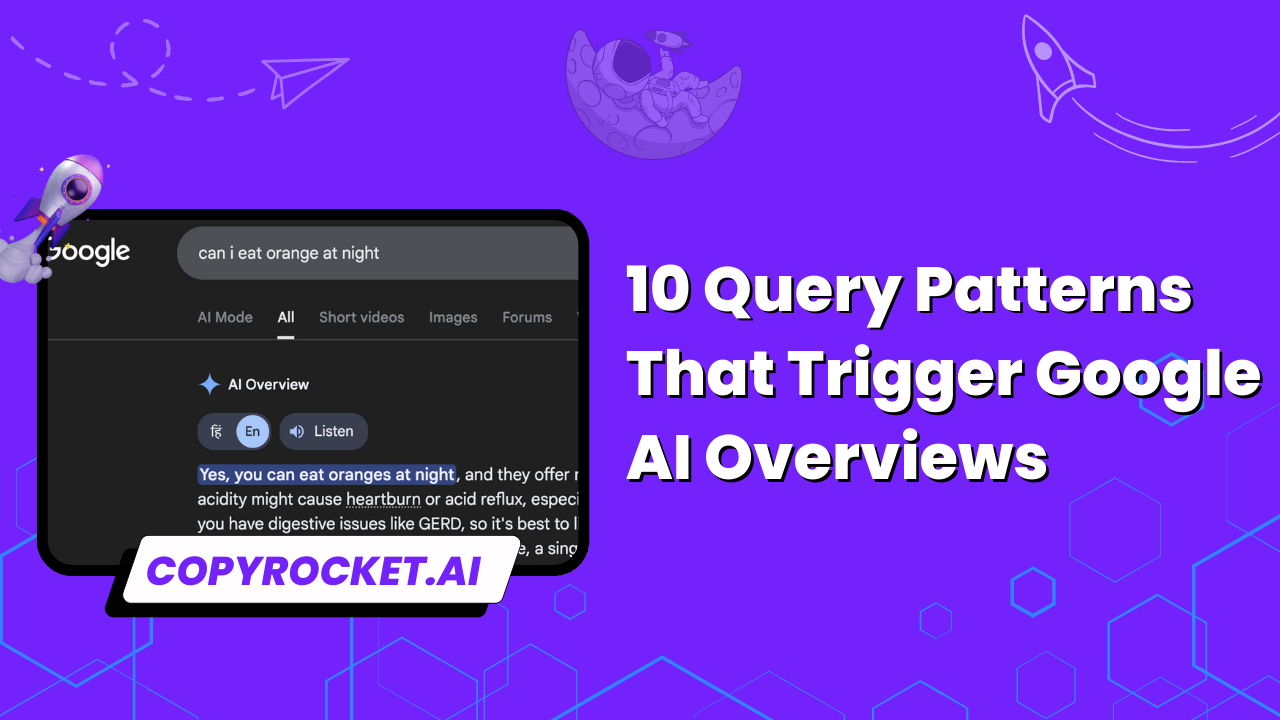
10 Query Patterns That Trigger Google AI Overviews
Learn the 10 query patterns that trigger Google AI Overviews and the exact page types, outlines, and formats to publish for each to earn citations and top 10 rankings.