
Generative Engine Optimization (GEO) Guide 2026: Rank in AI Answers + Checklist

Raman Singh
Raman Singh is a highly skilled marketing professional who serves as the head of marketing at Copyrocket AI
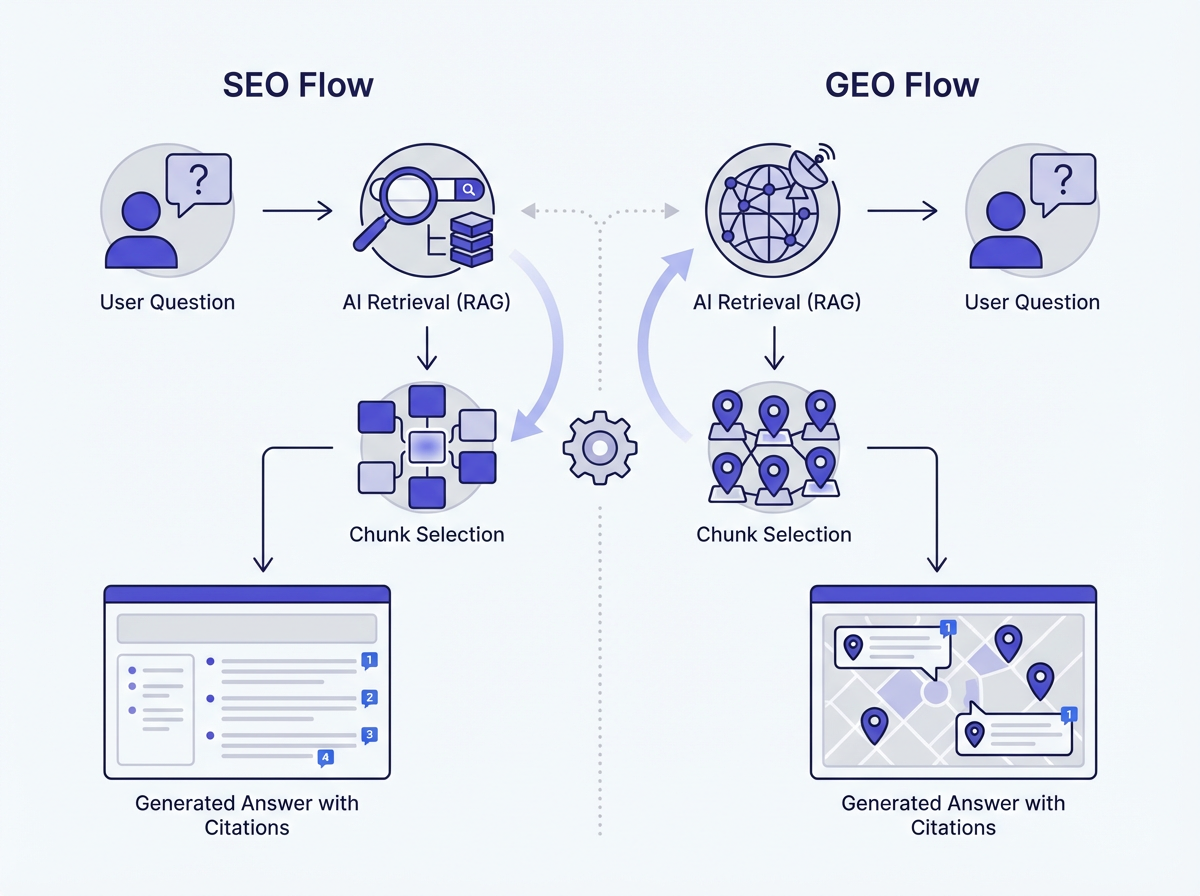
Generative Engine Optimization (GEO) is now a core part of search visibility. People ask longer questions. AI tools answer with short summaries. Many users stop there. Your job is simple: publish content that AI systems can fetch, trust, and cite. This guide shows the exact steps you can use in 2026, plus a practical checklist you can run every quarter.
Key Takeaways
- GEO helps your brand appear inside AI-generated answers, not only in blue-link results.
- AI systems reward clear structure, direct answers, and strong entity signals (brand, product, people, location).
- RAG systems pull small content chunks, so you must write pages that work at paragraph level.
- GEO needs technical access (crawlable pages), content formatting (bullets, steps, FAQs), and off-site mentions.
- Track “reference rate” and “citation share,” not only clicks and rankings.
- Use the 2026 GEO checklist to audit content, schema, citations, and brand mentions each month.
GEO Statistics Panel (2026 snapshot)
- Organic search share: ~53% of website traffic still comes from traditional organic search (source).
- Conversational query share: ~58% of queries are conversational in nature (source).
- AI query length shift: AI search queries average ~23 words vs ~4 words for classic Google queries (source).
- Google AI Overviews presence: AI Overviews appear on at least ~13% of SERPs in many tracking studies (source).
- Click behavior with AI summaries: When a generative summary appears, users click traditional links about ~8% of the time (source).
- Retail trend signal: Some retail reports project up to ~520% traffic growth from chatbots and AI search engines during peak shopping periods (source).
What GEO is in 2026 (and how it differs from SEO)
GEO i.e. Generative Engine Optimization means you optimize content so an AI system can select it, quote it, and cite it in an answer. SEO still matters. GEO adds new success criteria: inclusion inside the answer and correct brand framing.
Simple definition
- SEO: You optimize to rank pages in a list of links.
- GEO: You optimize to become a source inside AI-generated answers.
Why GEO is different in practice
- AI answers use chunks: Systems often retrieve short passages, not whole pages.
- AI answers favor structure: Bullets, steps, tables, and FAQs help extraction.
- AI answers favor entities: Clear names, attributes, and relationships improve recall.
- AI answers favor verification: Citations, dates, and primary sources reduce risk for the model.
Where GEO shows up (common surfaces)
- Google AI Overviews and AI Mode experiences
- ChatGPT browsing and citations (when enabled)
- Perplexity citations and source cards
- Gemini and other assistant experiences inside apps and browsers
How generative engines choose sources (RAG basics you need)
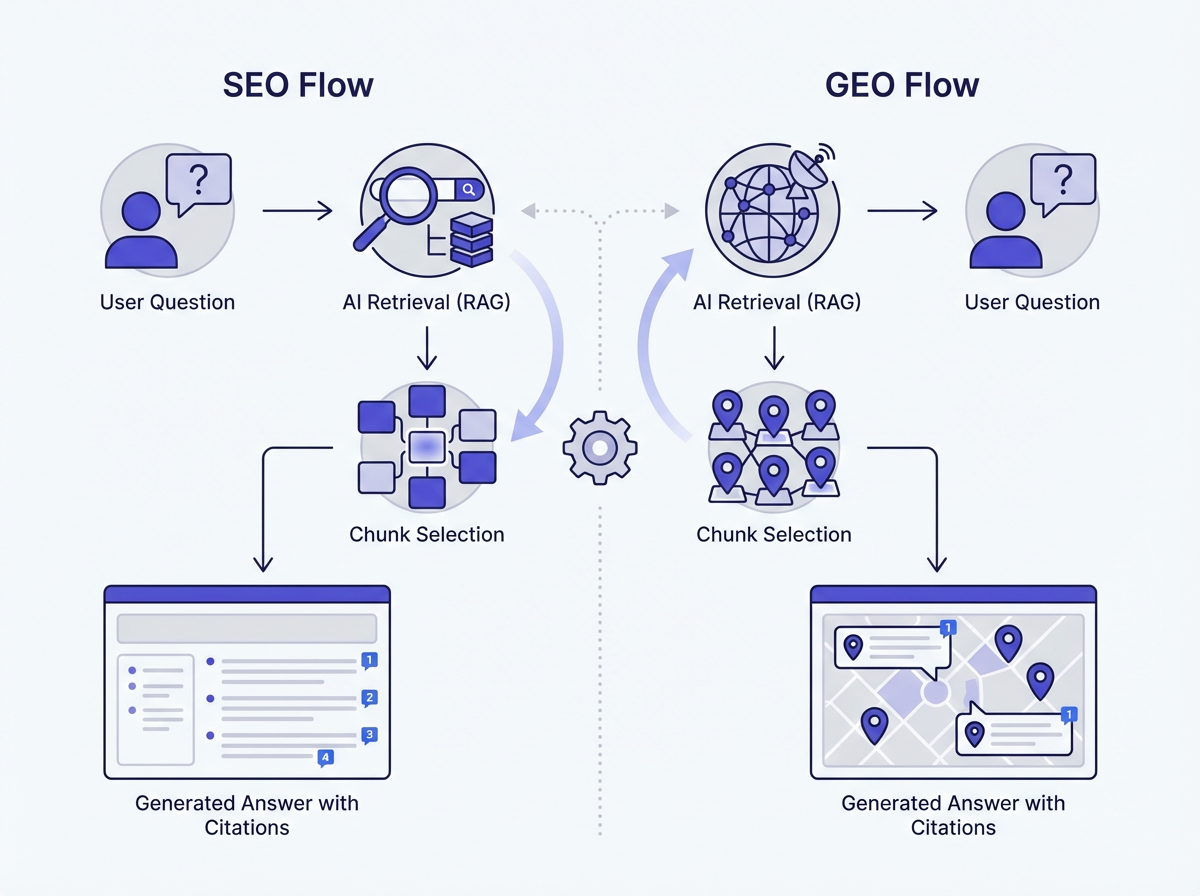
Most generative search systems use retrieval-augmented generation (RAG). RAG means the system retrieves relevant passages from indexed sources, then it writes an answer using those passages. You can improve your odds by making your content easy to retrieve and easy to cite.
RAG in plain steps
- The user asks a question in natural language.
- The system turns the question into a vector query.
- The system retrieves matching passages from its index.
- The model writes an answer and may add citations.
What this changes for your content
- Your best “unit” is a paragraph that can stand alone.
- Your headings must match real questions users ask.
- Your page must state facts with sources and dates.
- Your brand must appear near key facts, not only in the footer.
Core GEO ranking signals you can influence
Generative engines do not publish a public algorithm. You can still work on the signals they tend to rely on: accessibility, clarity, authority, and consistency across the web.
1) Content clarity and extractability
- Write a direct answer in the first 1 to 3 sentences under each heading.
- Use bullets for lists and numbered steps for processes.
- Define terms once, then use the same term consistently.
- Use short sentences with clear subjects and verbs.
2) Entity coverage (brand, product, people, location)
- State the official brand name and product names the same way on every page.
- Include key attributes: price range, compatibility, size, warranty, use cases, limits.
- Connect entities: “Product X works with Platform Y” or “Service Z serves City A.”
3) Evidence and citations
- Add primary sources when possible (standards, studies, official docs).
- Add dates on claims that can change (pricing, availability, policies).
- Use quotes only when you can cite the source page.
4) Off-site mentions and digital PR
- Earn mentions on relevant sites, even if the mention has no link.
- Publish data, benchmarks, and original research that others cite.
- Fix inconsistent brand naming across directories and profiles.
5) Technical access and indexing hygiene
- Allow crawling for key pages. Do not block with robots.txt by mistake.
- Keep pages fast and stable on mobile.
- Use clean HTML. Avoid hiding main content behind heavy scripts.
GEO content framework for 2026 (page template)
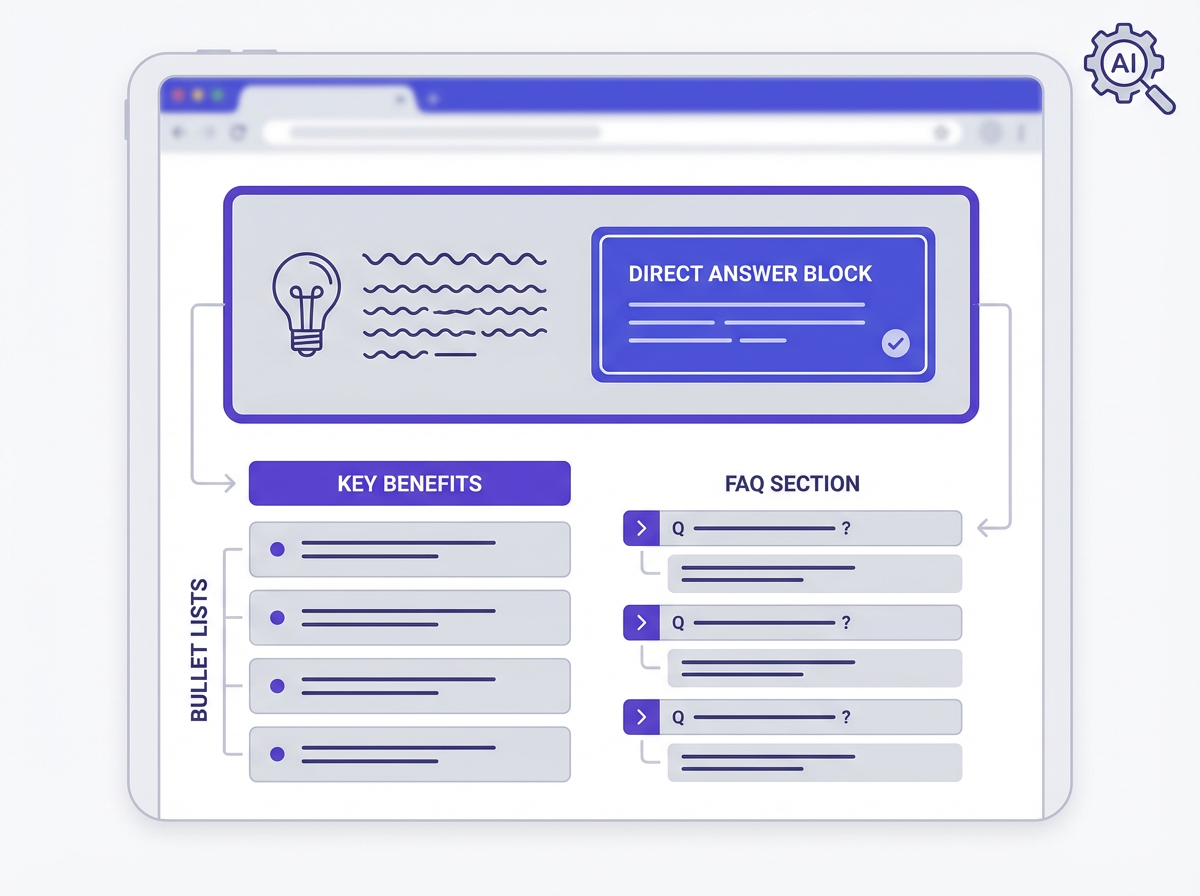
You need a repeatable template. This template helps AI systems extract answers and helps readers scan fast. Use it for guides, product pages, category pages, and help docs.
Recommended on-page structure
- Intro (2 to 3 lines): State what the page covers and who it helps.
- Direct answer block: One short paragraph that answers the main question.
- Bullets or steps: Break the answer into parts the model can quote.
- Examples: Add one real example with numbers or settings.
- Limits: State what the advice does not cover.
- FAQ: Add 5 to 10 related questions with short answers.
Chunk writing rules (for RAG retrieval)
- Keep each section focused on one sub-question.
- Use one idea per paragraph.
- Repeat the key noun (entity) instead of using many pronouns.
- Use consistent units and ranges (%, $, hours, miles).
What to publish (topic map for GEO)
- “What is” pages: Definitions and category explanations.
- “How to” pages: Steps, requirements, and troubleshooting.
- Comparisons: “X vs Y” and “X alternatives” pages.
- Use cases: “Best for” pages tied to real constraints.
- Proof pages: Case studies, benchmarks, and methodology pages.
Technical GEO: make your site easy for AI systems to use
Content quality fails if crawlers cannot access it. Technical GEO focuses on crawl access, clean rendering, and clear metadata.
Crawl and access checks
- Check robots.txt and meta robots on key templates.
- Make sure canonical tags point to the correct version.
- Remove soft-404 thin pages that dilute quality signals.
- Keep internal links consistent so crawlers find key hubs fast.
Structured data that helps (schema)
- Organization: name, URL, logo, sameAs profiles
- Person: author pages with credentials
- Article: headline, datePublished, dateModified
- FAQPage: for short Q&A blocks (use only when visible to users)
- HowTo: for step-based guides
- Product: offers, price, availability, brand
- Review: only when you follow guidelines and show real reviews
Rendering and page experience
- Serve core content in HTML first when possible.
- Reduce layout shifts that break extraction.
- Keep headings in order (H2 then H3) and avoid skipping levels.
Authority for GEO: how to earn citations and mentions
AI systems often prefer sources that appear consistent across many sites. You can build that consistency with a simple plan: publish proof, earn mentions, and keep facts aligned.
Build a “citation moat” with original assets
- Publish a benchmark report with a clear method section.
- Publish a glossary for your category with stable definitions.
- Publish a public comparison chart with update dates.
- Publish an API or documentation hub if you have a product.
Digital PR that supports GEO
- Pitch data stories to industry newsletters and reporters.
- Offer expert quotes that include your exact brand name and role.
- Fix brand profile pages on major platforms (Wikipedia-style summaries, Crunchbase-style profiles, app stores, directories).
Consistency checklist for entity trust
- Use one official brand name format everywhere.
- Use one tagline or category label everywhere.
- Keep pricing and policy details aligned across pages.
- Keep author bios aligned with LinkedIn and other profiles.
GEO measurement in 2026: what to track and how
Classic SEO metrics still matter. GEO adds new metrics that reflect AI answers. Track both, or you will miss the real shift.
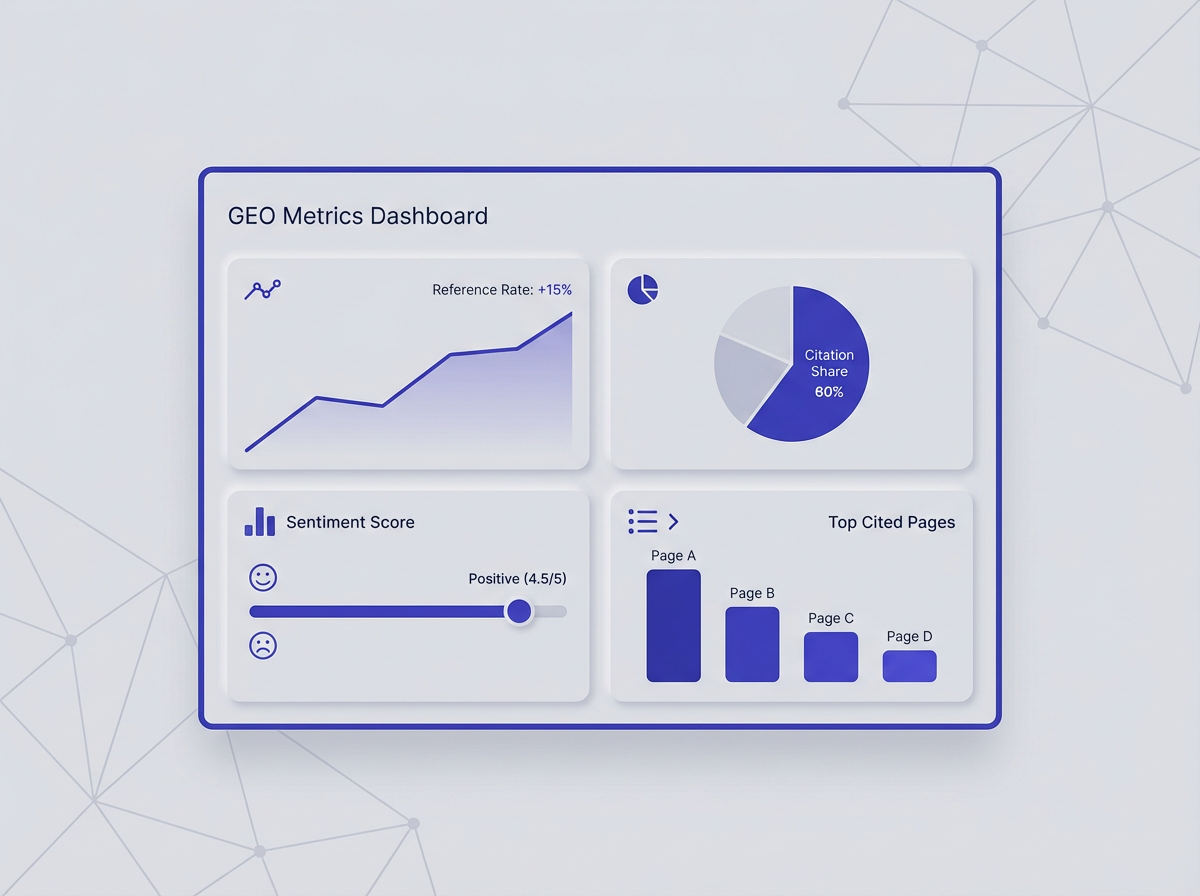
Key GEO metrics
- Reference rate: percent of tested prompts where the model mentions your brand.
- Citation rate: percent of prompts where the model cites your URL or domain.
- Citation share: your citations divided by total citations across competitors for the same prompt set.
- Sentiment: positive, neutral, or negative framing in answers.
- Topic association: which topics the model connects to your brand.
How to run a simple GEO testing program
- Create a prompt set of 50 to 200 questions from sales calls, support tickets, and SERP data.
- Group prompts by intent: learn, compare, buy, troubleshoot.
- Test prompts monthly across key systems (Google AI surfaces, Perplexity, ChatGPT browsing when available).
- Log brand mention, citation, rank position inside citations, and answer wording.
- Update pages that fail on clarity, evidence, or missing sub-answers.
Where traffic fits in
- Expect fewer clicks per impression on queries that trigger AI summaries.
- Expect higher intent when clicks do happen, since users pre-qualify inside the answer.
- Track assisted conversions and branded search lift, not only last-click.
GEO playbook by site type (what to do first)
Different sites win in different ways. Use the playbook that matches your site type so you do not waste effort.
Publishers and content hubs
- Cover topics with breadth, then add deep pages for sub-questions.
- Use strong author pages and editorial policies.
- Update evergreen pages with “last updated” dates and change logs.
B2B SaaS and lead gen sites
- Publish comparison pages for real alternatives and categories.
- Publish implementation guides and security pages that answer buyer questions.
- Publish case studies with numbers, timeframes, and context.
Ecommerce and retail
- Write product FAQs that answer size, fit, compatibility, care, and warranty.
- Publish “best for” guides with constraints (budget, skin type, room size).
- Keep inventory, pricing, and shipping policies consistent and dated.
Local and service businesses
- Publish service pages by problem type, not only by service name.
- Publish location pages with real service area details and proof.
- Use reviews and testimonials with clear context and dates.
Common GEO mistakes (and the fix)
Most GEO failures come from unclear writing, missing proof, or blocked access. Fix these first before you chase new tools.
Mistake: one page tries to answer everything
- Problem: AI retrieval pulls a small chunk that lacks the needed detail.
- Fix: Split into focused pages and add a hub page that links them.
Mistake: no direct answers under headings
- Problem: The model cannot extract a clean quote.
- Fix: Put the direct answer first, then expand with bullets.
Mistake: claims with no source or date
- Problem: The model avoids citing uncertain facts.
- Fix: Add citations and “as of” dates for changing facts.
Mistake: inconsistent brand naming
- Problem: Entity confusion reduces mentions.
- Fix: Standardize brand, product, and spokesperson names across the web.
Mistake: blocked crawling or heavy script rendering
- Problem: Systems cannot fetch content reliably.
- Fix: Serve core content in HTML and verify crawler access.
Generative Engine Optimization (GEO) checklist (2026)
Use this checklist as a monthly and quarterly routine. Assign an owner for each line item. Track completion in a shared sheet.
Content checklist
- Each key page answers one main question in the first 2 to 3 sentences.
- Each key page uses bullets or steps for the main explanation.
- Each key page includes 5 to 10 related questions in an FAQ block.
- Each key page includes examples, limits, and edge cases.
- Each key page includes dates on facts that can change.
- Each key page uses consistent entity terms (brand, product, category).
Technical checklist
- Robots.txt allows crawling for key sections.
- Meta robots tags are correct on templates.
- Canonical tags are correct on duplicates and parameters.
- Core content renders without user interaction.
- Schema is valid for Organization, Article, FAQPage, HowTo, Product where relevant.
- Sitemaps include all indexable pages and update dates.
Authority and off-site checklist
- Brand name and description match across top profiles and directories.
- At least 1 new third-party mention per month in relevant publications.
- At least 1 original data asset per quarter (report, benchmark, survey).
- At least 5 expert quotes per quarter with consistent brand attribution.
Measurement checklist
- Prompt set exists and is updated monthly.
- Reference rate and citation share are tracked monthly.
- Top “lost prompts” are mapped to content updates.
- Sentiment issues trigger a content and PR fix plan.
Frequently Asked Questions (FAQs)
What is the 30% rule in AI?
The “30% rule” often means a safety threshold for human review. A team flags AI output for review when it drives 30% or more of a decision, a document, or a user-facing claim. Teams use it to reduce risk from errors and missing context.
What is the 10 20 70 rule for AI?
The 10/20/70 rule is a planning split many teams use: 10% for the model and tools, 20% for data and prompts, and 70% for process change and people work. It reflects a common reality: adoption and workflow drive most results.
Are AI search results accurate?
AI search results can be accurate, but they can also include mistakes, outdated facts, or wrong context. You improve accuracy by publishing clear facts, citing sources, adding dates, and correcting pages fast when details change.
What percent of Google searches have AI Overviews?
Many tracking studies report AI Overviews on at least about 13% of SERPs, but the rate changes by query type, topic, and location. Informational queries tend to trigger them more than branded queries.
Does GEO replace SEO?
No. GEO builds on SEO. SEO helps discovery and crawling. GEO helps selection and citation inside AI answers. A strong plan uses both.
What is the fastest GEO win for an existing site?
Add direct answers under key headings, add a short FAQ section, and add sources and dates to important claims. These changes improve extractability and citation odds without a full redesign.
Final Thoughts
Generative Engine Optimization is now a visibility requirement, not a side project. AI systems reward clear answers, clean structure, and trusted sources. Use the checklist in this guide to fix access, improve page chunks, and build authority through consistent mentions. If you want faster results, start with your top 10 revenue pages and your top 50 customer questions, then measure reference rate and citation share every month.
Frequently Asked Questions
Written by
Raman Singh
Raman Singh is a highly skilled marketing professional who serves as the head of marketing at Copyrocket AI. With years of experience in the field, Raman has developed a deep understanding of all asp
View all postsYour AI Marketing Agents
Are Ready to Work
Stop spending hours on copywriting. Let AI craft high-converting ads, emails, blog posts & social media content in seconds.
Start Creating for FreeNo credit card required. 50+ AI tools included.
Related Articles
 General
NotebookLM For Coders: Turn Docs Into Faster Code
Code work often fails for a simple reason. You do not have the right context at the right time. You read docs in one tab, skim tickets in another tab, and then...
 General
How to Optimize for AI Search in 2026: The Complete Guide
AI search has shifted from experimental feature to primary search method for millions of users. ChatGPT Search, Google AI Overviews, Perplexity, Claude, and Gem...
 General
Claude Opus 4.6 Review: Here's What New!
Claude Opus 4.6 from Anthropic draws attention because teams want an AI model that writes better code, follows instructions, and stays consistent across long se...