
How to Build an AEO Strategy for 2026 (From Content to Measurement)

Raman Singh
Raman Singh is a highly skilled marketing professional who serves as the head of marketing at Copyrocket AI
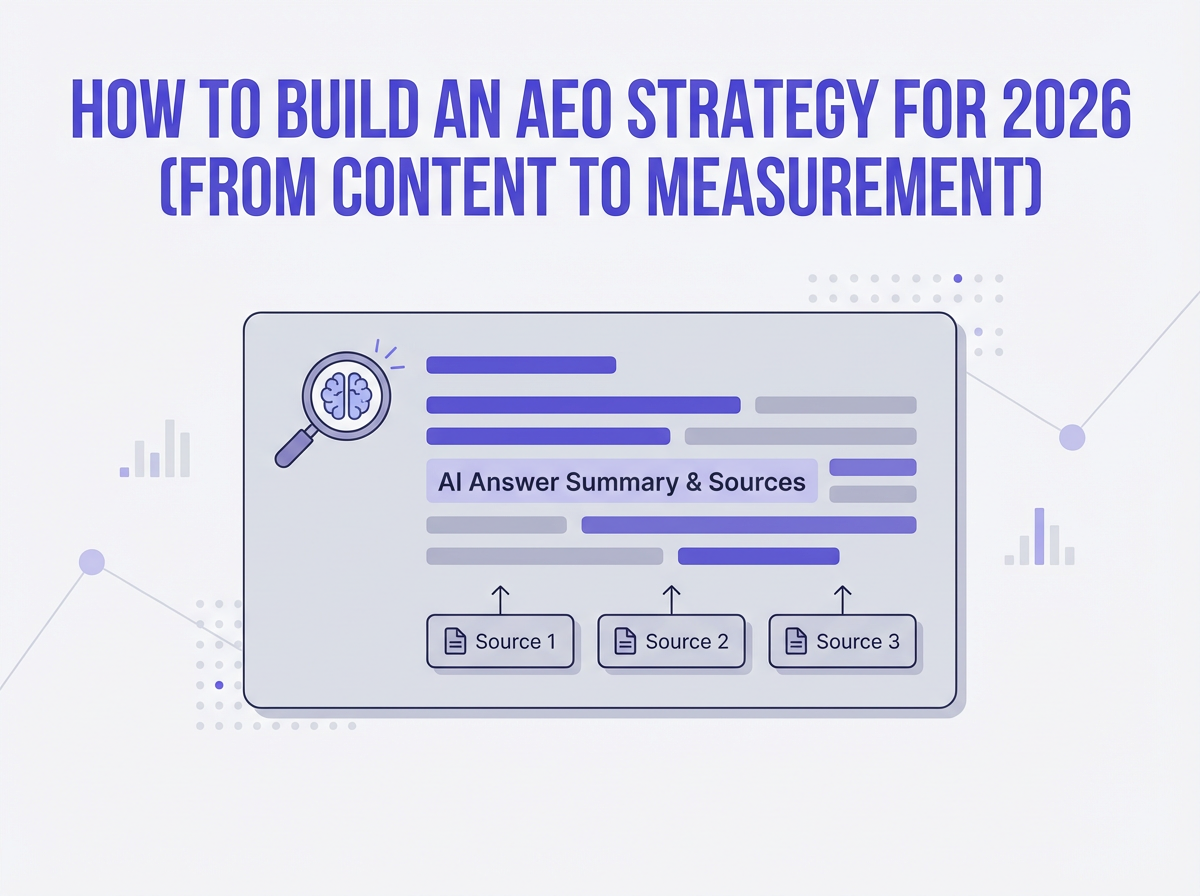
Search results now include AI answers, cited sources, and assistant-style summaries. People ask longer questions. AI systems reply in fewer words.
This shift changes how content earns attention. AEO (Answer Engine Optimization) helps your brand become the source that AI systems quote, cite, and recommend.
This guide shows how to build an AEO strategy for 2026 from planning to measurement. You will learn what to publish, how to structure it, how to strengthen entity signals, and how to track outcomes across AI surfaces.
Key Takeaways
- AEO in 2026 needs two tracks: answer-ready content and strong entity trust signals.
- Use a question-first content plan that maps queries to intent, format, and proof.
- Write in “answer blocks” with clear definitions, steps, and constraints AI can quote.
- Support answers with unique evidence like data, examples, screenshots, and policy details.
- Build citation gravity with consistent entities, authoritative mentions, and clean schema.
- Measure AEO with a dashboard that tracks prompts, citations, traffic quality, and revenue.
AEO for 2026 and set clear goals
AEO i.e. Answer Engine Optimization works best when your team agrees on what “winning” means. You should define AEO in plain terms, then set goals that match business outcomes. You should also decide which AI surfaces matter for your market.
What AEO means in 2026
- AEO definition: AEO is the practice of making your content easy for AI systems to select, quote, and cite as the best answer to a question.
- What changes from classic SEO: You optimize for selection and citation, not only for clicks.
- What stays the same: You still need relevance, credibility, and a good page experience.
Pick your primary AEO outcomes
- Answer visibility: Your brand appears in AI answers for priority questions.
- Citation share: Your pages get cited more often than competitors.
- Qualified visits: The visits that do arrive convert at a strong rate.
- Assisted conversions: People who saw your brand in an AI answer later buy.
Choose the AI surfaces you will track
- Google AI Overviews and featured snippets
- ChatGPT-style assistants and browsing answers
- Perplexity-style answer engines with citations
- Microsoft Copilot-style experiences
- Vertical assistants in your industry (if they matter)
Create a simple AEO strategy statement
- Audience: Who asks the questions?
- Topic set: Which topics lead to revenue or retention?
- Proof: What evidence will make your answers credible?
- Distribution: Where will people see and share your answers?
- Measurement: How will you track citations and outcomes?
Build your AEO query map (questions, intent, and answer formats)
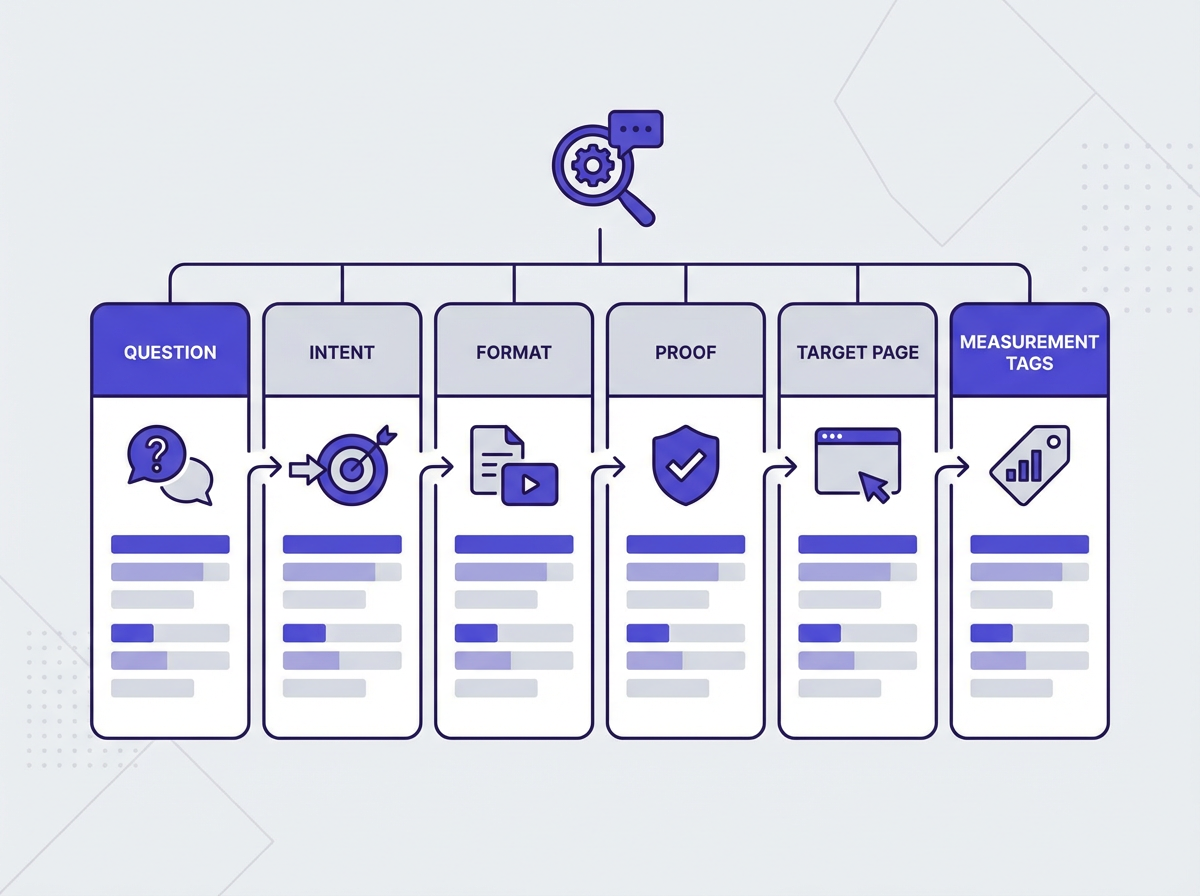
AEO starts with questions. You should build a query map that lists the exact questions people ask, the intent behind each question, and the best answer format. This map becomes your content backlog and your measurement list.
Collect questions from real sources
- Sales and support logs: Use call notes, tickets, and chat transcripts.
- On-site search: Export internal search queries and zero-result queries.
- Search Console: Pull queries that include “how,” “what,” “best,” “vs,” and “cost.”
- Community and forums: Look for repeated questions and pain points.
- Competitor pages: Extract headings and FAQ patterns that earn snippets.
- AI prompt mining: Ask assistants what users often ask about your category.
Classify each question by intent
- Know: “What is X?” “How does X work?”
- Do: “How do I set up X?” “How do I fix X?”
- Compare: “X vs Y” “Best X for Y”
- Evaluate: “Is X worth it?” “What are the risks of X?”
- Buy: “Pricing,” “plans,” “alternatives,” “ROI”
Assign an answer format that AI can reuse
- Definition block: 1–2 sentences that define the term.
- Step list: 5–9 steps with clear verbs.
- Decision table: A simple table that compares options.
- Checklist: A short list that confirms readiness.
- Formula: A clear way to calculate cost, time, or ROI.
- Troubleshooting tree: If/then logic for fixes.
Score questions to pick priorities
- Business value: Does the answer lead to revenue or retention?
- Answer demand: Do you see repeated asks across sources?
- Competition: Do competitors already earn citations?
- Proof readiness: Can you support the answer with evidence?
- Update need: Is current content outdated for 2026?
Create “answer-first” content that AI can quote
AI systems prefer content that states the answer fast, then supports it with proof. You should write pages that include short answer blocks, clear structure, and consistent terms. You should also reduce vague language that AI cannot verify.
Use the AEO page blueprint
- One-sentence answer: Put it near the top of the page.
- Short expansion: Add 3–5 sentences that explain the answer.
- Steps or bullets: Provide an actionable sequence.
- Constraints: State who the advice fits and who it does not fit.
- Proof: Add data, examples, screenshots, or policy references.
- Next action: Link to the next best page or tool.
Write answer blocks that match how assistants speak
- Use short sentences with subject-verb-object order.
- Use exact nouns. Repeat the key term where it helps clarity.
- Define acronyms on first use.
- Keep one paragraph focused on one idea.
- Avoid hedging words unless the topic needs them.
Add “proof packs” to increase citation likelihood
- Original data: A small survey, benchmark, or dataset you own.
- Process evidence: Screenshots of steps, settings, or results.
- Policy evidence: Clear terms, SLAs, refund rules, and security details.
- Expert attribution: Named authors with role, bio, and review notes.
- Version notes: Update dates and change logs for key pages.
Cover the full question set with content clusters
- Hub page: A category guide that defines the topic and links out.
- Spoke pages: Each page answers one primary question.
- Support pages: Glossary entries, templates, calculators, and checklists.
- Conversion pages: Product, pricing, and demo pages that match the same terms.
Use comparison content that stays fair
- State who each option fits.
- List 3–7 criteria that matter for buyers.
- Include a table with clear labels.
- Use plain claims you can prove.
- Link to sources for any market numbers.
Strengthen entity signals and brand trust for AI selection
AI answers often depend on entity understanding. An entity is a clear “thing” like a brand, person, product, method, or location. You should make your entities consistent across your site and across the web. This work increases trust and reduces confusion.
Make your brand entity consistent
- Use one official brand name and one official product name per product.
- Use consistent spelling across headers, titles, and schema.
- Publish a clear “About” page with company facts.
- Publish author pages with role, experience, and contact paths.
- Keep NAP data consistent if you have locations (name, address, phone).
Build topic authority with a glossary and definitions
- Create glossary entries for core terms in your category.
- Use the same definition across pages unless context requires a change.
- Link each glossary entry to 3–10 related guides.
- Add examples and “common mistakes” sections for each term.
Use schema that supports answers
- Organization schema: Clarifies your brand entity.
- Person schema: Supports author identity and expertise.
- Article schema: Helps content classification.
- FAQ schema: Helps question matching (use only for real FAQs on the page).
- HowTo schema: Helps step content (use only when steps match the page).
- Product schema: Helps product facts like price, features, and reviews.
Earn third-party mentions that AI systems trust
- Get listed in credible industry directories.
- Publish data that journalists can cite.
- Contribute expert quotes with clear credentials.
- Partner on webinars and publish the recap with key answers.
- Encourage customers to publish case studies on their sites when possible.
Optimize for retrieval: technical basics that affect AI answers
AI systems still need to crawl and understand your pages. You should remove technical friction that blocks indexing or weakens page clarity. You should also make sure your content loads fast and renders cleanly.
Indexing and crawl control
- Ensure key pages return 200 status codes and canonical to the right URL.
- Block thin pages and duplicate pages with noindex where needed.
- Use XML sitemaps that include only indexable URLs.
- Fix redirect chains and broken internal links.
- Make sure robots.txt does not block important assets.
Information architecture that supports question paths
- Use simple URL structures that reflect topic clusters.
- Use breadcrumb navigation for hubs and spokes.
- Link from hub pages to spoke pages with descriptive anchors.
- Link from spoke pages to the next best action page.
Page experience and readability
- Keep paragraphs short.
- Use descriptive headings that match real questions.
- Use tables for comparisons and specs.
- Add images that explain steps or frameworks.
- Compress images and avoid layout shifts.
Keep content fresh with update workflows
- Set review cycles for top pages (monthly, quarterly, or twice per year).
- Add “Last updated” dates when you make real changes.
- Track changes in a short page changelog for key guides.
- Remove outdated claims and replace them with current facts.
Design content for AI citations and human conversions
AEO success does not end with a citation. You still need the reader to trust you and take action. You should build pages that work for both AI extraction and human decision-making.
Place conversion paths next to the best answers
- Add a short CTA after the main answer block.
- Offer a tool that matches the question (calculator, template, checklist).
- Use internal links that match the next intent step.
- Keep CTAs specific. Use “Get the checklist” instead of “Learn more.”
Use “micro-commitments” for early-stage questions
- Email course with 3–5 lessons
- Downloadable SOP or policy template
- Interactive quiz that recommends an option
- Short product tour video with chapters
Build pages that reduce risk for buyers
- State pricing rules and contract terms in plain language.
- Explain security and privacy with clear controls and scopes.
- Publish implementation timelines with assumptions.
- Share case studies with numbers and context.
Use content formats that AI and people both like
- Checklists: Easy to quote and easy to act on.
- Tables: Easy to cite and easy to compare.
- Short definitions: Easy for assistants to reuse.
- Step-by-step guides: Easy for troubleshooting and setup.
Build an AEO measurement system (what to track and how)
You should measure AEO with the same discipline you use for SEO and paid media. You need a tracking plan that connects prompts to citations, and citations to outcomes. You also need a repeatable reporting cadence.
Start with a prompt and question tracking list
- Create a list of 50–200 priority questions from your query map.
- Write 2–5 prompt variants per question.
- Record the best target URL for each question.
- Tag each question by funnel stage and product line.
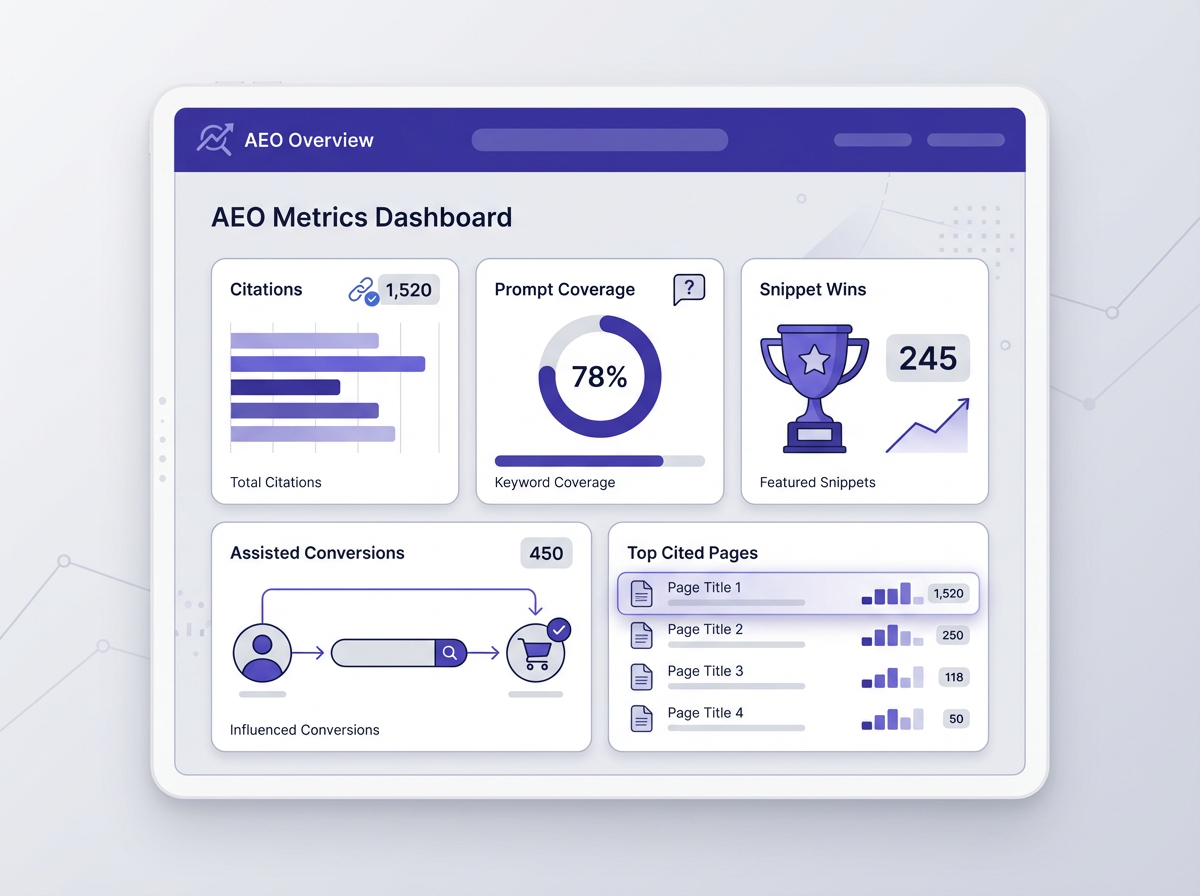
Track AEO visibility metrics
- Citation count: How often assistants cite your domain.
- Citation share: Your citations divided by total citations for the question set.
- Answer presence: Your brand appears even without a link.
- Snippet wins: Featured snippets and “People also ask” coverage.
- Top cited pages: Pages that earn the most citations.
Track traffic and engagement metrics that still matter
- Sessions and new users from organic search
- Branded search growth (a proxy for awareness)
- Time on page and scroll depth for key guides
- Template or tool usage
- Demo requests, trials, and signups from AEO pages
Track conversion and revenue impact
- Assisted conversions: Users who enter on AEO pages and convert later.
- Pipeline influence: Opportunities that touched AEO pages.
- Lead quality: Conversion rate by page cluster and question intent.
- Retention impact: Support deflection and fewer tickets for answered topics.
Set up attribution that does not break under AI traffic shifts
- Use first-party analytics with clean UTM rules for campaigns.
- Track events for downloads, tool use, and key clicks.
- Use CRM fields for “first touch page” and “top content touches.”
- Run periodic surveys that ask, “Where did you hear about us?”
Build a monthly AEO report your team will read
- Section 1: Wins (new citations, new snippet placements, top pages).
- Section 2: Losses (questions where competitors gained citations).
- Section 3: Actions (pages to update, new pages to publish, links to earn).
- Section 4: Business impact (leads, pipeline, retention signals).
Run a 90-day AEO execution plan (roles, cadence, and QA)
AEO improves when you publish, test, and update on a schedule. You should run AEO in 90-day cycles. Each cycle should ship new answers, improve existing pages, and expand proof and mentions.
Weeks 1–2: Strategy and backlog
- Finalize your query map and scoring.
- Pick 10–20 priority questions for the cycle.
- Assign target URLs and content owners.
- Define proof packs you can publish without delays.
Weeks 3–8: Publish and improve pages
- Publish 1–3 new spoke pages per week.
- Update 2–5 existing pages per week.
- Add schema and internal links as part of done criteria.
- Add one conversion asset per cluster (template, checklist, or calculator).
Weeks 9–12: Distribution and mentions
- Pitch your original data to industry writers.
- Repurpose answers into LinkedIn posts and short videos.
- Publish a webinar recap with a clear Q&A section.
- Secure 5–20 relevant mentions based on your niche.
Quality checklist for every AEO page
- The page answers the main question in the first 150 words.
- The page uses one primary term and consistent synonyms.
- The page includes steps, a checklist, or a table.
- The page includes proof that a reader can verify.
- The page links to related pages in the same cluster.
- The page includes a clear next action for the reader.
Team roles that keep AEO moving
- Content lead: Owns query map, briefs, and publishing cadence.
- Subject expert: Validates claims and adds real examples.
- SEO lead: Owns internal links, schema, and indexation.
- PR or partnerships: Earns mentions and citations off-site.
- Analytics lead: Owns dashboards and reporting.
Common AEO mistakes to avoid in 2026
Many teams publish more content but earn fewer citations. These mistakes cause that gap. You should use this list as a pre-launch check.
Mistake 1: Writing long intros and hiding the answer
- Fix: Put the direct answer first. Add context after the answer.
Mistake 2: Publishing opinions without proof
- Fix: Add data, examples, screenshots, or clear policies.
Mistake 3: Mixing terms and confusing the entity
- Fix: Standardize names, definitions, and product labels.
Mistake 4: Treating schema as a shortcut
- Fix: Use schema to describe real page content. Do not add fake FAQs.
Mistake 5: Measuring only clicks
- Fix: Track citations, brand presence, assisted conversions, and lead quality.
Frequently Asked Questions (FAQs)
What is an AEO strategy?
An AEO strategy is a plan to make your content easy for AI systems to select, quote, and cite as the best answer to specific questions.
How is AEO different from SEO in 2026?
SEO focuses on rankings and clicks. AEO focuses on answer selection, citations, and brand presence inside AI answers, even when clicks drop.
What content formats work best for AEO?
Short definition blocks, step lists, checklists, and comparison tables work best because AI systems can extract them with low risk.
Do I need schema for AEO?
Schema helps systems understand your content and entities. It does not replace good writing, proof, and clear structure.
How do I measure AEO performance?
You measure citations, citation share, answer presence, and the business outcomes tied to AEO pages, such as assisted conversions and lead quality.
How long does it take to see results from AEO?
Some pages earn citations in weeks. Most programs show clear trends in 60–120 days when teams publish, update, and earn mentions on a schedule.
Final Thoughts
How to Build an AEO Strategy for 2026 (From Content to Measurement) comes down to one system: map real questions, publish answer-first pages with proof, strengthen entity trust, and measure citations and outcomes every month.
If you want faster progress, start with 10 priority questions, update your best existing pages, and build one proof pack that others can cite.
Then ship the next cycle. If you want help, audit your top pages for answer blocks, entity consistency, and citation readiness, and turn the findings into a 90-day backlog.
Frequently Asked Questions
Written by
Raman Singh
Raman Singh is a highly skilled marketing professional who serves as the head of marketing at Copyrocket AI. With years of experience in the field, Raman has developed a deep understanding of all asp
View all postsYour AI Marketing Agents
Are Ready to Work
Stop spending hours on copywriting. Let AI craft high-converting ads, emails, blog posts & social media content in seconds.
Start Creating for FreeNo credit card required. 50+ AI tools included.
Related Articles
 General
NotebookLM For Coders: Turn Docs Into Faster Code
Code work often fails for a simple reason. You do not have the right context at the right time. You read docs in one tab, skim tickets in another tab, and then...
 General
How to Optimize for AI Search in 2026: The Complete Guide
AI search has shifted from experimental feature to primary search method for millions of users. ChatGPT Search, Google AI Overviews, Perplexity, Claude, and Gem...
 General
Claude Opus 4.6 Review: Here's What New!
Claude Opus 4.6 from Anthropic draws attention because teams want an AI model that writes better code, follows instructions, and stays consistent across long se...