
How to Optimize Content for ChatGPT Search: The 2026 Guide

Raman Singh
Raman Singh is a highly skilled marketing professional who serves as the head of marketing at Copyrocket AI

ChatGPT now serves 800 million users every week — and only 12% of the sites it cites appear on Google's first page. That gap reveals a hard truth: traditional SEO alone will not earn you a place in AI-generated answers. Optimizing for ChatGPT Search requires a distinct set of technical, structural, and authority signals. This guide covers every step, from robots.txt settings to schema markup to content architecture, so your site becomes the source ChatGPT cites.
Key Takeaways
ChatGPT citations overlap with Google's top results only 12% of the time, so you need a GEO strategy alongside your SEO strategy.
You must explicitly allow OAI-SearchBot in your robots.txt file — without it, ChatGPT's search crawler cannot index your content.
Structured content with clear H2/H3 headings and bullet points is 40% more likely to be cited by AI engines than unstructured prose.
Opening each section with a direct answer increases citation rates by 67% compared to content that buries the answer.
Pages with original data tables earn 4.1x more AI citations than pages without them.
ChatGPT cites only 2–7 domains per response on average, making first-mover authority-building critical in your niche.
Why ChatGPT Search Works Differently Than Google
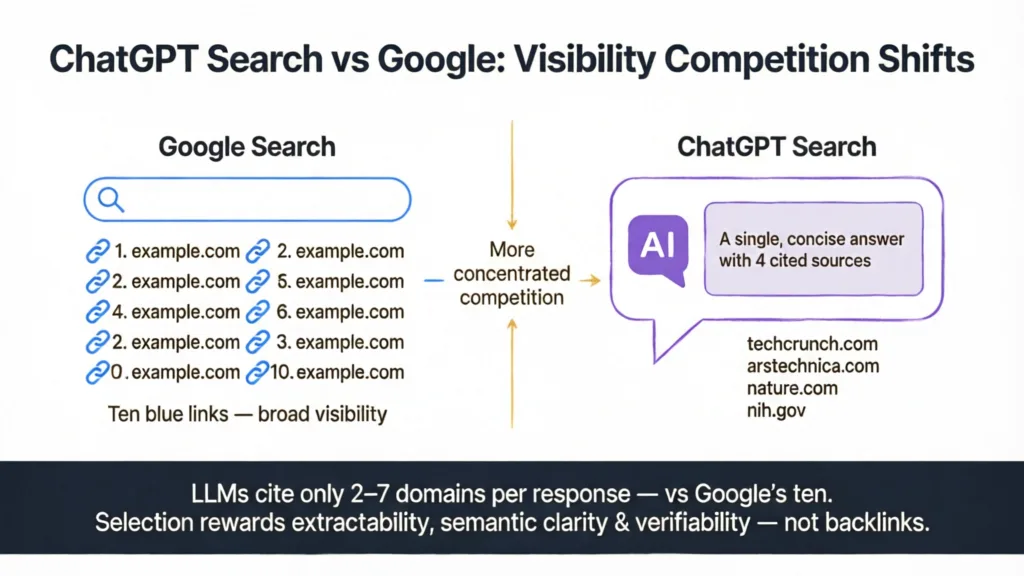
ChatGPT Search does not return a list of ten links. It generates a single synthesized answer and cites a handful of sources. LLMs cite just 2–7 domains per response on average, compared to Google's ten blue links. That means the competition for visibility is far more concentrated.
This matters because the selection criteria are different too. Google rewards backlink volume and on-page keyword signals. ChatGPT rewards content that is easy to extract, semantically clear, and verifiable through external sources. A well-structured page from a niche expert can outperform a domain authority leader if it answers the question more directly.
The Bing Connection You Cannot Ignore
ChatGPT Search is built on Microsoft's infrastructure. A study by SEO Toronto Experts found that 73% of ChatGPT's results are similar to Bing's search results. Microsoft has invested $14 billion in OpenAI, and Bing's newer webmaster guidance explicitly frames visibility as extending to "traditional results and AI experiences."
The practical implication: rank well on Bing and you dramatically improve your odds in ChatGPT. Submit your sitemap to Bing Webmaster Tools, ensure Bingbot can crawl your site without restrictions, and follow Bing's structured data guidelines for AI-readable content.
Citation Competition Is Fiercely Concentrated
Google AI Overviews now appear in 88% of informational search queries. ChatGPT serves 800 million weekly users. Perplexity processed 780 million queries in a single month. These platforms pull from a very small pool of trusted sources — and that pool is forming right now. Brands that build AI citation authority in 2026 will be far harder to displace in 2027.
Technical Setup: Getting Your Site AI-Crawlable
Before content quality or structure matters, AI crawlers need to reach your pages. Most optimization guides skip this step entirely.
Allow OAI-SearchBot in Your robots.txt
OpenAI uses two separate bots: GPTBot (for model training) and OAI-SearchBot (for ChatGPT's real-time search answers). Blocking GPTBot does not block search inclusion — but blocking OAI-SearchBot does.
Add this to your robots.txt to allow ChatGPT Search to crawl your content:
User-agent: OAI-SearchBot
Allow: /
OpenAI confirms that robots.txt changes for search can take up to 24 hours to propagate. This single configuration change is the most overlooked first step in any GEO strategy.
LLMs.txt: The Emerging Access Control Layer
LLMs.txt is a new standard that tells AI systems which parts of your site they can use and how. It sits at your domain root (yourdomain.com/llms.txt) and gives you granular control over AI access. Platforms like Perplexity and Common Crawl have started honoring it, and Semrush's 2026 AI search analysis identifies early adoption as a competitive signal.
This is not required yet, but it positions your site as AI-forward — a trust indicator that matters to models evaluating source credibility.
Page Speed: Crawlers Have Tight Timeouts
AI retrieval agents operate under time constraints when pulling real-time sources. Target a server response time under 200ms for your key landing pages and articles. Slow pages risk being skipped by AI crawlers during live search responses, regardless of content quality. Use Core Web Vitals data to identify d fix your slowest pages first.
Improve your website's Speed using our Core Web Vitals tool here with AI.
How to Structure Content for AI Extraction
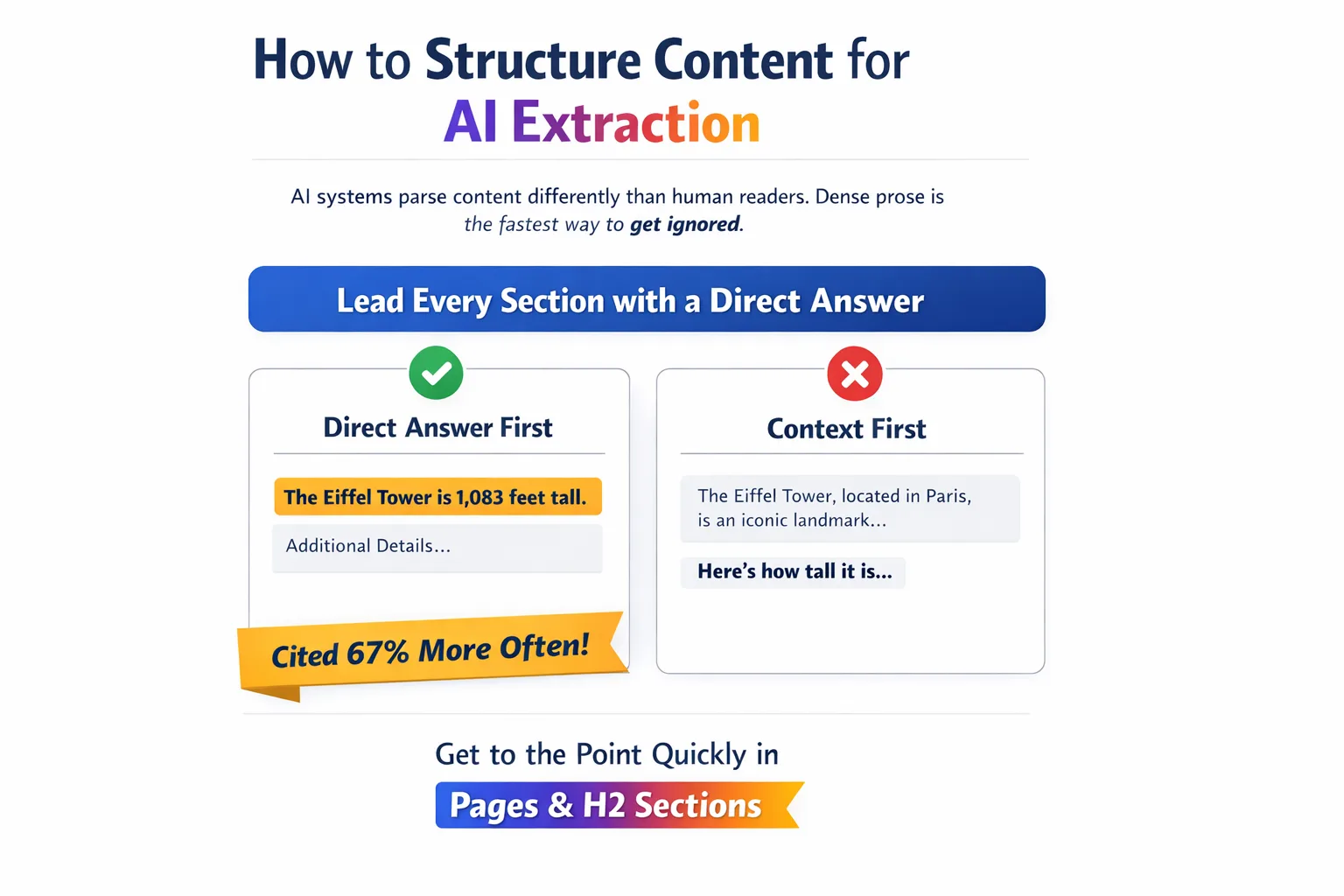
AI systems parse content differently than human readers. They look for structured, segmented information they can extract and synthesize into an answer. Dense prose is the fastest way to get ignored.
Lead Every Section with a Direct Answer
Opening paragraphs that answer the query upfront get cited 67% more often than content that builds context before reaching the point. This applies at the page level and at the section level. Each H2 section should open with a one- or two-sentence direct answer to the question its heading implies.
For example, instead of: "There are several approaches marketers take when thinking about content structure for AI..."
Write: "Use question-based H2 headings and answer each one directly in the first two sentences. This gives AI systems an extractable unit of information."
Use Chunk-Based Writing
Break your content into standalone sections of 60–120 words. Each chunk should contain a clear heading, a direct definition or answer, and supporting detail. This format makes it easy for ChatGPT to extract a specific passage without needing context from surrounding paragraphs. Each section becomes independently quotable.
Use Question-Based Headings
Frame your H2 and H3 headings as the questions your readers actually ask. Instead of "Schema Markup Benefits," use "What schema markup types does ChatGPT prefer?" This directly mirrors how users query AI systems and how AI models map intent to content sections.
Search Engine Land's 2026 AI content optimization guide found that Q&A formats perform best for GEO, because they match the conversational structure of AI queries.
Include Original Data and Tables
Pages that include original data tables earn 4.1x more AI citations, according to Princeton University researchers. Comparison tables, benchmark data, and structured datasets give AI systems a ready-made answer format. They also signal that your page contains primary-source information — one of the strongest trust signals for citation selection.
Build the Authority Signals ChatGPT Trusts
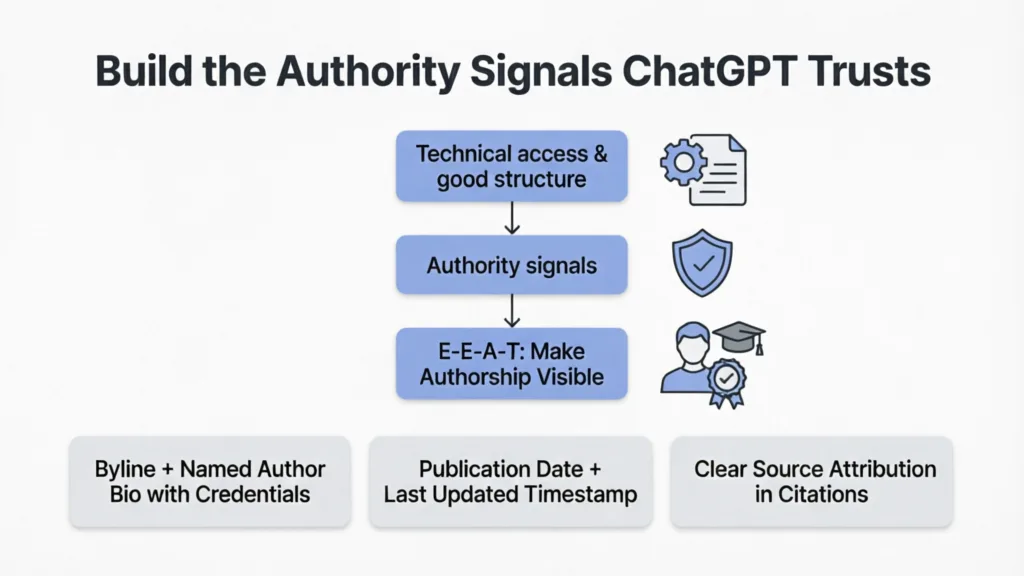
Technical access and good structure get you into the consideration set. Authority signals determine whether you stay there.
E-E-A-T: Make Authorship Visible
Google's E-E-A-T framework (Experience, Expertise, Authoritativeness, Trustworthiness) applies directly to AI citation selection. ChatGPT evaluates authorship signals when choosing sources. Add named author bios with credentials to every article. Include bylines, publication dates, and "last updated" timestamps. Use JSON-LD Person schema to make authorship machine-readable.
Get Mentioned on High-Citation Platforms
Wikipedia accounts for 7.8% of ChatGPT's citations. Reddit drives 1.8% of citations. Forbes, G2, and TechRadar each contribute roughly 1%. These numbers reveal where AI models gather third-party validation. Being mentioned on these platforms — not just linking to them — boosts your "trust score" in ChatGPT's retrieval logic.
An Ahrefs study of 75,000 brands found that YouTube mentions had the strongest correlation with ChatGPT visibility across platforms. Publish video content, ensure transcripts are available, and optimize YouTube descriptions with the same answer-first structure you use on your website.
Use Digital PR to Build Cross-Platform Authority
ChatGPT cross-references claims. If your content makes an assertion that's corroborated by Reddit discussions, industry forums, or reputable news sites, your citation probability increases. Pitch data-driven stories to industry publications. Earn mentions on review platforms like G2 and Capterra. Participate meaningfully in Reddit threads related to your niche.
This is distinct from traditional link building. The goal is a visible presence across the sources AI models already trust, not just backlink acquisition.
Schema Markup for AI-Readable Content
Schema markup tells AI systems exactly what your content is and how to use it. Proper Article and FAQ schema increases AI citations by 28%, according to Search Engine Land's 2026 GEO benchmark study.
Priority Schema Types for ChatGPT Optimization
These are the schema types that matter most for GEO in 2026:
FAQPage schema — Makes question-answer pairs directly extractable by AI systems
Article schema — Establishes content type, author, and publish/update dates
HowTo schema — Structures step-by-step guides for AI extraction
Organization schema — Defines your brand as a recognized entity
Person schema — Links author credentials to published content
Use JSON-LD @graph to connect your Organization, Author, and FAQPage schemas in a single semantic map. This gives AI systems a complete picture of your content's source, structure, and authority in one pass.
Keep Content Fresh: The Recency Factor
Content freshness is one of the three core pillars ChatGPT uses for source selection, alongside extractability and authority.
Content updated within the last 30 days earns 3.2x more AI citations than older content, according to Search Engine Land's GEO research. Gemini's 2026 AI search analysis sets the threshold at 3 months — content refreshed within that window has roughly 40% higher citation probability for fast-moving topics like AI, finance, and technology.
This does not mean rewriting every article monthly. It means auditing your most important pages quarterly, updating statistics and examples, refreshing the "last updated" timestamp, and adding new sections that address emerging questions. Set a content refresh calendar and treat it as a core GEO task.
Use Copyrocket AI's Trend Watch to Spot Trends.
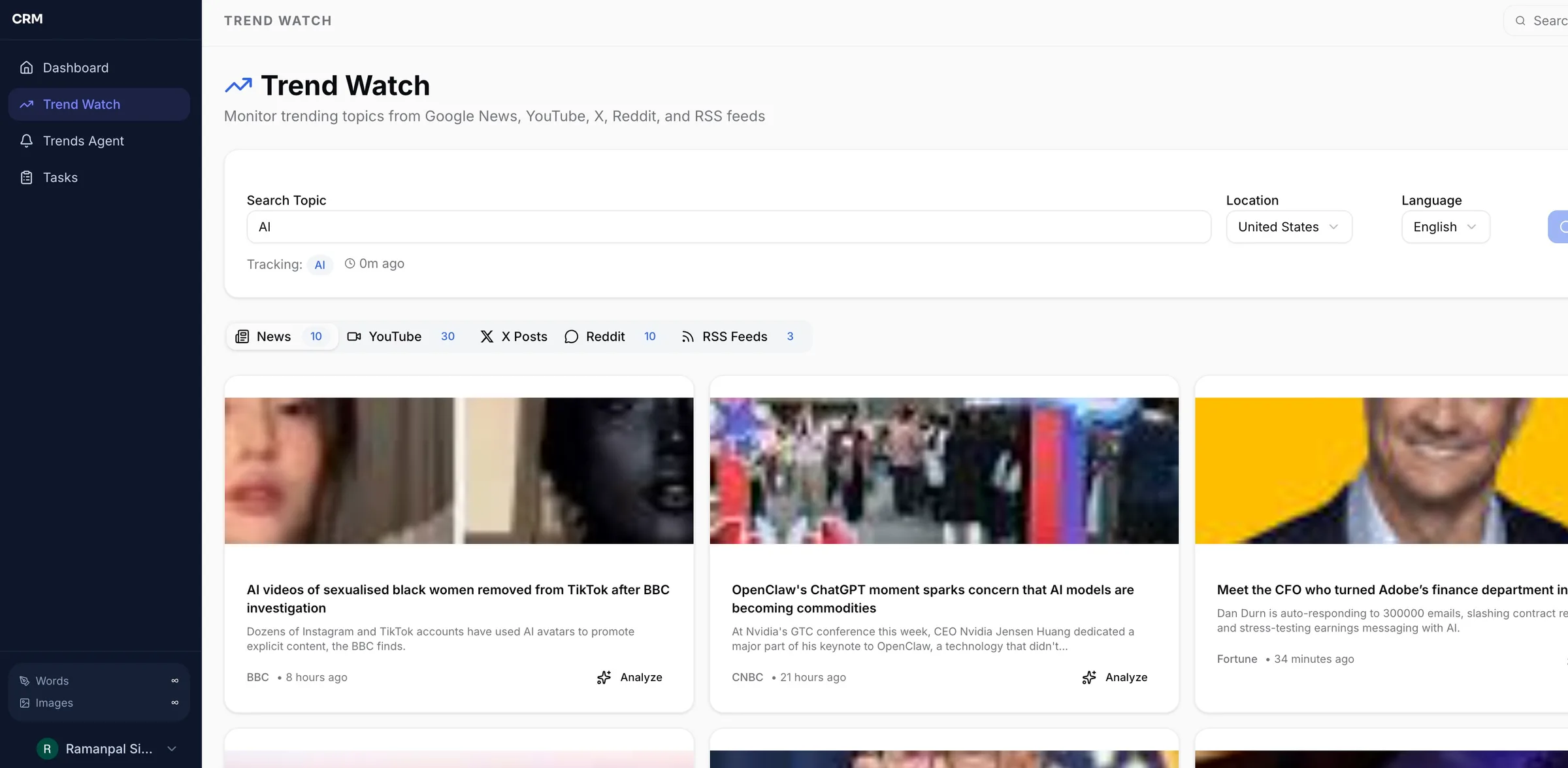
Signup to Copyrocket AI and on your CRM > Trend's Watch.
Search for your term and press enter.
Now get all recent posts across News, Reddit, X Twitter, Youtube and Blog Feeds.
How to Track Your ChatGPT Search Performance
Traditional SEO metrics like keyword position do not measure AI visibility. You need different signals.
Monitor utm_source=chatgpt.com
When ChatGPT links to your site and a user clicks through, the referral shows up in your analytics as utm_source=chatgpt.com. Set up a custom segment in Google Analytics or your analytics platform to track this traffic specifically. Growth in this segment is the clearest direct signal that your GEO strategy is working.
Test Your Own Brand in ChatGPT
Prompt ChatGPT with questions your target customers would ask. Look for whether your brand, product, or content appears in the response. If it does, note the framing and the competing sources. If it does not, identify which sources are cited instead and analyze what they do structurally and editorially that you do not yet do.
Tracking citation frequency, share of voice against competitors, and how accurately AI represents your brand gives you actionable intelligence that search rank tracking cannot provide.
Track Your ChatGPT Search Visibility with CopyrocketAI
Knowing how to optimize for ChatGPT Search is half the work seeing whether it's actually happening is the other half. CopyrocketAI gives you three tools built for exactly this.
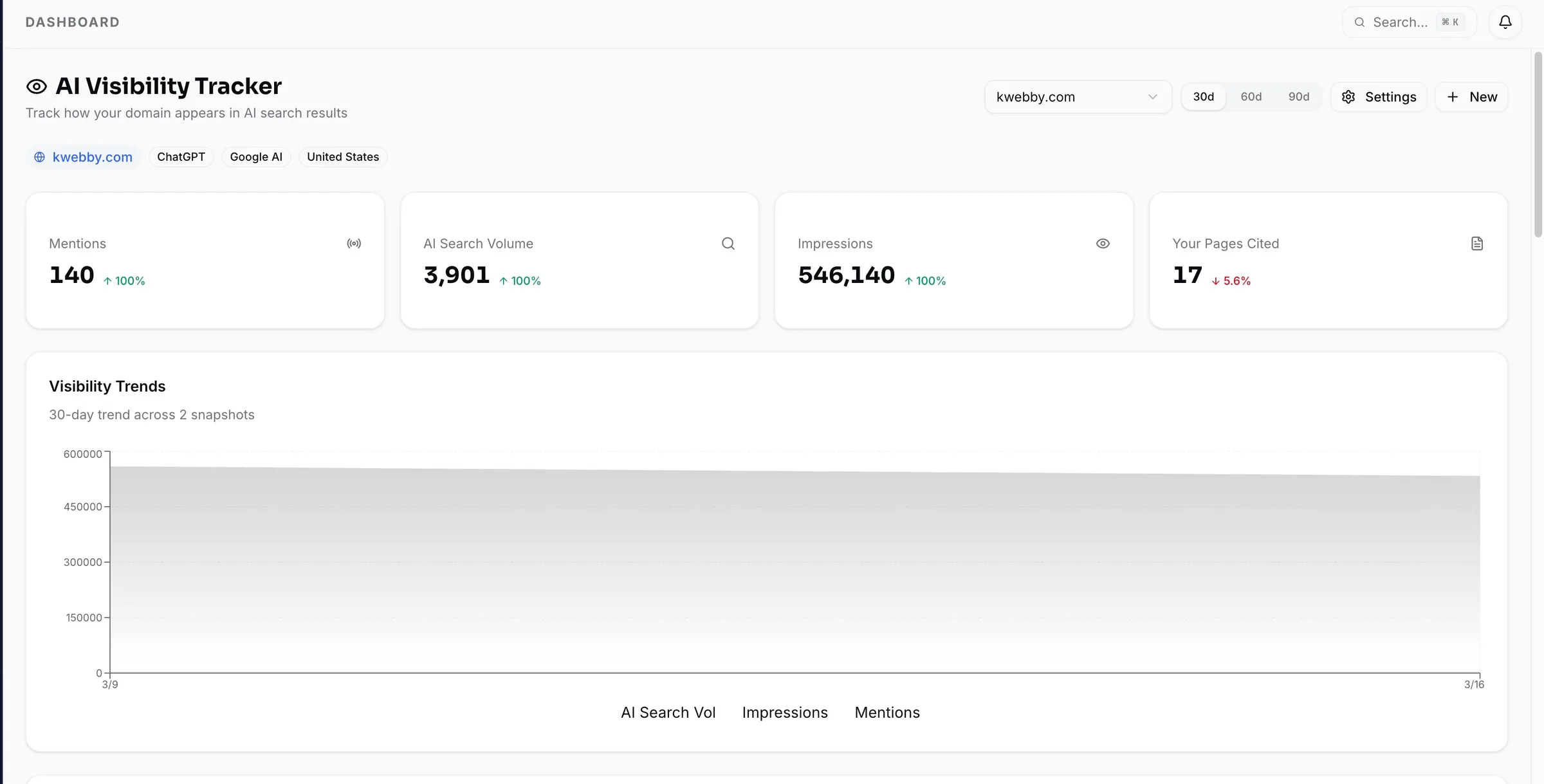
AI Visibility monitors your domain's citations across ChatGPT, Google AI Overviews, Claude, and Perplexity over time, with competitor comparison and weekly snapshots so you can see your share of AI voice growing (or slipping).
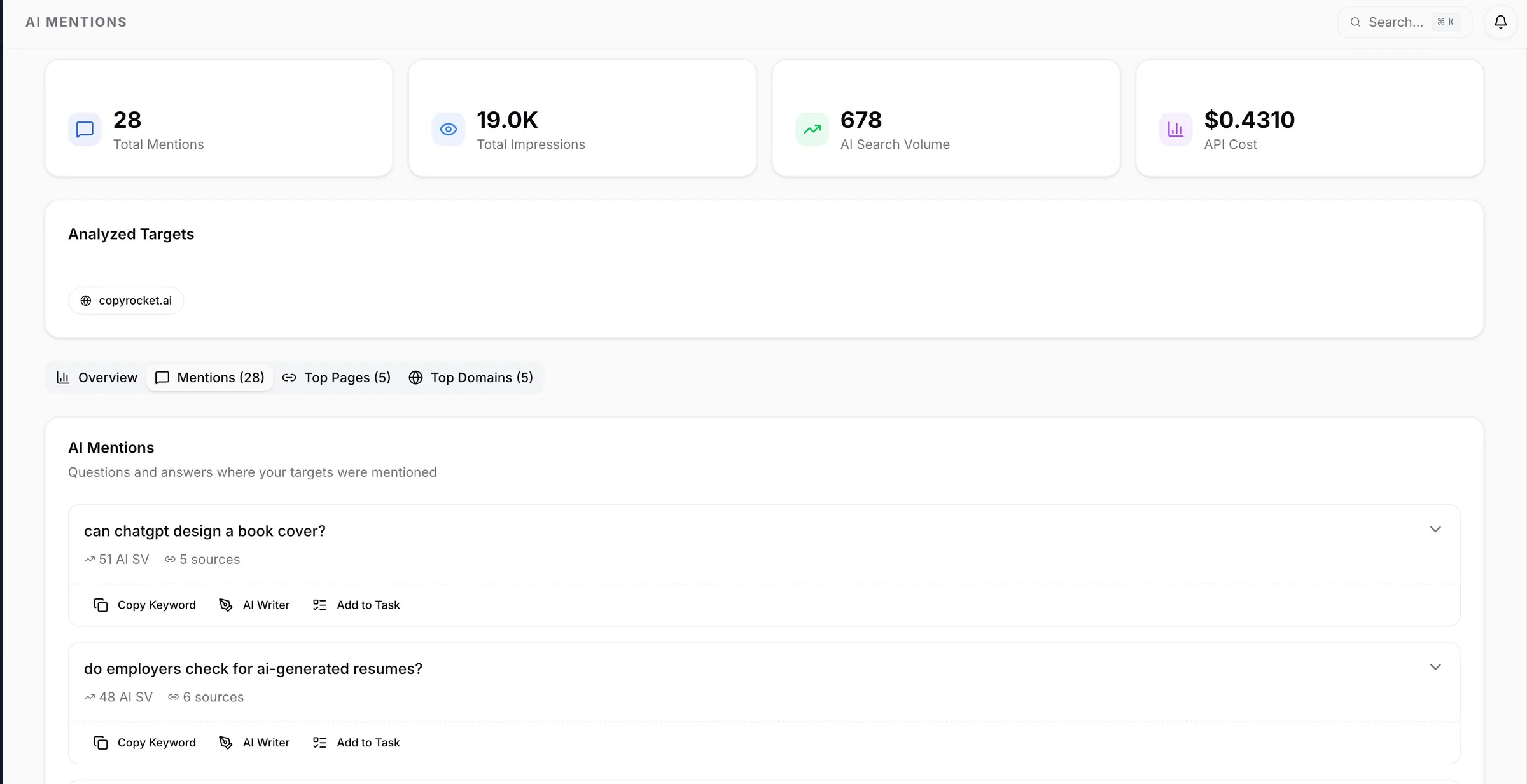
AI Mentions scans AI-generated responses for your brand and domain name, so you know when and how AI systems are referencing your content.
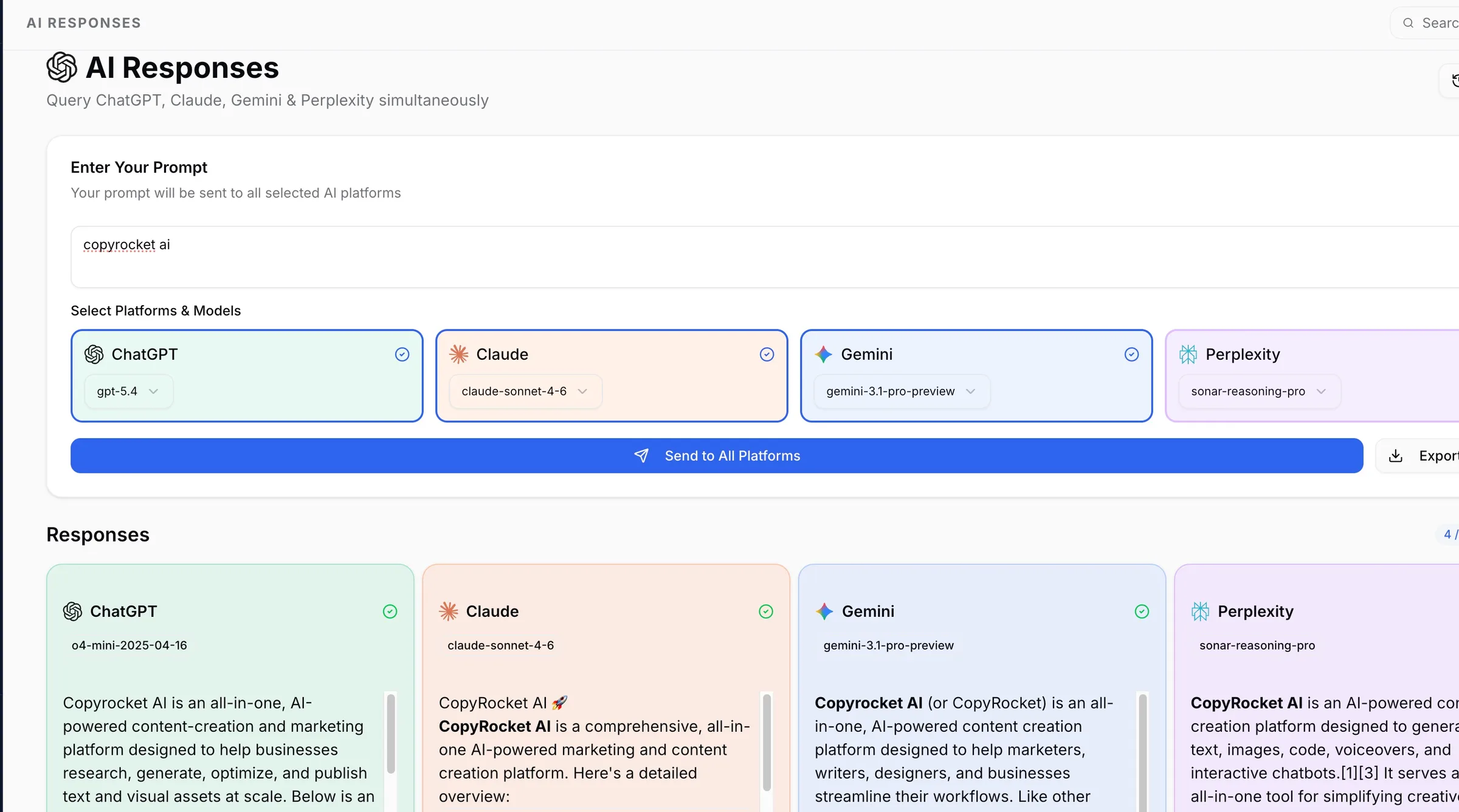
AI Responses lets you query ChatGPT, Claude, Gemini, and Perplexity with the same prompt simultaneously, so you can see your citation status across every major AI engine from one screen.
Try these tools free at CopyrocketAI →
Final Thoughts
ChatGPT Search is not a future trend — it is a present reality reshaping how 800 million weekly users find information.
The brands earning citations today are building a compounding advantage: more citations mean more authority signals, which means more citations.
Start with the technical layer — allow OAI-SearchBot, add schema markup, and hit your page speed targets.
Then work on content structure and cross-platform authority. Track your utm_source=chatgpt.com referrals monthly to measure progress. The window to establish early AI search authority is open now, and the steps to get there are measurable and specific.
Frequently Asked Questions

Written by
Raman Singh
Raman Singh is a highly skilled marketing professional who serves as the head of marketing at Copyrocket AI. With years of experience in the field, Raman has developed a deep understanding of all asp
View all postsYour AI Marketing Agents
Are Ready to Work
Stop spending hours on copywriting. Let AI craft high-converting ads, emails, blog posts & social media content in seconds.
Start Creating for FreeNo credit card required. 50+ AI tools included.
Related Articles
 General
NotebookLM For Coders: Turn Docs Into Faster Code
Code work often fails for a simple reason. You do not have the right context at the right time. You read docs in one tab, skim tickets in another tab, and then...

 General
How to Optimize for AI Search in 2026: The Complete Guide
AI search has shifted from experimental feature to primary search method for millions of users. ChatGPT Search, Google AI Overviews, Perplexity, Claude, and Gem...
 General
Claude Opus 4.6 Review: Here's What New!
Claude Opus 4.6 from Anthropic draws attention because teams want an AI model that writes better code, follows instructions, and stays consistent across long se...