
Google AI Mode: What It Means for SEO in 2026

Raman Singh
Raman Singh is a highly skilled marketing professional who serves as the head of marketing at Copyrocket AI
A Moz study analyzing 40,000 keywords found that only 12% of Google AI Mode citations come from pages ranking in the top 10 organic results. Read that again: 88% of the citations appearing inside AI Mode responses link to content that never made page one. If your entire SEO strategy is built around ranking, you are now optimizing for a metric that no longer determines AI visibility. This guide breaks down exactly what Google AI Mode is, how it selects sources, what the data says about its real-world traffic impact, and — most importantly — a practical step-by-step approach to adapting your content strategy before your competitors do.
Key Takeaways
Google AI Mode, powered by Gemini 3.1, replaces the traditional 10-link results page with one synthesized AI answer. Only 35% of cited URLs overlap with page-one organic rankings, according to Semrush's domain analysis.
AI Mode generates approximately 93% zero-click searches, compared to 34% for traditional Google — per behavioral data from Geolify. A keyword that once generated 1,000 monthly clicks can now produce roughly 70.
Only 12% of AI Mode citations match the top-10 organic results for the same query, according to Moz. Ranking and AI citation are now separate challenges requiring separate strategies.
AI Mode uses "query fan-out" — breaking one question into up to 16 simultaneous sub-searches. Content covering a full topic cluster earns citations across multiple sub-queries, giving comprehensive pages a structural advantage over narrow, keyword-targeted ones.
Google now self-cites its own properties in 17.42% of all AI Mode responses — a 3x increase since mid-2025 — per SE Ranking's study of 1.3 million citations. Publishers compete with the platform itself for citation space.
Generative Engine Optimization (GEO) and Answer Engine Optimization (AEO) are replacing keyword SEO as the primary disciplines for informational content visibility. The goal shifts from "rank #1" to "be the source AI trusts."
What Is Google AI Mode?

Google AI Mode is a conversational, AI-powered search experience built on Google's Gemini 2.5 model. Instead of displaying a ranked list of links, it generates one complete, synthesized response to the user's query. Sources are cited in a collapsible sidebar panel — not as clickable headline results. Users access AI Mode through a dedicated tab in Google Search, and they can ask follow-up questions in the same session without restarting.
Think of it as Google becoming its own answer. In traditional search, Google pointed you to websites. In AI Mode, Google is the website — it reads, summarizes, and responds, then tells you where it sourced each piece of information.
Real-life example: Imagine you are the content manager for a mid-size SaaS company and you search "best CRM for small businesses in 2026." In traditional Google, you'd see Capterra, HubSpot, Forbes Advisor, and G2 in the top results. In AI Mode, you see a synthesized comparison table with pros, cons, pricing tiers, and a recommended pick — all assembled from 8–12 sources. You get your answer without clicking anything. For every CRM company whose product is not mentioned in that AI response, they effectively do not exist for that user in that moment.
How AI Mode Differs from AI Overviews
AI Overviews (formerly Search Generative Experience, or SGE) appear as a summary box at the top of regular search results. The traditional organic links still display below them. AI Overviews reduce clicks — Evergreen Media's 2026 analysis documented a 34.5% drop in position-1 CTR when an AI Overview appears — but page-one results remain visible.
AI Mode is a completely different surface. It replaces the 10 blue links entirely with one AI response. There is no "below the fold" for organic results to catch stray clicks. This is why AI Mode produces dramatically higher zero-click rates: the traditional results simply do not exist on that page.
The practical distinction matters for prioritization. Ranking on page one gives you partial protection against AI Overviews because your result still shows below the summary. For AI Mode, ranking gives you no automatic benefit — only 35% of cited URLs are from page-one results, which means citation selection follows its own logic entirely.
The Engine Behind It: Query Fan-Out Explained
Query fan-out is the most important concept in AI Mode SEO — and it is almost universally skipped by articles covering this topic, because understanding it changes how you think about content strategy.
Here is exactly what happens when a user submits a question to AI Mode:
Decomposition: Gemini breaks the user's question into a set of "latent sub-queries." For the question "how do I improve my website's SEO in 2026," sub-queries might include: what is SEO in 2026, what changed in Google's algorithm this year, how do AI Overviews affect rankings, what are the best on-page SEO practices, what does E-E-A-T mean, and more.
Parallel search: Google runs all sub-queries simultaneously — sometimes up to 16 at once, per documentation cited by Gemini in its analysis.
Source matching: For each sub-query, Google identifies the most relevant, credible source.
Assembly: Gemini assembles the best answers into one coherent response, citing each source for the specific claim it contributed.
Why this matters for your content: A page that comprehensively covers one topic — including its sub-questions, definitions, edge cases, and comparisons — can earn citations across multiple sub-queries from a single AI Mode response. A page that only answers the headline question earns at most one citation. The fan-out mechanism structurally rewards depth and topic coverage over keyword optimization.
Real-world tip: Before writing your next piece, list every question a user might logically ask after reading the headline topic. Those are your sub-topics. Each one needs its own dedicated section, answered directly and completely. That is how you optimize for fan-out without knowing which specific sub-queries Google will generate.
How AI Mode Is Changing Organic Traffic — With Real Numbers
The traffic data behind AI Mode adoption is not theoretical. Publishers in markets where AI Mode has widely deployed are already seeing the effects in their analytics.
The Zero-Click Reality Is Here
Geolify's behavioral data shows three distinct zero-click rates across Google's search surfaces:
Search Surface | Zero-Click Rate |
|---|---|
Traditional Google | ~34% |
Google with AI Overviews | ~43% |
Google AI Mode | ~93% |
The AI Mode figure is not a projection — it reflects how users actually behave when served a complete AI answer. Most get what they need and leave.
What this means in practice: Take a keyword your site ranks #1 for with 10,000 monthly searches and a 15% CTR — that is 1,500 monthly visits. If AI Mode begins handling that query at the 93% zero-click rate, your effective CTR drops from 15% to roughly 1%, producing about 100 monthly visits from the same search volume. That is not a bad month — that is the new baseline.
EnFuse Solutions documented a 61% organic CTR decline across informational query categories in markets where AI Overviews expanded. NerdWallet — one of the most SEO-sophisticated finance publishers — generated 35% more revenue in 2024 while simultaneously losing 20% of its monthly organic traffic. The decoupling of revenue from organic traffic is not a failure of their SEO; it is an adaptation to a new reality.
Why Page-One Rankings No Longer Guarantee Visibility
The gap between ranking and being cited in AI Mode has a clear structural explanation.
Traditional PageRank evaluates links, authority, and relevance to determine which pages to show. AI Mode's citation selection evaluates something different: can this page's content be cleanly extracted, attributed, and used to answer a specific sub-query? A page can rank #1 for all the traditional reasons — strong domain authority, exact-match keywords, high-quality backlinks — and still not be structured in a way that AI systems can easily parse and cite.
Semrush's research found overlap ranging from 30% on SEO-specific queries to 60% on more technical SEO subtopics. The overlap is higher for narrow, technical queries because the pool of authoritative sources is smaller. For broader informational queries — where AI Mode is most commonly triggered — the gap between ranking and citation widens.
How Google Selects Sources for AI Mode Citations
Citation selection is the new ranking algorithm for AI Mode. This is where optimization effort should go.
Google Is Citing Itself — A Lot
SE Ranking's February 2026 study of 1.3 million AI Mode citations found that Google.com properties account for 17.42% of all citations. That is a 3x increase from June 2025 (5.7%). Google's own YouTube, Maps, Business Profiles, and search result pages collectively receive more AI Mode citations than any external domain.
This matters for independent publishers in a direct, practical way. If you model citation space as a finite resource, Google claiming 17% of it means every other domain competes for 83%. And since citation allocation is not evenly distributed — a handful of authoritative domains capture most external citations — the effective competition for mid-tier publishers is more intense than the top-line number suggests.
The shift in where Google's self-citations go also reveals something about AI Mode's direction. In June 2025, 97.9% of Google's self-citations pointed to Google Business Profiles — predominantly a local SEO signal. By February 2026, 59% now point to organic search result pages. Google is using AI Mode to deepen user engagement with its own search ecosystem, not just its maps product.
What Makes a Page Citation-Worthy
Based on research from SE Ranking, Moz, Semrush, and Google's own documentation, the factors that drive AI Mode citation selection fall into four categories:
1. Structural clarity. AI systems extract specific sentences, not full pages. Content with clear question-based headings, direct answers in opening sentences, and data in scannable formats (tables, numbered steps, short bullet points with explanatory prose) gets parsed more efficiently than discursive, paragraph-heavy content without clear structure.
2. Topical completeness. A page that answers not just the main question but also its logical sub-questions — definitions, comparisons, edge cases, how-to steps — earns citations across multiple fan-out sub-queries. This is why content hubs (a main guide plus interconnected subtopic pages) consistently outperform standalone articles for AI citation rates.
3. Verified E-E-A-T. Google's developer documentation on AI Overviews and AI Mode confirms that Experience, Expertise, Authoritativeness, and Trustworthiness signals affect source selection. For AI Mode, E-E-A-T is less about formal credentials and more about verifiability — can the AI confirm who wrote this, what organization published it, whether it has been cited by other credible sources, and how recently it was updated?
4. Cross-web brand presence. AI Mode draws from the broader web, not just individual pages. Reddit's 603% traffic growth since June 2023 reflects AI systems' appetite for authentic third-party discussion. A brand mentioned positively in forums, directories, independent reviews, and industry publications earns stronger AI visibility signals than one that appears only on its own website.
How to Optimize for Google AI Mode: A Step-by-Step Approach
The optimization framework for AI Mode has five distinct areas. Work through them in order — the first three are foundational and unlock the benefit of the last two.
Step 1: Audit and Restructure Existing Content for AI Extraction
This is the highest-leverage starting point for most content teams because it improves existing assets rather than requiring new production.
Tutorial: How to restructure a blog post for AI Mode in 5 steps
Identify your highest-traffic informational posts. These are most likely to be affected by AI Mode's zero-click shift, and most likely to benefit from citation optimization.
Rewrite every H2 as a direct question. Change "Benefits of Content Marketing" to "What Are the Benefits of Content Marketing?" The question format matches the natural language sub-queries AI Mode generates.
Move the answer to the top of each section. The first 2–3 sentences below each heading should contain the direct answer. If you currently bury the point in paragraph three, move it to paragraph one. AI systems extract the most direct response to the sub-query — if your answer is in the middle of a dense paragraph, it competes with less relevant text.
Add a structured data layer. Implement FAQ schema for your FAQ sections, HowTo schema for instructional content, and Article schema with author, organization, and date fields. Google's structured data documentation confirms these help AI systems parse content intent.
Add a "Quick Answer" box at the top of each post. A 2–3 sentence summary at the very top of the article — clearly labeled — gives AI Mode a ready-made extraction target. Many AI citations pull from this type of summary box because it is the most concise, standalone answer on the page.
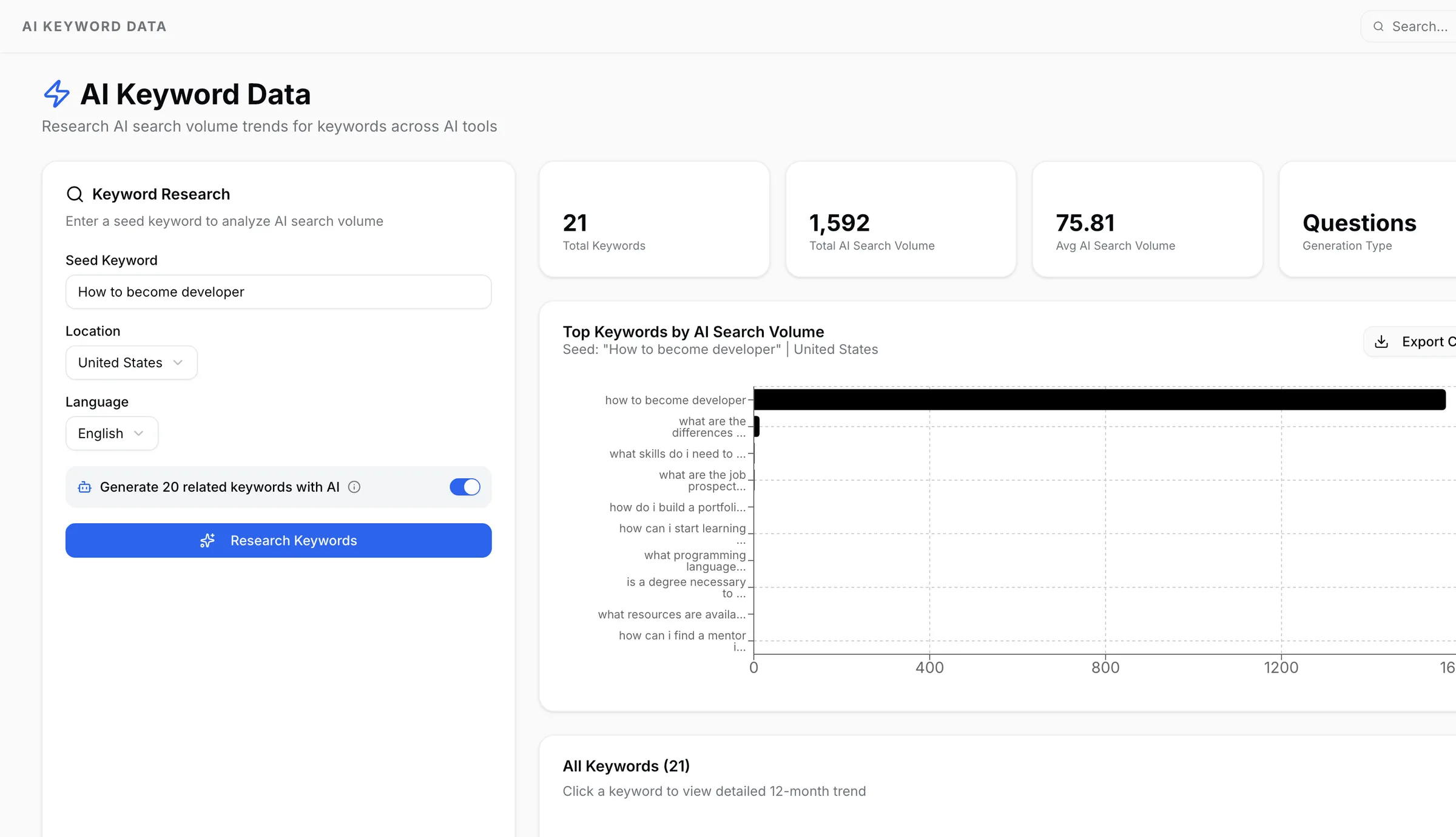
Pro Tip: Use our AI Keyword research to find what people are searching on Google AI;
First signup to Copyrocket AI and navigate to GEO > AI Keywords tool
Then research for your core keyword, select your desired country and language and click submit and here you get the data like below;
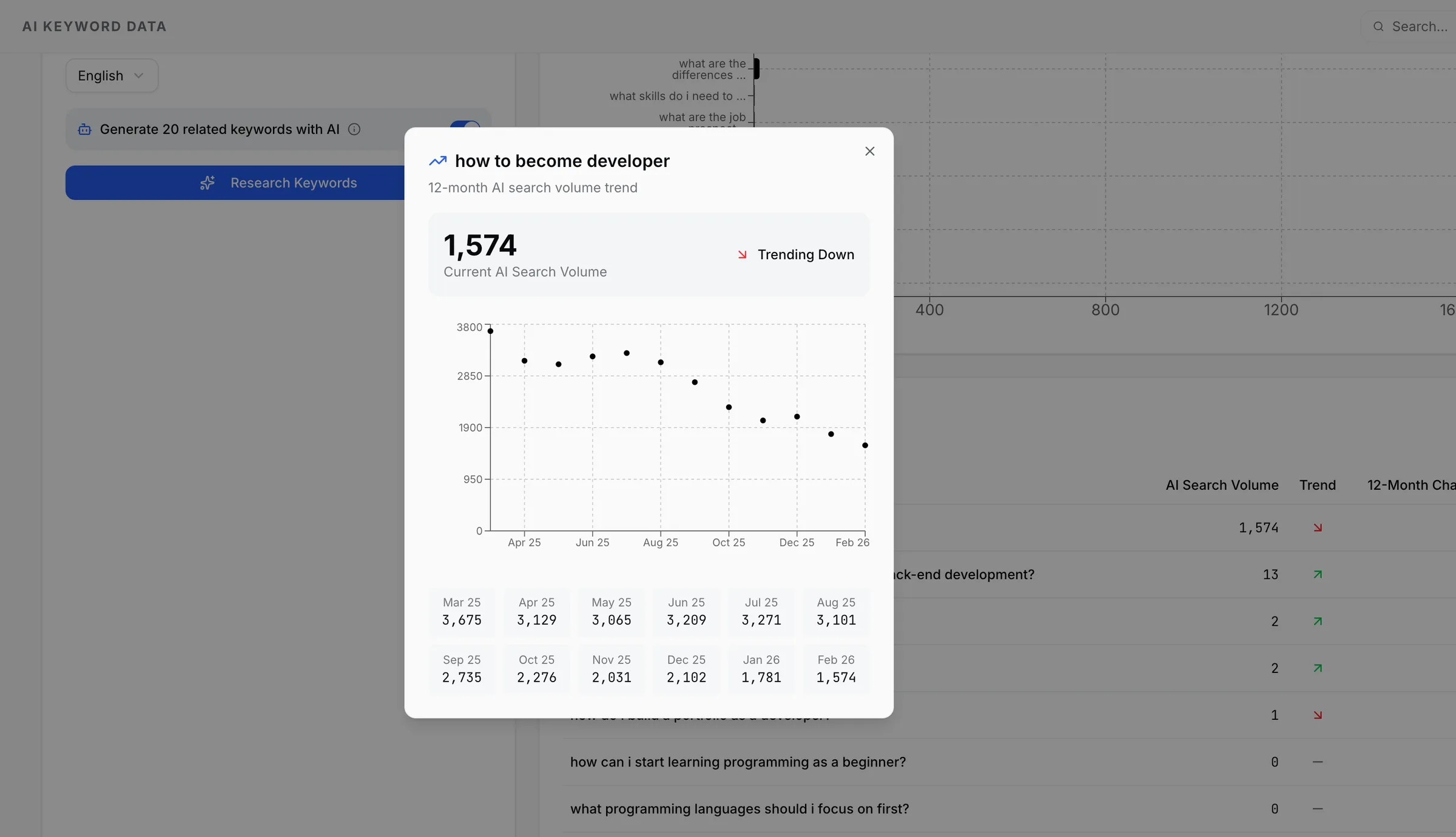
Click on the keyword to see the trend over the time for specific keyword;
Real-life example: A SaaS company selling project management software rewrites its "What Is Project Management?" guide using this approach. Before the rewrite, the article ranked #4 organically but earned zero AI Mode citations for any of 200 tracked project management queries. After restructuring with question headings, top-of-section answers, and FAQ schema, it began appearing as a cited source in AI Mode responses for 34 queries in the first 60 days — without any change to its organic ranking.
Step 2: Build Content Hubs for Topical Authority
A single well-optimized page cannot match a site with deep topical coverage for AI Mode citations. Fan-out rewards sites that can answer the full cluster of related questions from a single domain.
How a content hub works: A main pillar guide (long-form, comprehensive) is surrounded by satellite articles that each cover one sub-topic in depth. The pillar links to every satellite. Each satellite links back to the pillar and to related satellites. Together, they cover the full topic space — every question a user might ask — and the internal linking tells Google which pages belong to the cluster.
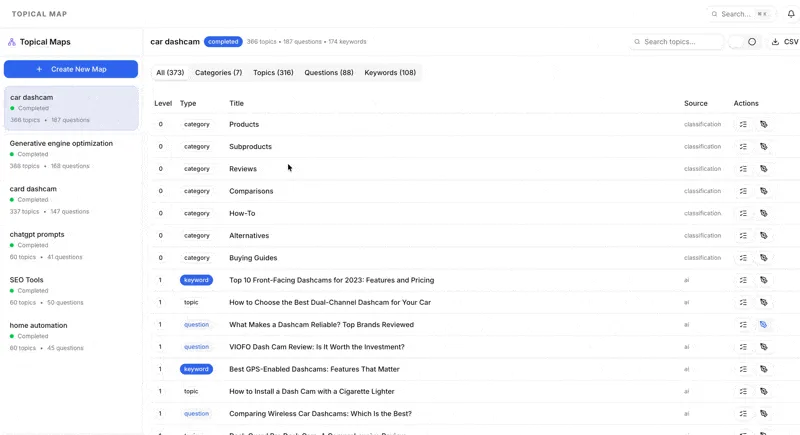
Use Copyrocket AI's Topical Map builder to curate 300+ Topics in one go.
Signup to copyrocket and navigate to Keywords > Topical Map and click on create new map;
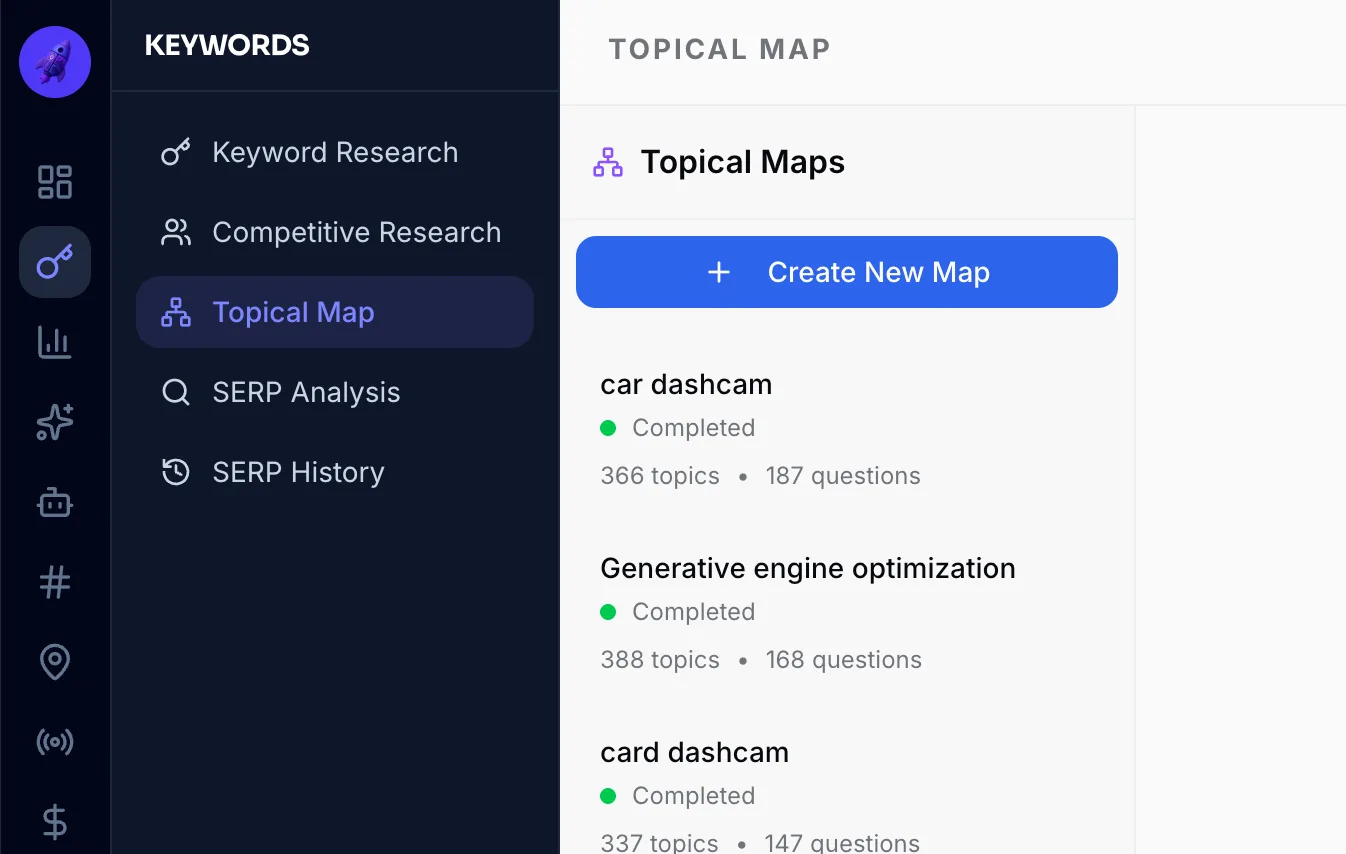
Type your core keyword and let the tool create Topical map for you in few minutes;
Practical example for an HR software company:
Pillar: "Complete Guide to Employee Onboarding Software in 2026" (3,000+ words, covers every sub-topic at a surface level)
Satellites:
"What Is Employee Onboarding Software? A Definition"
"How to Choose Onboarding Software for Remote Teams"
"Employee Onboarding Software vs. HRIS: What's the Difference?"
"Onboarding Software Pricing: What to Expect in 2026"
"How Long Does Employee Onboarding Take? (Benchmarks and Data)"
"Employee Onboarding Checklist: 30-60-90 Day Template"
Each satellite page answers one question exhaustively. When AI Mode fans out a query about onboarding software, multiple satellite pages from this company are eligible for citation across different sub-queries. A competitor with only a single "Everything About Onboarding Software" page can earn one citation at most from the same AI Mode response.
Tip: The fastest way to identify what satellites to build is to paste your main topic into Google and collect every "People Also Ask" question. Each one is a satellite page waiting to be created.
Step 3: Strengthen E-E-A-T Signals for AI Credibility
E-E-A-T (Experience, Expertise, Authoritativeness, Trustworthiness) has always influenced Google rankings. For AI Mode, its role shifts: it determines whether your content is considered citation-worthy at all.
Here is what E-E-A-T looks like in practice for AI Mode optimization:
Author bio upgrade: Replace generic author descriptions ("Jane Smith is a content writer at Acme Corp") with specific, verifiable credentials ("Jane Smith has 9 years of experience in B2B SaaS marketing. She previously ran demand gen at [Company], and her research on content attribution has been cited by Search Engine Land and Moz."). The specificity is what matters — AI systems can cross-reference credentials across the web.
Original data integration: Publish original research, surveys, or proprietary data at least once per quarter. A post that says "in our survey of 500 marketing managers, 67% reported reducing their organic traffic targets for 2026" is inherently citation-worthy because no AI can generate that data — it must be sourced. Search Engine Land's expert panel identified original data as the single most effective tactic for earning AI engine citations across multiple SEO leaders interviewed.
Update frequency: AI Mode favors fresh sources for fast-moving topics. Add a clear "Last updated:" date at the top of every article and update statistics and examples at least every six months. RichClicks' analysis of AI Mode selection patterns recommends refreshing content every 4–6 weeks for topics where AI results are actively changing.
Third-party validation: Seek mentions in industry publications, interviews, podcast appearances, and directories. AI Mode cross-references your domain's reputation across the web. A company mentioned in Search Engine Land, Moz, and HubSpot's blog earns stronger AI trust signals than one that has only published on its own site.
Step 4: Write for Conversational and Multi-Turn Queries
AI Mode users write differently than traditional search users. Google's 2026 search trends data shows a shift from short keyword queries ("CRM software 2026") to constraint-rich conversational queries ("what's the best CRM for a 15-person sales team with a $200/month budget that integrates with HubSpot?").
These longer queries generate more complex fan-out patterns — more sub-queries, more citation slots, and more opportunity for specialized content to get cited.
Tip: Target the long tail of AI Mode. Write content that answers constraint-specific questions directly. Instead of a generic "Best CRM Software" guide, create a page titled "Best CRM for Small Sales Teams Under 20 People" with a section specifically comparing budget-tier options. That page matches a very specific sub-query pattern that the generic guide misses entirely.
Tip: Build multi-turn FAQ sections. Write FAQ answers that acknowledge follow-up questions and address them in sequence. A FAQ answer that says "Yes, you can use X for remote teams — but if you are dealing with team sizes over 50, here is what to watch for..." pre-empts the user's next follow-up. AI Mode rewards this because it serves the multi-turn conversation intent built into the product.
Step 5: Track AI Visibility Separately from Organic Rankings
Most standard SEO reporting tools cannot currently tell you how often your content appears in AI Mode responses. Google Search Console does not yet distinguish between traffic from traditional results, AI Mode, and AI Overviews, which means teams relying only on GSC are flying partially blind.
Signup to Copyrocket AI here and Navigate to GEO > AI Visibility Tracker and select your property or add one in properties section.
Then Give it a moment to fetch the current AI rankings for your domain across ChatGPT + Google AI you will see the following dashboard;
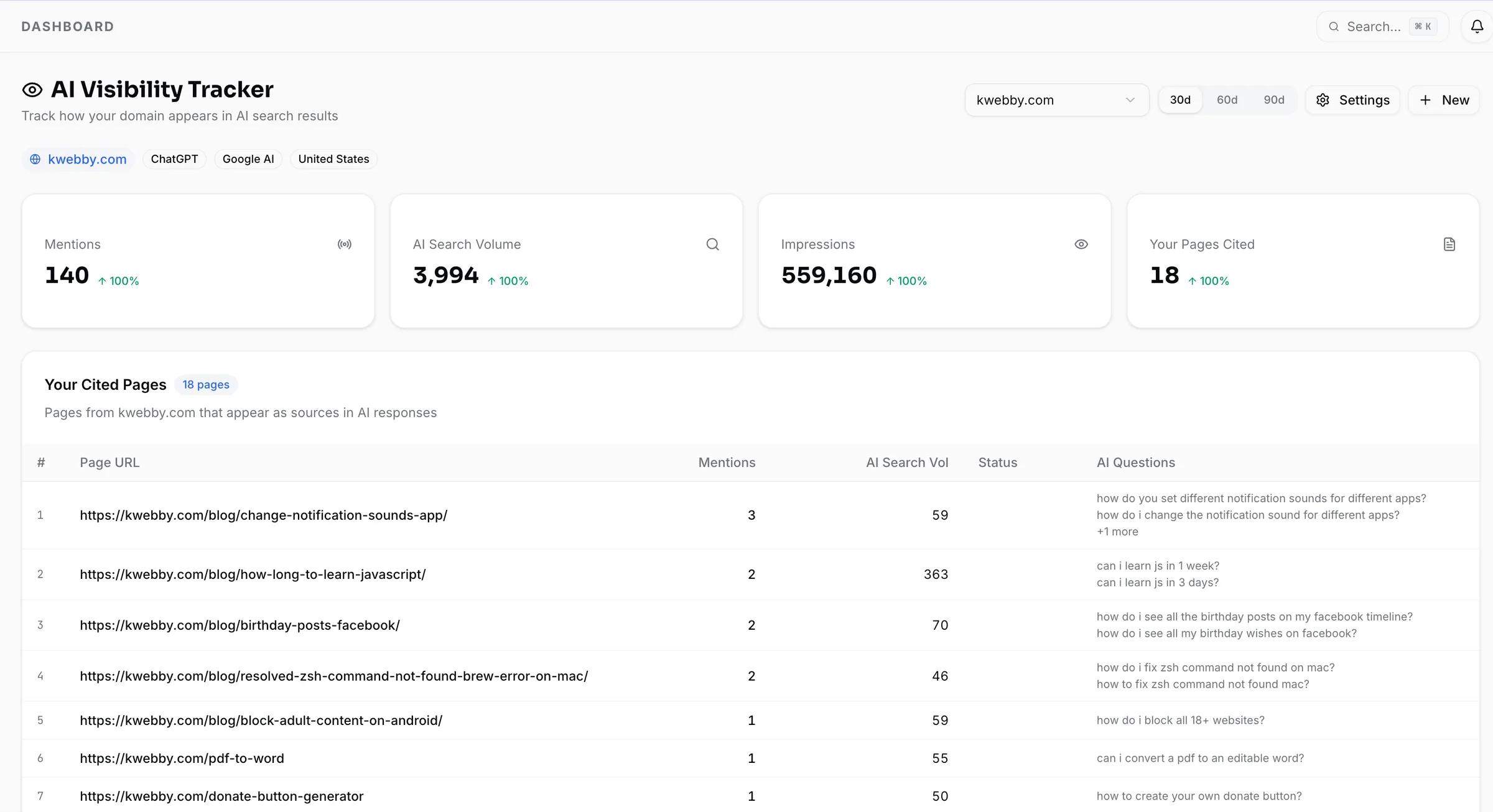
To create Weekly Ranking tracker click on "New" button on top right and fill the following form;
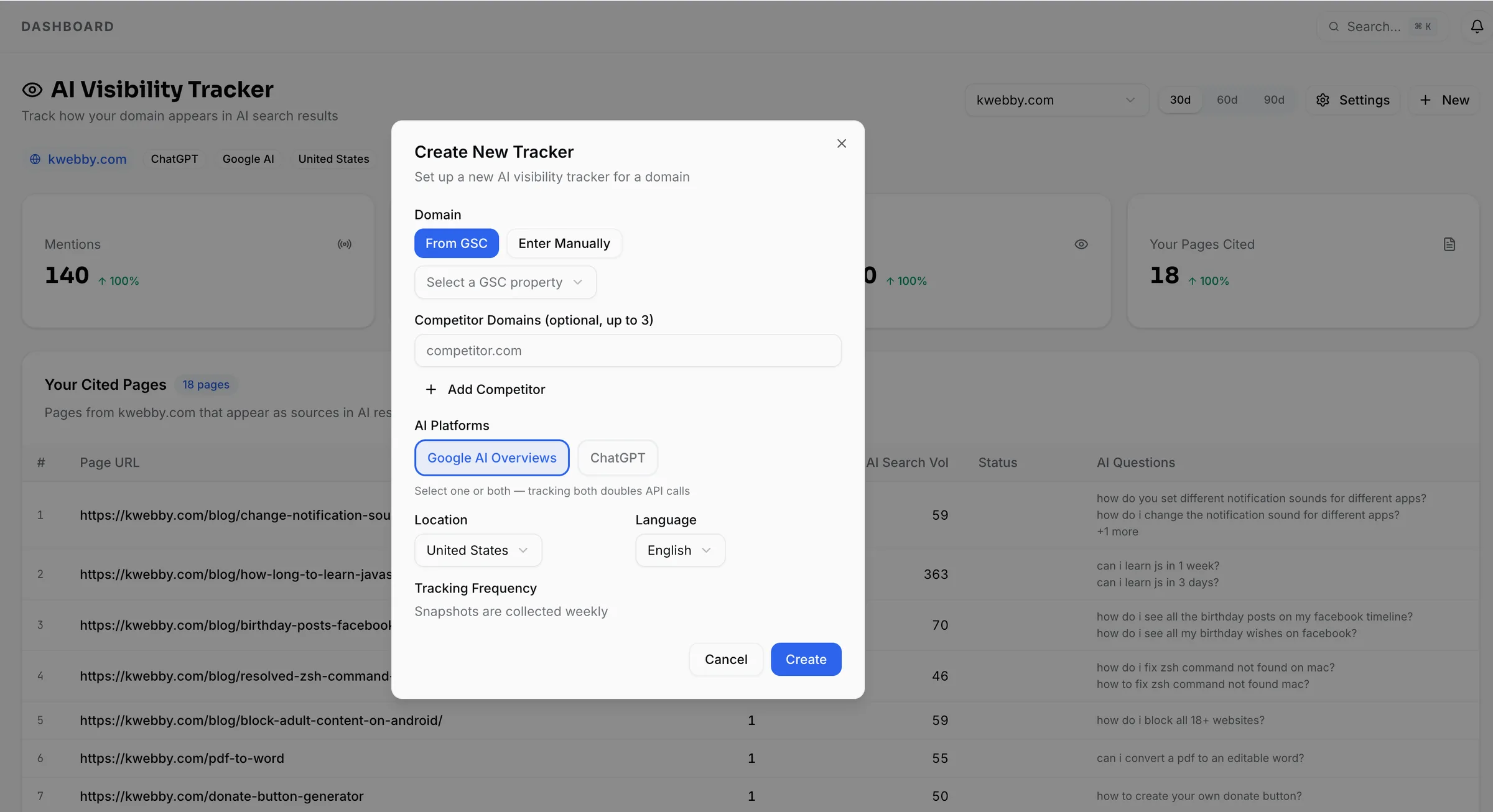
Now you will get updates regarding your ranking weekly in your email or you can come back to the tool anyday to check the same.
Here are other tools that will help you to build a practical AI visibility tracking setup in 2026:
Semrush AI Toolkit: Tracks which of your pages appear as sources in AI Mode and AI Overview responses for your target queries. Updated daily.
SE Ranking AI Visibility Monitor: Monitors citation frequency and tracks changes over time as you update content.
Brand mention monitoring (Mention, BrandWatch, or free Google Alerts): Tracks unlinked mentions across the web — forums, reviews, news — which feed into AI's cross-web brand signals.
Branded search volume trend (GSC): Rising branded search volume often reflects users who encountered your brand in an AI citation and then searched your brand name directly. It is an indirect but measurable signal of AI presence.
Build a monthly report that tracks these four metrics alongside traditional rankings and organic traffic. The combination gives you a complete picture of both your traditional SEO health and your AI visibility performance.
The Rise of GEO and AEO
Traditional SEO focuses on ranking signals: backlinks, keyword optimization, page structure, and technical performance. These remain necessary but no longer determine visibility for informational queries handled by AI Mode.
Generative Engine Optimization (GEO) is the practice of optimizing content to be cited and surfaced by generative AI systems — Google AI Mode, ChatGPT, Perplexity, Meta AI, and others. GEO focuses on citation authority, semantic depth, structured data, and entity recognition.
Answer Engine Optimization (AEO) is the practice of structuring content to directly answer specific questions, so answer engines select it as the source for their response. AEO is most applicable to FAQs, how-to guides, definitions, and comparison queries — all of which map closely to AI Mode's primary use cases.
Both GEO and AEO share one principle: your content must be the most useful, direct, and credible answer to the user's question. Not the most keyword-optimized. The most genuinely useful. Search Engine Land's 2026 expert panel describes this period as a "bifurcation" in SEO — teams optimizing for traditional organic traffic and teams optimizing for AI share of voice need different strategies, different KPIs, and increasingly, different content formats.
Real-life scenario: A financial services company publishes a long-form guide on "How to Choose a Financial Advisor." It ranks #6 organically. Under traditional SEO, the priority is link building to move to #1. Under GEO/AEO, the priority is restructuring the guide with direct-answer sections, adding author credentials (the author is a CFP), embedding original survey data, and building out satellite pages for every related sub-question ("fee-only vs. fee-based advisors," "how to check a financial advisor's credentials," "average financial advisor fees by service type"). The result: the page stays at #6 organically but begins earning AI Mode citations for 40+ related queries — each one representing brand exposure to users who never clicked a traditional result.
Final Thoughts
Google AI Mode is already here and already reshaping how search visibility works. The data is unambiguous: ranking on page one and being cited in AI Mode are separate challenges requiring separate strategies. The 12% citation-to-ranking overlap means the vast majority of AI visibility goes to content that earned it through a different mechanism than traditional SEO — topical authority, structural clarity, verifiable credibility, and a cross-web brand presence.
The path forward is not to abandon traditional SEO. It is to layer AI optimization on top of it. Restructure your best existing content for AI extraction. Build topic clusters that cover the full fan-out surface. Strengthen the E-E-A-T signals that make AI systems trust your content enough to cite it by name. And measure your AI share of voice alongside traditional rankings so you can see what is actually working.
Start this week: pick your three highest-traffic informational posts. Rewrite the H2 headings as questions, move the direct answers to the top of each section, and add FAQ schema. Those three changes alone will improve your AI extraction profile without touching your rankings. That is the first step in the 2026 SEO playbook.
Frequently Asked Questions
Written by
Raman Singh
Raman Singh is a highly skilled marketing professional who serves as the head of marketing at Copyrocket AI. With years of experience in the field, Raman has developed a deep understanding of all asp
View all postsYour AI Marketing Agents
Are Ready to Work
Stop spending hours on copywriting. Let AI craft high-converting ads, emails, blog posts & social media content in seconds.
Start Creating for FreeNo credit card required. 50+ AI tools included.
Related Articles
 General
NotebookLM For Coders: Turn Docs Into Faster Code
Code work often fails for a simple reason. You do not have the right context at the right time. You read docs in one tab, skim tickets in another tab, and then...
 General
How to Optimize for AI Search in 2026: The Complete Guide
AI search has shifted from experimental feature to primary search method for millions of users. ChatGPT Search, Google AI Overviews, Perplexity, Claude, and Gem...
 General
Claude Opus 4.6 Review: Here's What New!
Claude Opus 4.6 from Anthropic draws attention because teams want an AI model that writes better code, follows instructions, and stays consistent across long se...