
GEO vs. SEO: Why You Need Both Strategies in 2026

Raman Singh
Raman Singh is a highly skilled marketing professional who serves as the head of marketing at Copyrocket AI

AI-referred sessions jumped 527% year-over-year in the first five months of 2025. Search is splitting into two parallel systems, traditional search engines and AI-generated answer engines and they reward different behaviours.
Teams that treat GEO as a replacement for SEO lose ground on both fronts. Teams that run them together win on both.
This guide explains exactly how the two differ, where they overlap, and how to build one content strategy that earns rankings and citations simultaneously.
Key Takeaways
AI-referred sessions grew 527% year-over-year in early 2025, but AI traffic still represents only 1.08% of all website traffic across industries — SEO isn't optional yet.
ChatGPT alone accounts for 87.4% of all AI referral traffic, making it the dominant GEO target in 2026.
AI referral traffic converts at 2x the rate of traditional organic search — the traffic is smaller but higher intent.
26% of brands have zero mentions in AI Overviews — being invisible to AI engines is already a competitive disadvantage.
40 to 60% of cited sources rotate monthly in AI responses — GEO is not a one-time optimisation; it requires ongoing content freshness.
98% of CMOs are investing in Answer Engine Optimization — the market has moved; the question is whether your content strategy has too.
What SEO Does (and Still Does Well)
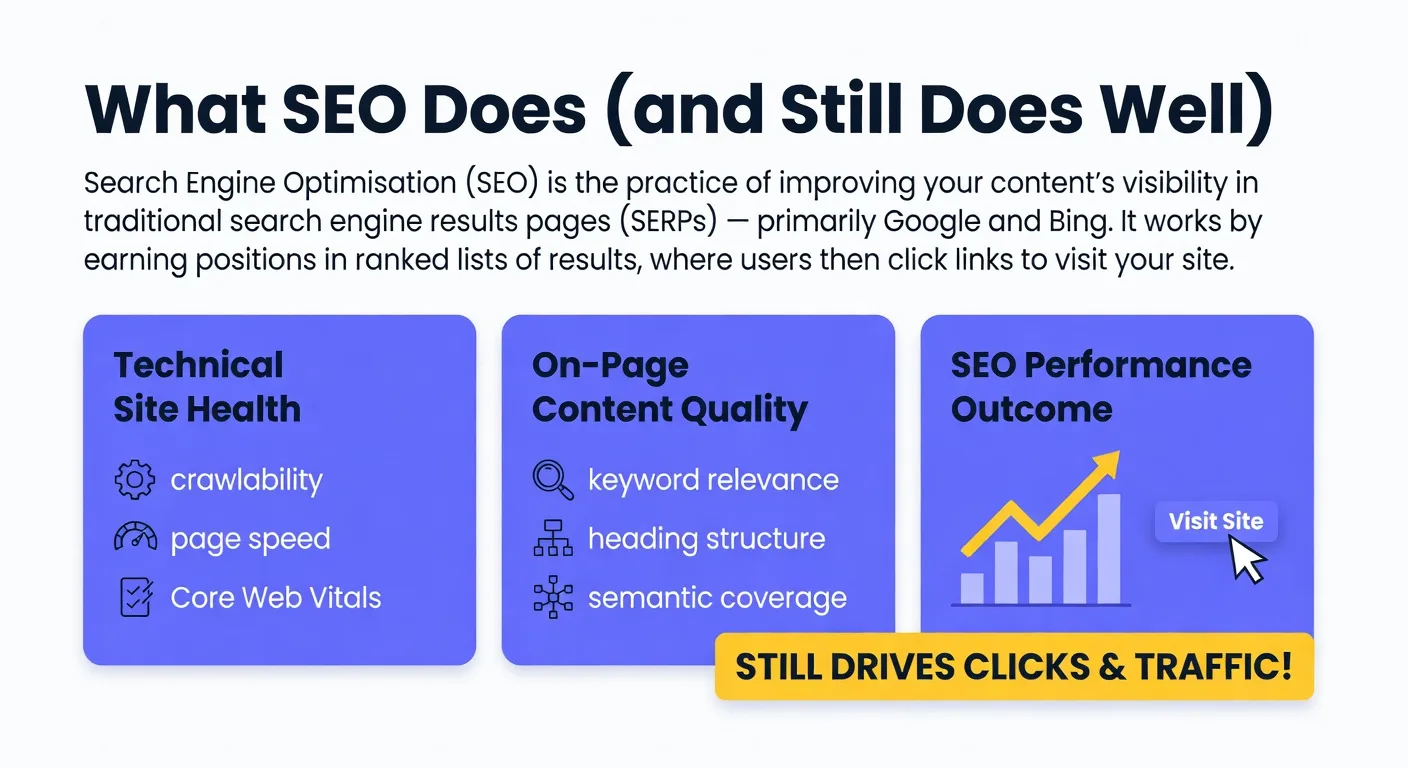
Search Engine Optimisation (SEO) is the practice of improving your content's visibility in traditional search engine results pages (SERPs) — primarily Google and Bing. It works by earning positions in ranked lists of results, where users then click links to visit your site.
SEO performance depends on three pillars: technical site health (crawlability, page speed, Core Web Vitals), on-page content quality (keyword relevance, heading structure, semantic coverage), and off-page authority (backlinks, domain reputation). When all three work together, your pages rank higher, attract more clicks, and drive measurable traffic.
SEO is not declining. Google processes over 8.5 billion queries per day. Traditional search still dominates total search volume. For most businesses, SEO-driven traffic is the primary source of organic visits and will remain so through 2026 and beyond.
The problem isn't that SEO is failing. The problem is that a parallel system — one with different rules and different rewards — is growing alongside it, and most content strategies aren't built for both.
What GEO Does (and Why It's Different)
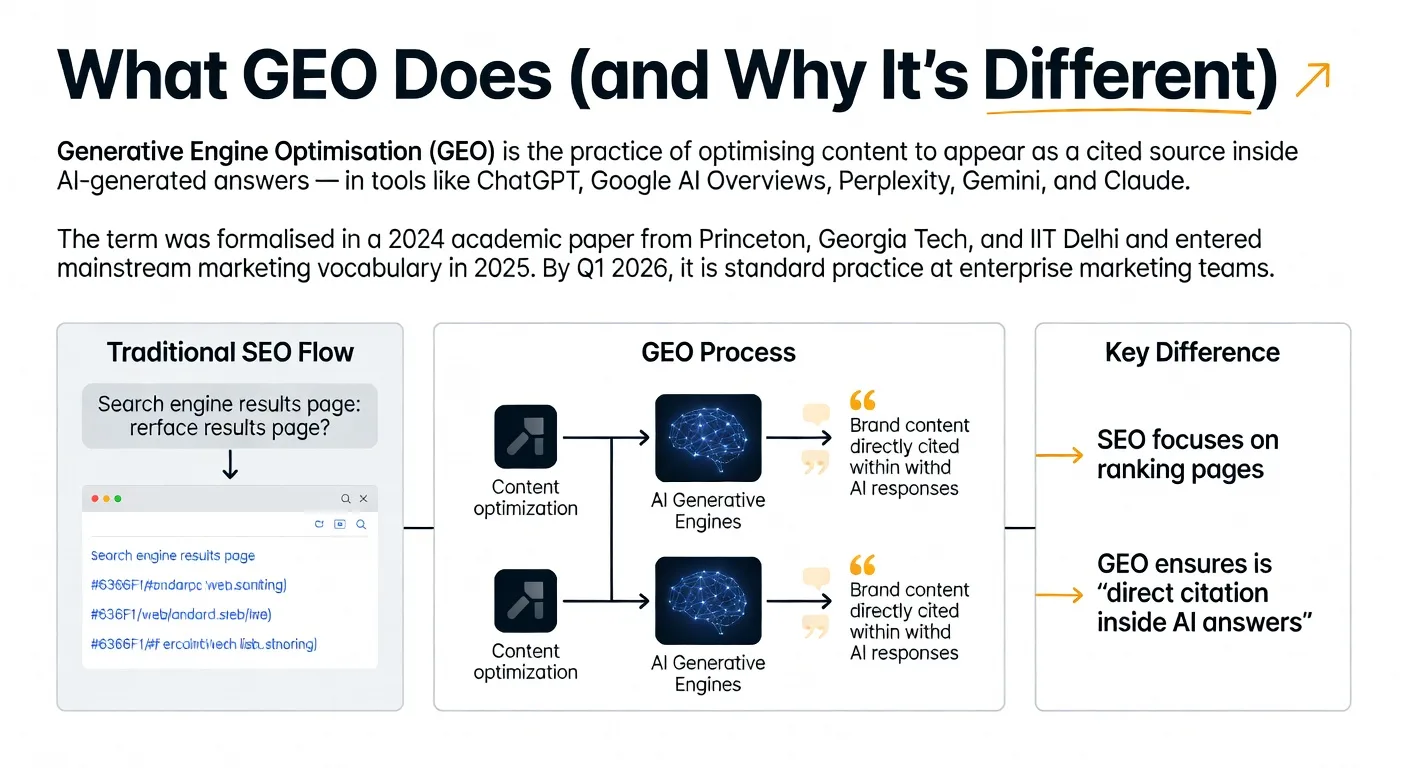
Generative Engine Optimisation (GEO) is the practice of optimising content to appear as a cited source inside AI-generated answers — in tools like ChatGPT, Google AI Overviews, Perplexity, Gemini, and Claude.
The term was formalised in a 2024 academic paper from Princeton, Georgia Tech, and IIT Delhi and entered mainstream marketing vocabulary in 2025. By Q1 2026, it is standard practice at enterprise marketing teams.
GEO works differently from SEO in three fundamental ways:
There is no ranked list. AI engines generate one synthesised answer. There is no position #1 to #10. You are either cited or you are not.
Clicks are not the primary outcome. 93% of AI search sessions end without a website visit. GEO visibility is measured by brand mention frequency, citation rate, and how accurately AI engines represent your product or service — not by clicks.
The ranking signals are different. SEO rewards backlinks and keyword relevance. GEO rewards semantic completeness, entity density, content freshness, E-E-A-T signals, and the presence of specific, verifiable data. Sites with over 32,000 referring domains are still 3.5x more likely to be cited by ChatGPT than low-authority domains — so authority matters in both systems — but GEO adds a layer of structural and data requirements that SEO alone does not address.
The 5 Core Differences Between GEO and SEO
1. What "Ranking" Means
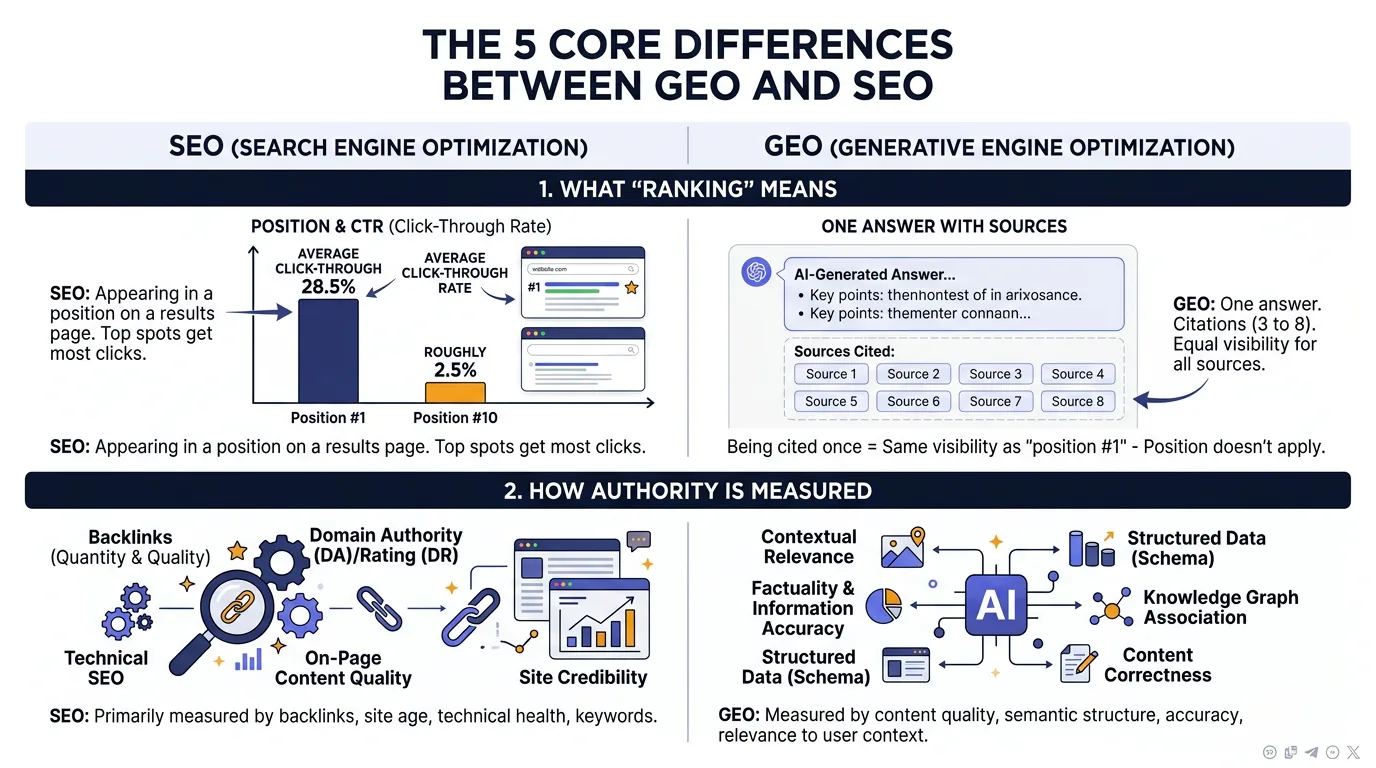
In SEO, ranking means appearing in a position on a results page. Position #1 earns a 28.5% average click-through rate. Position #10 earns roughly 2.5%.
In GEO, there is no position. The AI generates one answer and cites 3 to 8 sources. Being cited once provides the same visibility as being cited at "position #1" — the concept of ranking position does not apply.
2. How Authority Is Measured
SEO authority is primarily measured by backlinks — the quantity and quality of websites linking to your domain. Domain Authority scores (from Moz, Ahrefs, Semrush) correlate strongly with traditional organic rankings.
GEO authority is measured by multi-platform presence — brand mentions on Wikipedia, Reddit, Quora, G2, and authoritative industry publications carry more weight for AI citation probability than backlink count alone. Domains with millions of brand mentions on Quora and Reddit earn roughly 4x more ChatGPT citations than domains with minimal community presence.
3. Content Format Requirements
SEO rewards long-form content with good keyword coverage. A 2,000-word article with clear H2 sections and relevant keywords performs well in traditional search.
GEO requires that same content to also have self-contained answer blocks — passages of 134 to 167 words that fully answer a specific question without needing surrounding context. Without these extractable blocks, AI engines may retrieve the page but never cite it. Content scoring 8.5/10 or higher on semantic completeness is 4.2x more likely to appear in AI Overviews.
4. Traffic Patterns
SEO traffic is click-based. Users see your link in results, click through, and arrive on your site. Volume is measured in sessions and pageviews.
GEO traffic is intent-filtered. AI referral traffic converts at 2x the rate of traditional organic search, while requiring only one-third the sessions. Users who click through from an AI citation have already received a vetted recommendation — they arrive with higher intent and lower resistance.
5. Generation Gap in Adoption
35% of Gen Z uses AI as their first research stop, compared to 19% of millennials and 7% of Gen X (Gartner, 2025). Brands targeting younger audiences face GEO urgency now. Brands targeting older demographics have more runway — but the window is closing as AI search adoption accelerates across all age groups.
Where GEO and SEO Overlap (The Compound Effect)
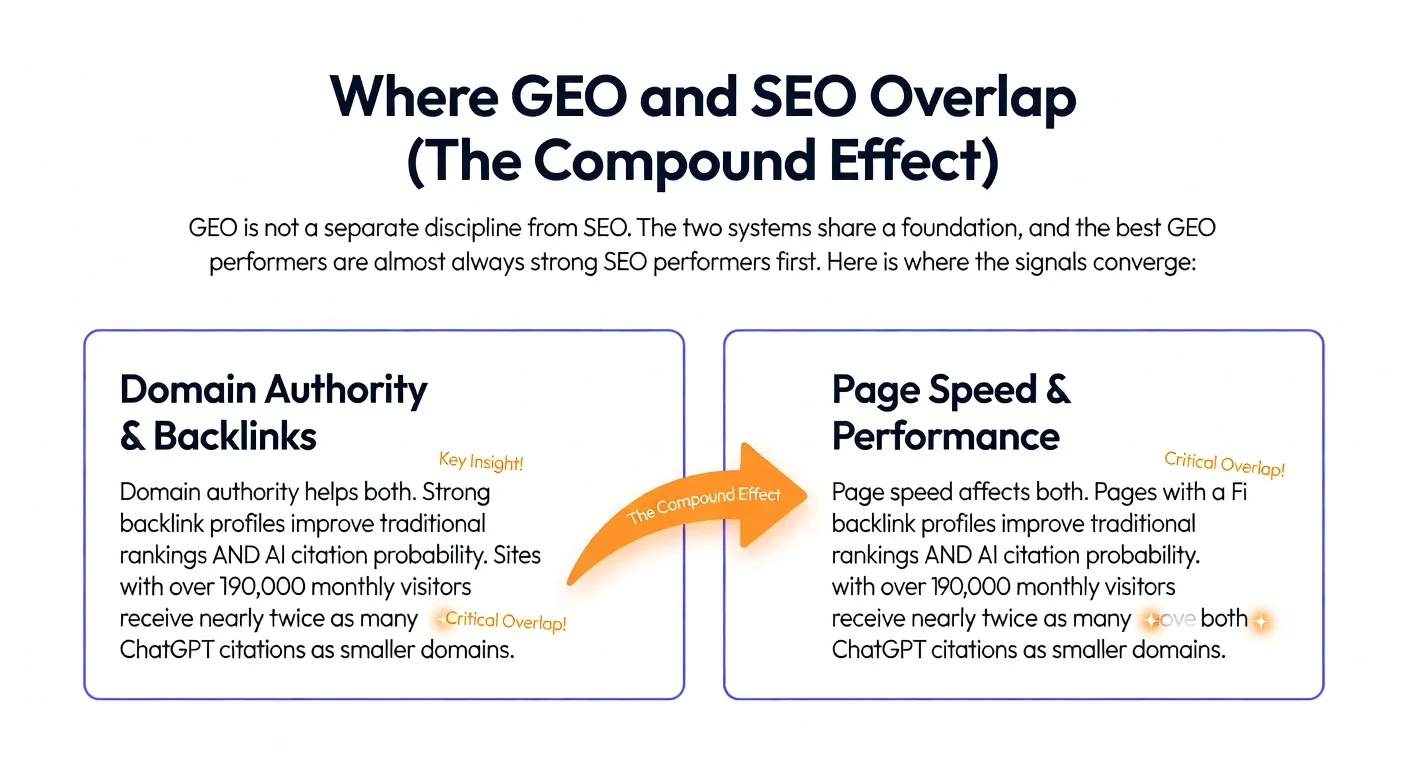
GEO is not a separate discipline from SEO. The two systems share a foundation, and the best GEO performers are almost always strong SEO performers first. Here is where the signals converge:
Domain authority helps both. Strong backlink profiles improve traditional rankings AND AI citation probability. Sites with over 190,000 monthly visitors receive nearly twice as many ChatGPT citations as smaller domains.
Page speed affects both. Pages with a First Contentful Paint under 0.4 seconds earn 6.7 ChatGPT citations on average; slow pages drop to 2.1. Core Web Vitals targets that improve Google rankings also improve Bing crawl quality — which feeds directly into ChatGPT's source pool.
E-E-A-T is universal. Experience, Expertise, Authoritativeness, and Trustworthiness signals (author bios, original research, authoritative citations) improve both Google's quality evaluation and AI engines' trust scoring. 96% of AI Overview content comes from sources with verified E-E-A-T signals.
Fresh content wins everywhere. Content updated within 30 days receives a 76.4% citation boost in ChatGPT and performs better in traditional search against newly published competitor pages. One update schedule serves both goals.
The compound effect: a page optimised for both SEO and GEO simultaneously earns traditional organic traffic, appears in AI-generated answers, and benefits from the 2x conversion rate of AI-referred visitors. Teams that run only SEO capture one stream. Teams that run both capture all three.
How to Build One Strategy That Covers Both
Start With Keyword Research That Captures Both Intent Types
Traditional SEO keyword research identifies terms by monthly search volume and keyword difficulty. GEO requires an additional layer: AI prompt volume — how often users type a query into ChatGPT or Gemini rather than Google.
Run keyword research for both Google search volume and AI prompt volume before planning content.
Use our AI Keyword Research tool to find if user's are actually searching it;
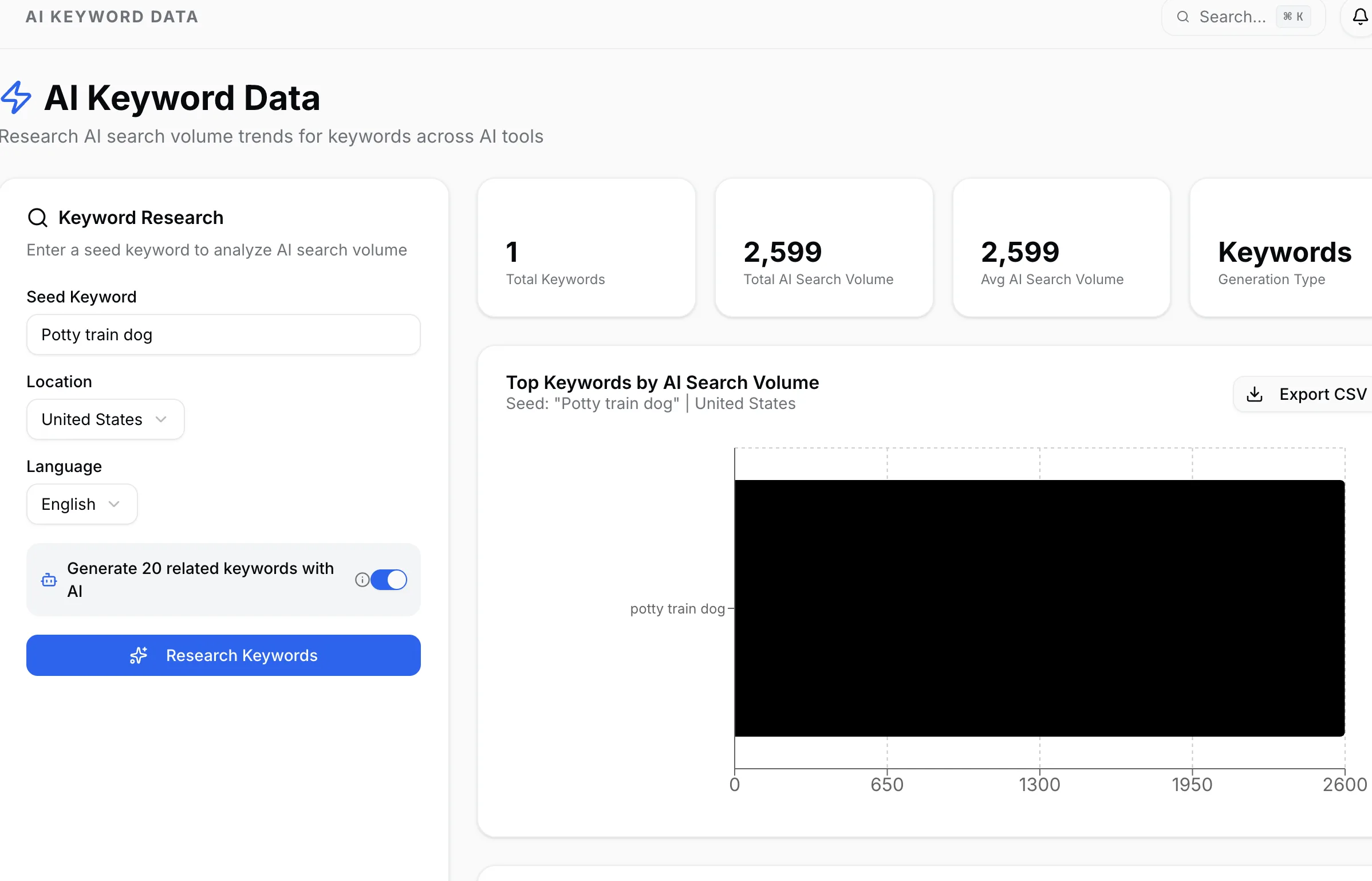
High-volume SEO keywords with growing AI prompt demand are the highest-priority targets — they earn traffic from both systems.
Write for Extractability Alongside Readability
Every article you publish should include, per H2 section: a direct answer in the opening 1–2 sentences, a supporting statistic with a linked source, and at least one named entity (tool, platform, person, concept).
This structure satisfies both Google's semantic relevance evaluation and AI engines' extractability requirements.
Do not write separately for SEO and GEO. Write once with the structure that satisfies both.
Use Schema Markup for Every Content Type
FAQPage schema, HowTo schema, and Article schema with author attribution are not just GEO signals — they improve rich result eligibility in traditional search too. Pages with appropriate schema show a 73% higher AI Overview selection rate and earn featured snippet placements in standard Google results.
Refresh Content on a Quarterly Cycle
[40 to 60% of cited sources in AI Responses rotate monthly](https://www.superlines.io/articles/the-state-of-geo-in-q1-2026). A page that earns citations in March may lose them by June if a competitor publishes fresher data. Set a quarterly update schedule for every target article — update statistics, add new examples, and republish with a new date.
Use Our Content Audit Tool which checks your content not only on Google SERPs but also on LLMs like ChatGPT, Claude, Perplexity and Gemini;
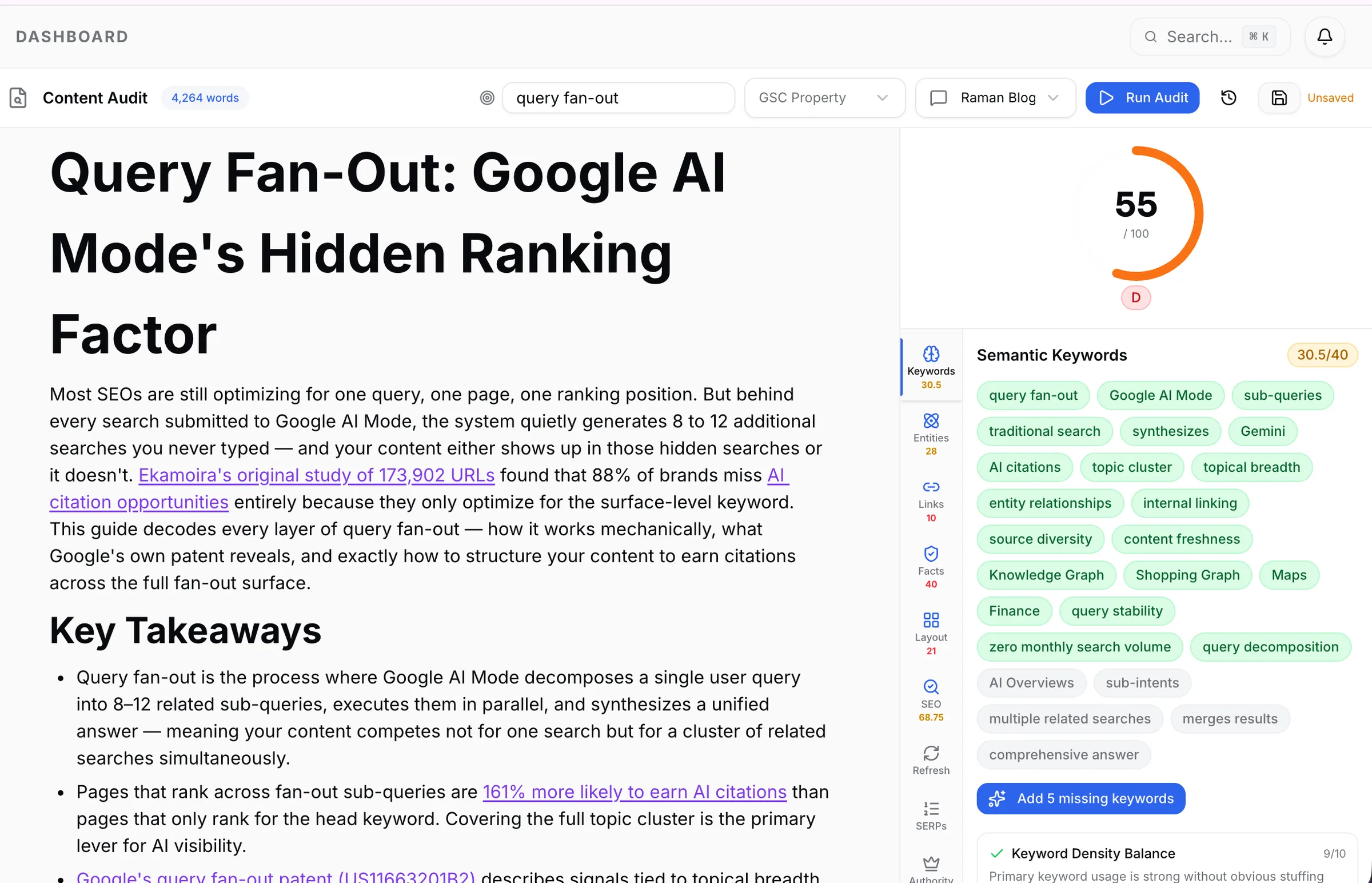
This practice also prevents content decay in traditional search, where newly published competitor content erodes your rankings over time.
Build Community Presence Alongside Owned Content
Domains with millions of brand mentions on Quora and Reddit earn roughly 4x more ChatGPT citations. This signal doesn't come from posting on those platforms — it comes from publishing content so useful that practitioners reference it in community discussions.
Publish original data. Publish benchmark studies. Publish How-to guides with specific, reproducible numbers. Community presence follows content quality; you cannot manufacture it directly.
Measure GEO and SEO Performance in One Dashboard
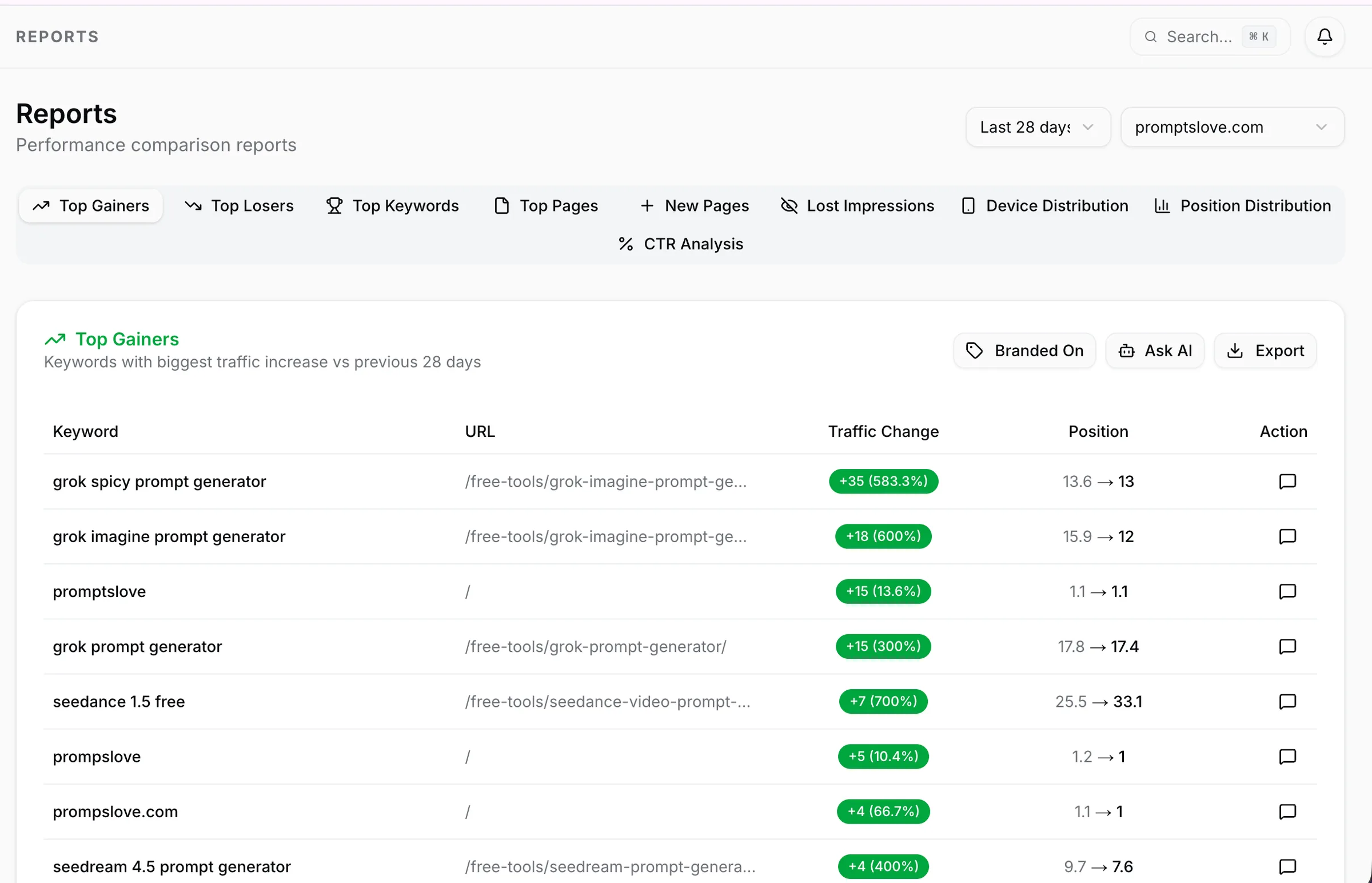
Most analytics setups track SEO performance well — organic traffic, keyword rankings, CTR from Google Search Console. GEO performance requires a separate tracking layer.
Metrics to track for GEO:
AI citation rate: what percentage of AI Overviews for your target keywords cite your domain
Brand mention frequency: how often your brand name appears in AI-generated responses, with and without citation links
Share of voice vs. competitors: who else is being cited for your target queries, and at what frequency
Rotation tracking: which of your cited pages are losing citations month-over-month and need content refreshes
26% of brands currently have zero mentions in AI Overviews for their core category queries. Knowing your current baseline is the first step to improving it.
Track Both SEO and GEO Performance with CopyrocketAI
Running two optimisation strategies without unified measurement creates blind spots. CopyrocketAI gives you four tools to track both in one place.
AI Visibility monitors how often your domain appears in Google AI Overviews and ChatGPT responses across your target keyword set, with weekly snapshots and competitor comparison so you see share of voice, not just raw citation counts.
AI Mentions tracks when your brand name appears in AI-generated answers — including unprompted mentions where AI recommends your product without a direct citation link.
AI Responses lets you run side-by-side comparisons of how ChatGPT, Claude, Gemini, and Perplexity answer the same query, revealing exactly which sources each engine cites and where your brand is mentioned or missing.
AI Keyword Data surfaces AI prompt volume alongside traditional search volume, so your keyword strategy targets the queries with demand in both systems.
Try these tools free at CopyrocketAI →
Final Thoughts
GEO and SEO are not competing strategies. They share a foundation — content quality, domain authority, technical health, E-E-A-T signals — and diverge at the layer of structure and measurement. Brands running both earn traffic from traditional search, citations from AI engines, and the conversion premium that AI-referred visitors deliver.
The practical starting point is simple: audit your existing top-performing SEO pages, add extractable answer blocks after each H2, link every statistic to its source, and set up a quarterly refresh schedule. Then add a GEO measurement layer so you can track whether those changes are moving your citation rate. Do both, measure both, and iterate on both — that is the full 2026 search strategy.
Frequently Asked Questions

Written by
Raman Singh
Raman Singh is a highly skilled marketing professional who serves as the head of marketing at Copyrocket AI. With years of experience in the field, Raman has developed a deep understanding of all asp
View all postsYour AI Marketing Agents
Are Ready to Work
Stop spending hours on copywriting. Let AI craft high-converting ads, emails, blog posts & social media content in seconds.
Start Creating for FreeNo credit card required. 50+ AI tools included.
Related Articles
 General
NotebookLM For Coders: Turn Docs Into Faster Code
Code work often fails for a simple reason. You do not have the right context at the right time. You read docs in one tab, skim tickets in another tab, and then...

 General
How to Optimize for AI Search in 2026: The Complete Guide
AI search has shifted from experimental feature to primary search method for millions of users. ChatGPT Search, Google AI Overviews, Perplexity, Claude, and Gem...
 General
Claude Opus 4.6 Review: Here's What New!
Claude Opus 4.6 from Anthropic draws attention because teams want an AI model that writes better code, follows instructions, and stays consistent across long se...