
11 Best Local SEO Tools for Agencies in 2026

Raman Singh
Raman Singh is a highly skilled marketing professional who serves as the head of marketing at Copyrocket AI

Local search keeps changing in 2026. Google Maps results shift by street, category, and search intent. AI Overviews and voice search local SEO also change how people pick a business. Agencies now need local SEO tools that track the map pack, manage Google Business Profiles, fix NAP consistency, and prove results with clear local SEO reporting.
This article lists the 11 best local SEO tools 2026 for agencies. It also explains how to choose an agency local SEO software stack based on clients, locations, and workflow needs. You will learn which tools work best for Google Business Profile management tool tasks like GBP optimization, GBP posts scheduling, and GBP Q&A management.
You will also learn which tools handle local citation management, business directory submissions, and cleanup for multi-location SEO. You will get guidance for local rank tracking, including geo-grid rank tracking, Local SERP tracking, and local keyword tracking. You will also see options for white-label local SEO, client reporting automation, and Agency Workflow Automation.
You can use this guide as a buying checklist and as a process guide for delivery.
Key Takeaways
The 11 best local SEO tools for agencies in 2026 cover GBP optimization, local listings management, reviews, rank tracking, audits, and reporting.
A strong stack uses at least four categories: GBP management, citation/NAP cleanup, local rank tracking, and white-label reporting.
Geo-grid rank tracking shows how Google Maps visibility changes by distance. It is different from classic local keyword tracking.
Review velocity and rating trends correlate with local pack performance. Agencies should treat Review management software as a core tool, not an add-on.
Copyrocket AI offers AI Visibility local SEO and voice search local SEO increase the need for clean entity data, LocalBusiness schema, and consistent listings.
BrightLocal alternatives, Whitespark alternatives, and Yext alternatives exist. The best choice depends on scale, automation, and budget.
Agencies should standardize onboarding, citation cleanup, and monthly reporting with repeatable SOPs and integrations (GA4, GSC, Looker Studio, CRM).
11 Best Local SEO Tools for Agencies in 2026 (Comparison Table)
Quarterly note: pricing and limits change often. Verify current plans on vendor pricing pages before purchase. Last review date for this table: 2026-04.
Tool | Best for | Key local features | Scale fit | Reporting | Typical onboarding time |
|---|---|---|---|---|---|
Copyrocket AI | AI Visibility, Rank Tracking, Review Monitoring | AI Visibility Checker, Rank Tracker, 10 Connections, Local Keyword researcher, Insights, Audits and more | Small to mid | PDF Downloads | Instant |
BrightLocal | All-in-one local SEO dashboard | Local rank tracking, citations, audits, review management | Small to mid agencies | White-label local SEO reports | 1–3 days |
Semrush (Listing + Local) | SEO suite + local add-ons | Local listings management, local competitor analysis, position tracking | Mid to enterprise | PDF + dashboards | 3–10 days |
Moz Local | Listings distribution | Local citation management, NAP consistency, duplicate suppression | SMB to mid | Basic reports | 1–5 days |
Yext | Enterprise listings + knowledge graph | Listings, knowledge management, store locator SEO support | Mid to enterprise | Strong dashboards | 2–6 weeks |
Whitespark | Citation building + local link building tools | Business directory submissions, citation cleanup, link prospects | Small to mid | Limited | 1–7 days |
Local Falcon | Geo-grid rank tracking | Google Maps ranking tool, map pack tracking, share of local voice | Small to enterprise | Exports + reports | 1–2 days |
Places Scout | Local SERP tracking + grids | geo grids, local competitor analysis, map pack tracking | Mid agencies | White-label options | 2–7 days |
GatherUp | Review management software | Review generation, monitoring, reputation management | Small to enterprise | Client reporting automation | 3–14 days |
Review funnels + automation | Review requests, routing, monitoring, widgets | Small to mid | White-label | 1–7 days | |
Screaming Frog SEO Spider | Technical + on-page local SEO | Audits, templates, schema checks, internal links | Any | Exports | Same day |
the table gives the quick view. The sections below explain what each tool does well, what it costs, and where it fits in an agency stack.
Copyrocket AI - Local SEO Pack
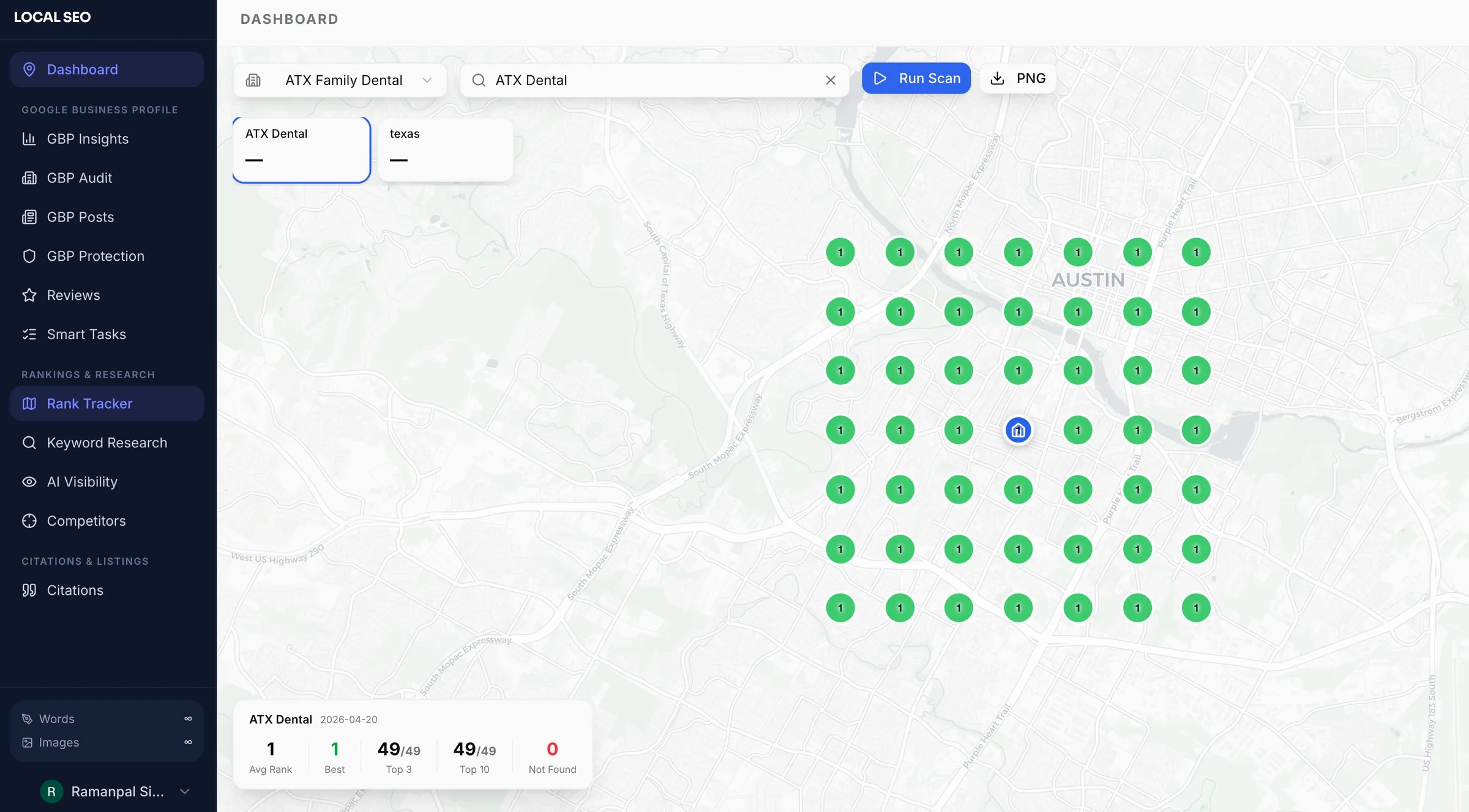
Copyrocket AI Local SEO Pack fits agencies that manage many Google Business Profiles and want faster daily execution. The tool combines GBP insights, audits, review work, and map-based rank tracking in one dashboard.
Features
Up to 10 agency connections: Copy and manage multiple client profiles from one account.
Google Business Profile detailed insights: Track ranking keywords, phone calls, website visits, and direction requests.
GBP audit with AI action steps: Check reviews, Q&A, competitiveness, and duplicates. Get clear fixes and AI tips.
Google Business Profile protection: Block or flag unwanted edits to your listing.
Review monitor with AI replies: Read reviews in the dashboard and generate reply drafts with AI.
Daily smart tasks: Get a daily list of actions that support local visibility.
Map-based Local rank tracker: See GEO grid rank tracking on a map for clear coverage gaps.
Local keyword research: Find local terms that match search intent and service areas.
AI visibility checker: Check brand mentions across ChatGPT, Claude, Gemini, and Perplexity.
Competitors watch + citation builder: Compare performance vs competitors and get 80+ citation targets in one click for local backlink building.
Pricing
Plans start at $29/month, Click here to signup now.
BrightLocal
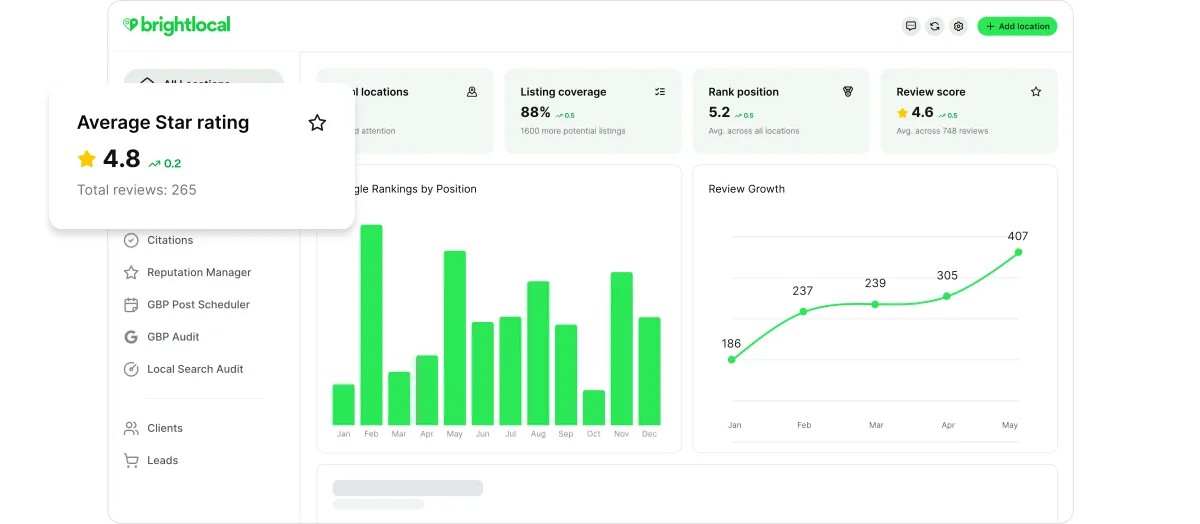
BrightLocal is a popular choice for agencies that want one local SEO dashboard for audits, rankings, citations, and reporting. Many teams also use it as a baseline when they compare BrightLocal alternatives. BrightLocal works well for multi-location SEO because it supports location groups, scheduled reports, and repeatable local SEO reporting.
BrightLocal also supports local pack optimization work because it tracks local rankings and surfaces listing issues that affect map pack visibility. It is not a full CRM, but it supports agency workflow automation through scheduled tasks and exports.
Features
Local rank tracking for organic and local results
Local SERP tracking with location settings
Local SEO audit tool for GBP, citations, and on-page local SEO checks
Local citation management via citation building services and tracking
Review monitoring and basic reputation management
White-label local SEO reports and scheduled delivery
Client reporting automation with templates and recurring schedules
Pricing
Common cost drivers include:
Number of locations
Number of keywords for local keyword tracking
Citation building volume
White-label reporting needs
Semrush (Local Add-ons)
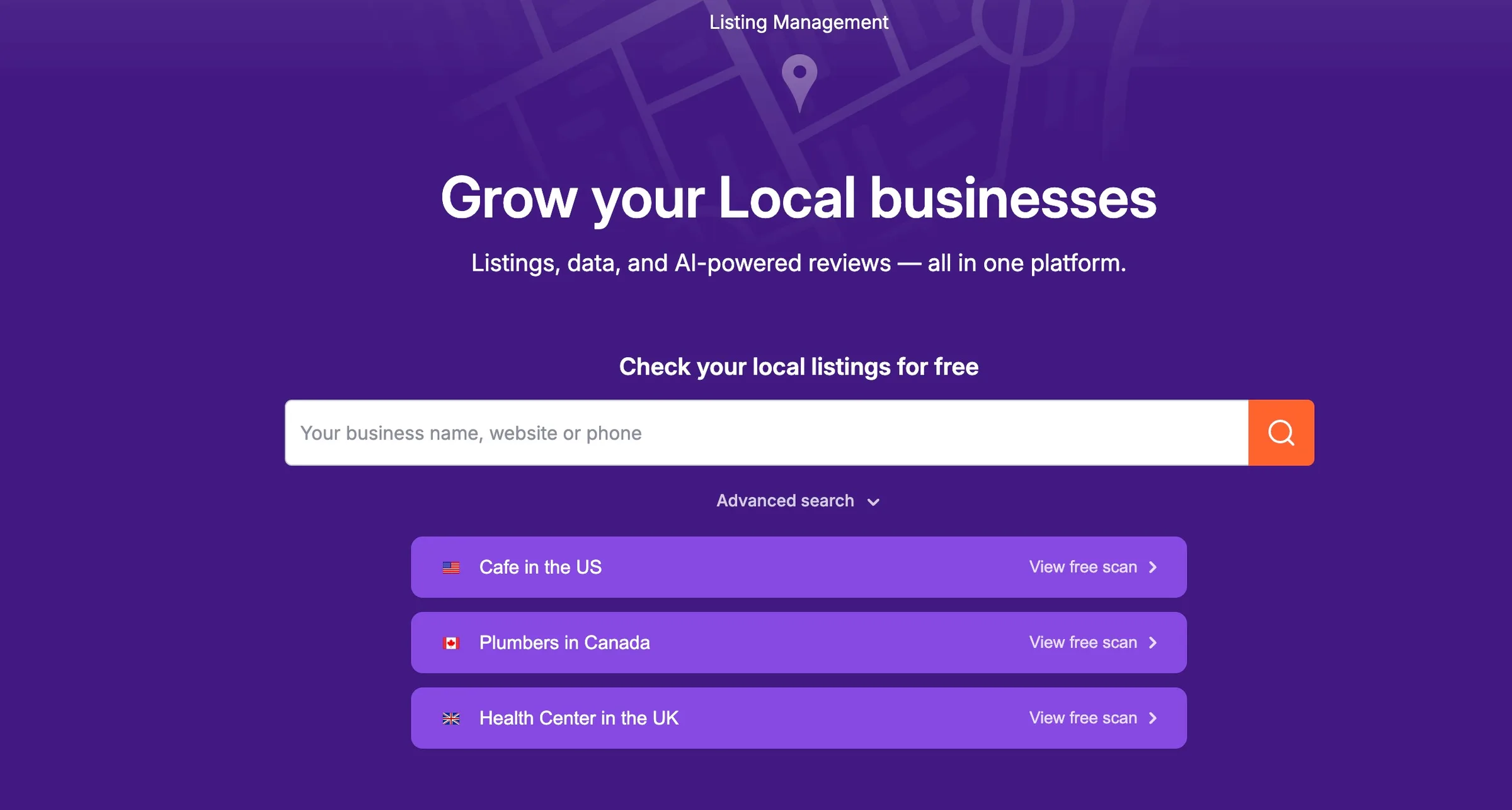
Semrush is a broad SEO platform, but it can support agency local SEO software needs when you add local features. Agencies often use Semrush for local competitor analysis, keyword research, and content planning, then pair it with a dedicated Google Maps ranking tool for geo grids.
Semrush fits agencies that want one system for SEO plus local listings management. It also helps with AI Overviews local SEO because it supports topic research and intent mapping, which can guide pages that answer local questions.
Features
Listing management add-on for local listings management and NAP consistency
Position Tracking for local keyword tracking with location settings
Local competitor analysis with domain and keyword comparisons
Site Audit for on-page local SEO and technical issues
Reporting for clients with PDF and dashboard options
Integrations and exports for Looker Studio workflows
Pricing
Local features may require add-ons
Cost drivers include:
Seats and projects
Keyword tracking volume
Listing management locations
Moz Local
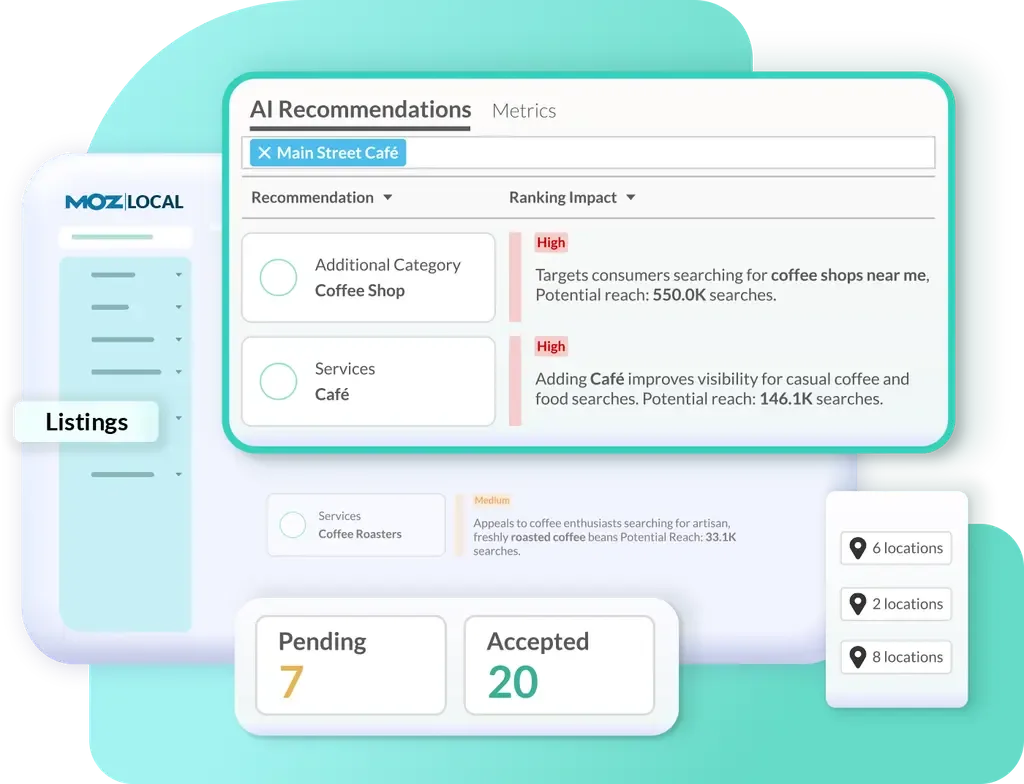
Moz Local focuses on listings distribution and NAP consistency. It is a common Yext alternative for smaller brands that want simpler listings coverage. Agencies use Moz Local when they need steady directory syncing and duplicate handling without enterprise complexity.
Moz Local works best when you pair it with a separate local rank tracking tool and a review management platform. It supports multi-location SEO, but it does not replace a full GBP optimization workflow tool.
Features
Local citation management and distribution to key data partners
NAP consistency monitoring and alerts
Duplicate listing management support (varies by market)
Location data fields for categories, hours, and attributes
Basic reporting for listing status and completeness
Pricing
Pricing is usually per location per year or per month
Cost drivers include:
Number of locations
Listing network coverage in your target country
Support level
Yext
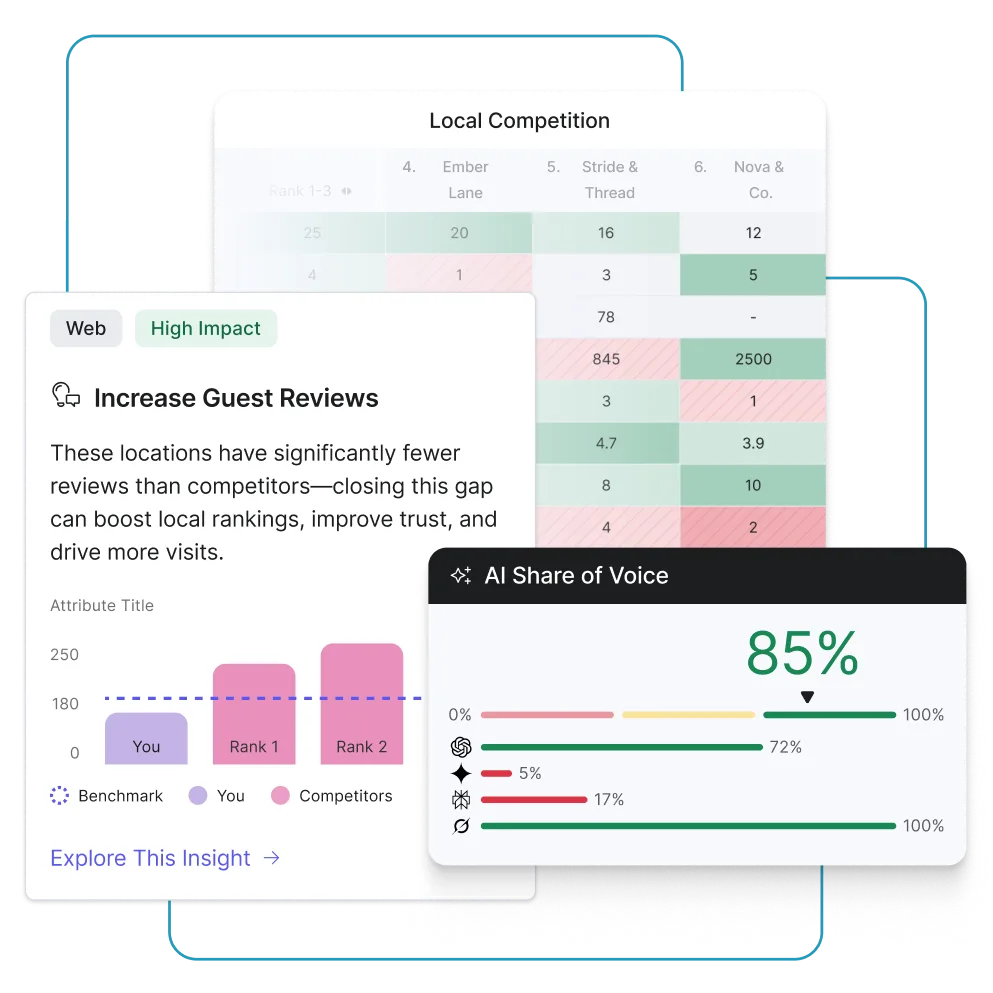
Yext is a strong choice for enterprise listings and knowledge management. It acts like a structured data hub for business facts across directories, apps, and search platforms. Agencies that serve franchises and large multi-location brands often choose Yext because it supports bulk updates, approvals, and governance.
Yext also supports store locator SEO because it can keep location data consistent across systems. Many agencies compare Yext alternatives when they want lower cost per location, but Yext remains a standard for scale and control.
Features
Local listings management across a large network
Knowledge graph for structured business data
Bulk updates and workflow approvals for multi-location SEO
API access for agency workflow automation (plan dependent)
Reporting dashboards for listing health and engagement
Support for location pages and store locator data feeds
Pricing
Cost drivers include:
Number of locations
Network coverage and add-on products
API and advanced workflow features
Whitespark
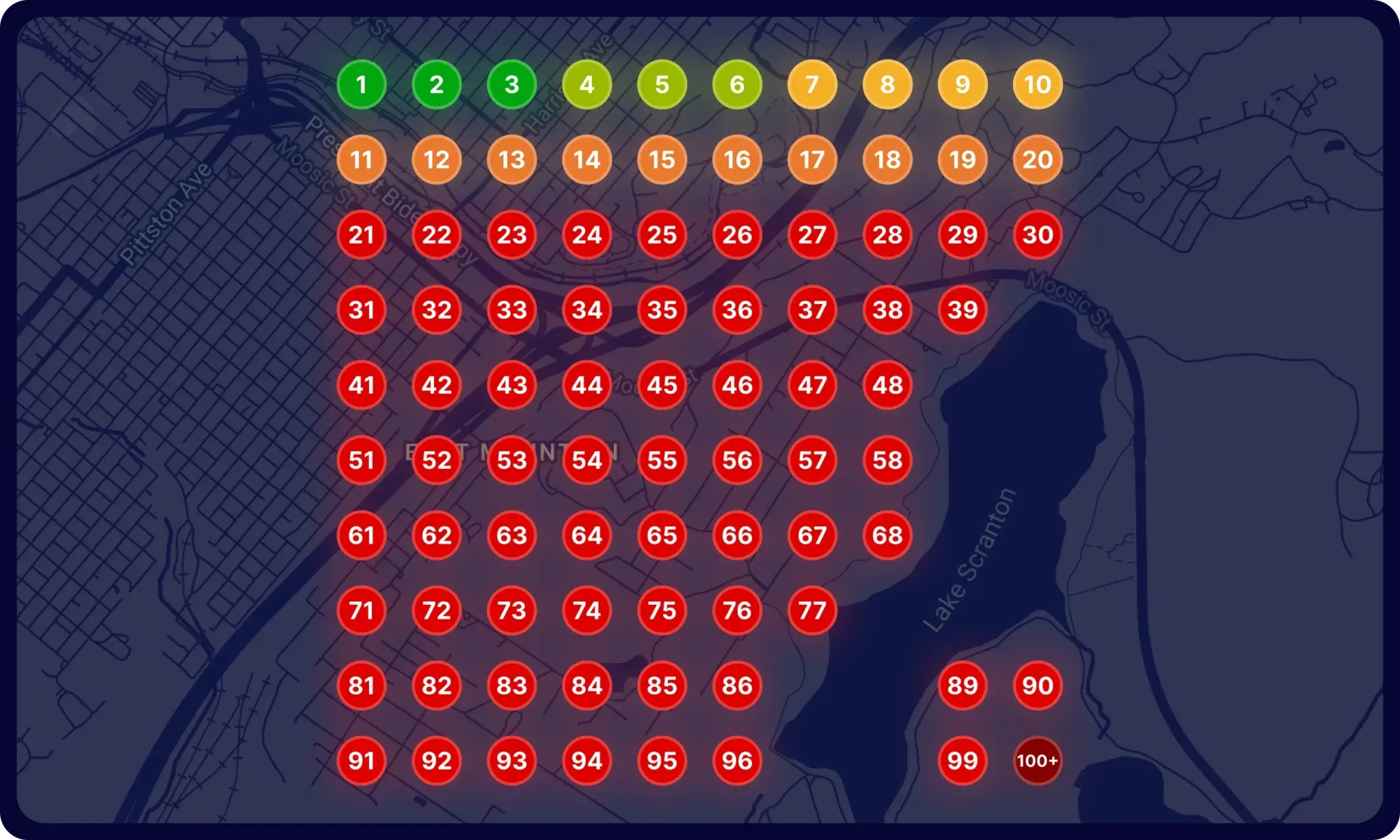
Whitespark is known for citation building and local link building tools. Agencies use it for business directory submissions, citation audits, and cleanup projects. It is also a common reference point for Whitespark alternatives, but Whitespark remains strong for hands-on citation work.
Whitespark fits agencies that sell citation cleanup as a defined service. It also supports local competitor analysis through citation gap checks, which helps you find directories where competitors appear and the client does not.
Features
Citation finder and citation building services
Citation audit and cleanup workflows
NAP consistency checks and duplicate discovery
Local link building tools for prospecting and outreach lists
Competitor citation gap analysis
Pricing
Common pricing models include:
Per-location citation building packages
Per-project cleanup
Subscription for tools plus service add-ons
Local Falcon
Local Falcon is a dedicated geo-grid rank tracking platform. It answers a key agency question: “How visible is this location across the city on Google Maps?” It shows map pack tracking and grid points that represent searchers in different places.
This matters because Google Maps rankings often change by distance and proximity. A single “rank 3” report can hide weak coverage in nearby neighborhoods. Local Falcon gives agencies a clear Google Maps ranking tool for local pack optimization work.
Features
Geo-grid rank tracking for Google Maps
Share of local voice metrics for grid coverage
Scheduled scans and alerts for rank changes
Competitor overlays for local competitor analysis
Exports for local SEO reporting and client decks
Pricing
Pricing is usually based on scan credits and features
Cost drivers include:
Grid size and scan frequency
Number of locations and keywords
White-label reporting needs (if available on plan)
Places Scout
Places Scout supports local SERP tracking with geo grids and competitive insights. Agencies use it for map pack tracking and for diagnosing ranking drops that only happen in certain areas. It can also support audits for GBP optimization by showing category and competitor patterns.
Places Scout fits agencies that want geo-grid rank tracking plus deeper competitor views. It can work as a Local Falcon alternative for teams that prefer its interface and reporting options.
Features
Geo-grid rank tracking for Maps and local pack results
Local competitor analysis with visibility comparisons
Local keyword tracking with location-based settings
Reporting exports and white-label options (plan dependent)
Historical trend views for local SERP tracking
Pricing
Cost drivers include:
Number of grid scans
Number of locations
Reporting and export features
GatherUp
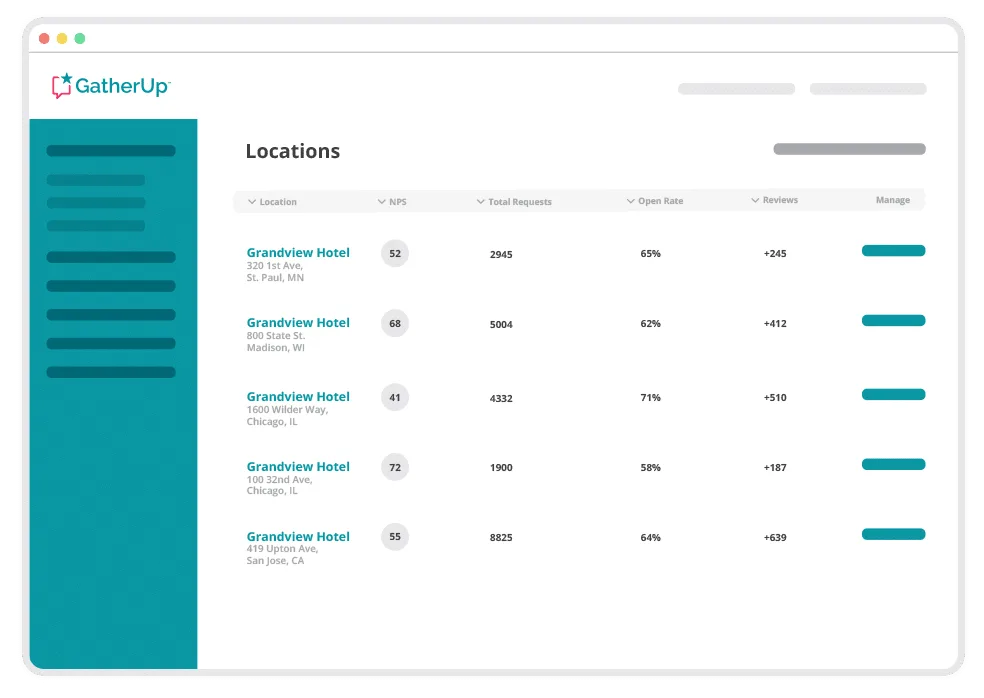
GatherUp is a review management software platform that supports review generation, monitoring, and response workflows. Agencies use it for reputation management because reviews influence both conversions and local pack performance.
Evidence on reviews and local rankings: the Whitespark Local Search Ranking Factors surveys consistently list review signals as meaningful for local pack and Maps visibility. Review signals include quantity, velocity, diversity, and sentiment. Agencies should treat review velocity as an ongoing KPI, not a one-time push. Source: Whitespark Local Search Ranking Factors (latest editions through 2023 and ongoing updates). Also see Google’s own guidance that “high-quality, positive reviews” improve business visibility. Source: Google Business Profile Help documentation.
Features
Review request campaigns via SMS and email
Review monitoring across major platforms
Response workflows and routing for teams
Reputation management dashboards and alerts
Widgets for showcasing reviews on location pages
Client reporting automation for review KPIs
Pricing
Cost drivers include:
Number of locations
Messaging volume
Advanced workflows and integrations
Grade.us
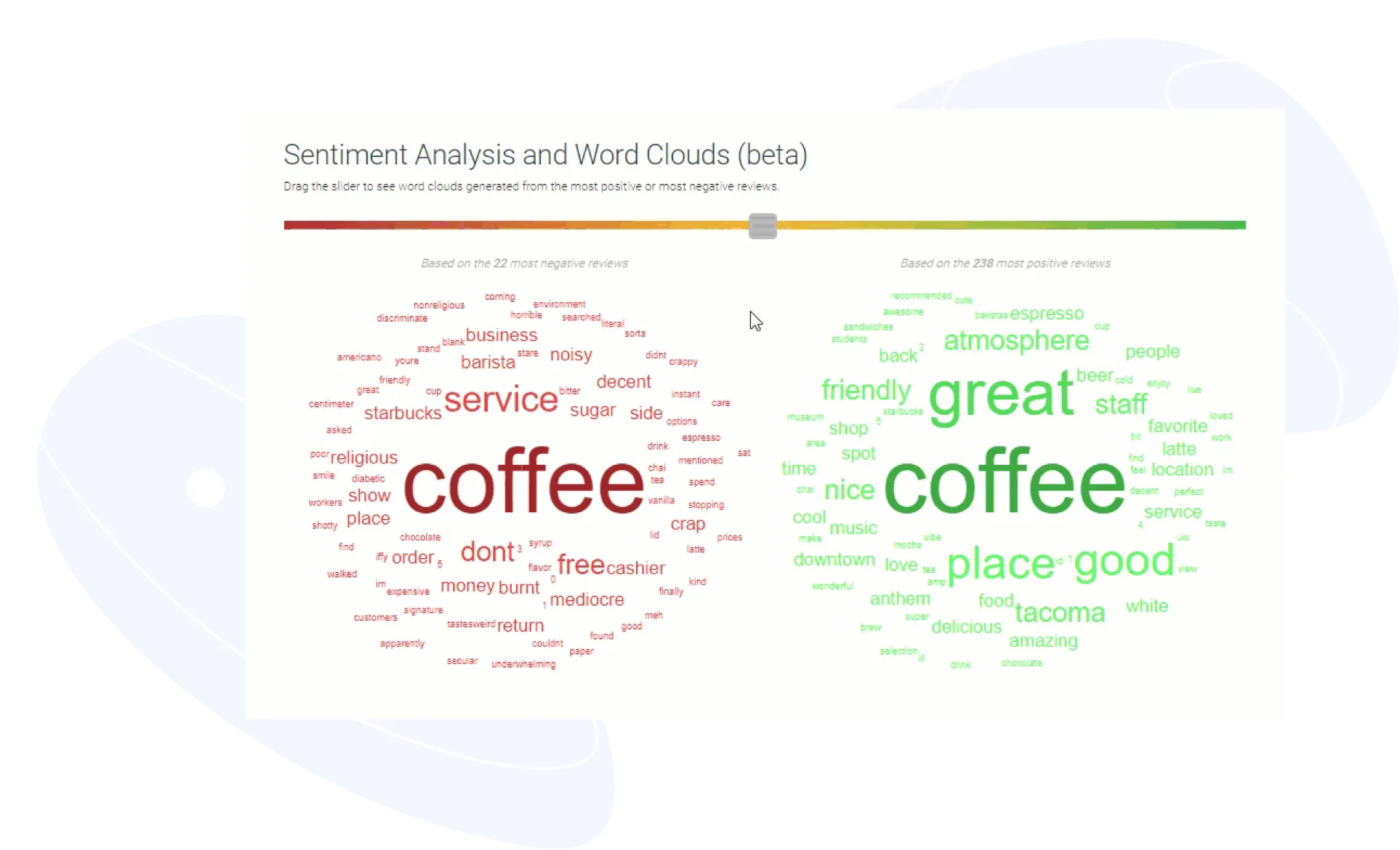
Grade.us focuses on review funnels and automation. Agencies use it when they want fast setup, white-label options, and clear review request flows for each location. It supports reputation management by routing unhappy customers to private feedback and guiding happy customers to public review sites.
Grade.us works well for agencies that sell review generation as a monthly add-on. It pairs well with a GBP optimization tool and a local SEO reporting stack.
Features
Review request funnels and landing pages
Automated follow-ups and reminders
Monitoring for new reviews across platforms
White-label local SEO options for agency branding
Embeds and widgets for websites and store locator SEO pages
Pricing
Pricing varies by plan and number of locations
Cost drivers include:
White-label features
Location count
Automation and integrations
Screaming Frog SEO Spider
Screaming Frog is not a local-only tool, but agencies use it as a core local SEO audit tool for technical and on-page local SEO work. It helps you find broken internal links, missing titles, thin location pages, and indexation issues that block local growth.
It also supports local schema markup checks. You can crawl location pages and validate that LocalBusiness schema appears on the right URLs, with correct NAP fields and geo coordinates when needed.
Features
Crawl-based audits for on-page local SEO
Bulk extraction for NAP consistency checks across location pages
Schema extraction to verify LocalBusiness schema presence
Redirect and canonical audits for multi-location SEO sites
Integrations with GA and GSC (setup dependent)
Pricing
Free version with crawl limits
Paid license for higher crawl limits and advanced features
Cost drivers include:
Number of users
Need for automation via scheduled crawls (requires setup)
How to Choose a Local SEO Tool Stack for an Agency (Decision Matrix)
Agencies get better results when they buy tools by workflow, not by brand. Use this matrix to match agency size and client needs to minimum features.
Decision matrix by agency size and delivery needs
Agency profile | Minimum tool categories | Minimum features to require | Common mistakes to avoid |
|---|---|---|---|
1–10 clients, mostly single-location | GBP + rank tracking + reviews + reporting | GBP posts scheduling, basic local rank tracking, review requests, white-label local SEO reports | Buying enterprise listings tools too early |
10–50 clients, mixed single and multi-location | GBP at scale + citations + geo grids + reporting | Bulk actions, NAP consistency checks, geo-grid rank tracking, client reporting automation | Tracking only organic ranks and ignoring Maps |
50+ clients or franchise brands | Listings network + GBP workflows + API + dashboards | Multi-user roles, approvals, API, location groups, store locator SEO support | Manual reporting and manual listing edits |
Criteria that matter most in 2026
Google Business Profile management tool depth
Require GBP optimization support for categories, services, attributes, and photos
Require GBP posts scheduling and GBP Q&A management if you sell ongoing GBP work
Tracking accuracy
Require separate tracking for organic, local pack, and Maps
Require geo-grid rank tracking for competitive metros
Citation and NAP cleanup
Require local citation management that supports suppression and duplicates
Require proof of submissions and change logs for client trust
Reporting
Require white-label local SEO reports and a local SEO dashboard
Require scheduled delivery and client reporting automation
Integrations
Require exports or connectors for GA4, GSC, Looker Studio, and your CRM
after you pick tools, you need clear measurement rules. Local SEO tracking fails when agencies mix Maps, local pack, and organic into one number.
Local Rank Tracking in 2026: Maps vs Local Pack vs Organic
Local rank tracking has three main views. Each view answers a different client question.
What is the difference between Maps, local pack, and organic tracking?
Google Maps tracking measures visibility inside Maps results. It reflects proximity and map intent.
Local pack tracking measures the 3-pack inside Google Search. It can differ from Maps because Search blends more signals and layouts.
Organic tracking measures classic blue-link rankings. It reflects page relevance, links, and on-page local SEO.
What is geo-grid rank tracking and which tools support it?
Geo-grid rank tracking runs the same keyword search from many points on a map grid. It shows how rankings change by distance and neighborhood. It helps agencies explain why a business ranks well near the store but poorly across town.
Tools in this list that support geo grids:
Local Falcon
Places Scout
Method note: grid tools simulate searches from coordinates. Results can still vary by device type, personalization, and time. Agencies should run scans on a fixed schedule and compare trends, not single scans.
Tracking shows the problem. The next step is fixing entity data and listings so Google trusts the business.
Citations, NAP Consistency, and Listings: What Works for Multi-Location SEO
Citations still matter in 2026 because they support entity confidence. They also reduce customer friction. Wrong hours and wrong addresses create bad visits and bad reviews.
Which tool is best for citation building and NAP cleanup for multi-location brands?
For many agencies, the best approach is a split model:
Use Yext for large brands that need fast bulk updates, approvals, and governance.
Use Moz Local for simpler distribution needs and steady syncing.
Use Whitespark for hands-on citation cleanup, niche directories, and citation gap work.
A practical rule:
If the client has 100+ locations and frequent data changes, start with Yext.
If the client has 1–50 locations and stable data, start with Moz Local plus Whitespark cleanup.
Listings and citations support trust. Reviews drive both trust and clicks. Agencies should treat reviews as a production line.
Reviews and Reputation Management: Systems That Agencies Can Run
Reviews affect conversions in every local niche. Reviews also correlate with local pack performance. Google states that more positive reviews can improve visibility. Source: Google Business Profile Help.
Agencies should track:
Review count by location
Review velocity per month
Average rating and rating trend
Response rate and response time
Which tools handle review generation and reputation management?
GatherUp works well for multi-location review workflows and reporting.
Grade.us works well for fast setup, white-label delivery, and review funnels.
A simple agency rule:
If you need deeper workflows and analytics, pick GatherUp.
If you need fast deployment and strong white-label, pick Grade.us.
After you fix listings and reviews, clients ask for proof. Reporting needs to be clear and repeatable.
White-Label Reporting, Dashboards, and Agency Workflow Automation
Agencies lose time when they build reports by hand. They also lose trust when reports mix metrics that do not match user behavior.
Which local SEO tools offer white-label reporting for agencies?
From this list, common white-label local SEO and reporting options include:
BrightLocal (strong white-label local SEO reports)
Grade.us (white-label review reporting)
Places Scout (white-label options on some plans)
Semrush also supports client reporting automation through report builders and exports, but it is not local-only.
Common integrations that reduce labor
GA4 for conversion events on location pages and store locator SEO flows
GSC for queries that trigger location pages
Looker Studio for blended dashboards across tools
CRM integration for review request triggers and lead tracking
A reporting rule that clients understand:
Report Maps visibility (geo grids) separately from organic traffic and leads.
Report GBP actions separately from website conversions.
The tool list and strategy only work if the agency uses a repeatable process. The next section gives SOPs you can copy.
Practical Tips and Examples (Agency SOPs)
Workflow 1: New client onboarding checklist (first 14 days)
Confirm NAP source of truth in writing (legal name, address format, phone, suite rules).
Audit GBP:
Primary category and secondary categories
Services and products
Attributes, hours, holiday hours
Photos and cover image
GBP Q&A management plan
Run a local SEO audit tool crawl:
Location page indexation
Title tags and H1 patterns
Internal links to location pages
Local schema markup and LocalBusiness schema checks
Baseline tracking:
Local keyword tracking for core terms
Geo-grid rank tracking for 3–5 money terms
Local competitor analysis list for top 5 competitors
Review system setup:
Choose GatherUp or Grade.us
Build a review request template and follow-up schedule
Reporting setup:
Create a white-label local SEO report template
Set monthly delivery and client reporting automation
Workflow 2: Citation cleanup SOP (single location or small chain)
Run a citation audit (BrightLocal or Whitespark).
Fix duplicates and wrong addresses first.
Submit core business directory submissions next.
Track NAP consistency weekly for 30 days.
Re-scan rankings after cleanup using local SERP tracking.
Workflow 3: Monthly local SEO reporting SOP (30–45 minutes per client)
Pull geo-grid rank tracking trend for 1–3 keywords.
Pull local pack tracking and organic tracking separately.
Pull GBP insights and actions if available.
Pull review velocity, rating trend, and response rate.
List 3 actions completed and 3 actions planned.
Add one local competitor analysis note if a competitor gained visibility.
Final thoughts
Agencies win local SEO with a clear stack and a repeatable process. Use one system for listings and NAP consistency, one system for reviews and reputation management, and one system for geo-grid rank tracking. Then connect everything with white-label local SEO reporting and client reporting automation. This approach improves delivery speed, improves measurement, and makes results easier to explain.
Frequently Asked Questions

Written by
Raman Singh
Raman Singh is a highly skilled marketing professional who serves as the head of marketing at Copyrocket AI. With years of experience in the field, Raman has developed a deep understanding of all asp
View all postsYour AI Marketing Agents
Are Ready to Work
Stop spending hours on copywriting. Let AI craft high-converting ads, emails, blog posts & social media content in seconds.
Start Creating for FreeNo credit card required. 50+ AI tools included.
Related Articles
 General
NotebookLM For Coders: Turn Docs Into Faster Code
Code work often fails for a simple reason. You do not have the right context at the right time. You read docs in one tab, skim tickets in another tab, and then...

 General
How to Optimize for AI Search in 2026: The Complete Guide
AI search has shifted from experimental feature to primary search method for millions of users. ChatGPT Search, Google AI Overviews, Perplexity, Claude, and Gem...
 General
Claude Opus 4.6 Review: Here's What New!
Claude Opus 4.6 from Anthropic draws attention because teams want an AI model that writes better code, follows instructions, and stays consistent across long se...