
How to Optimize for Google AI Overviews: A Technical Guide to Getting Cited

Raman Singh
Raman Singh is a highly skilled marketing professional who serves as the head of marketing at Copyrocket AI

Google AI Overviews now appear on approximately 31% of all search result pages — and when they do, organic CTR drops by 61%. Brands cited inside those overviews earn 35% more organic clicks and 91% more paid clicks. Brands not cited lose traffic quietly, with no warning in their analytics.
This guide covers the seven ranking factors that drive AI Overview citations, the structural tactics that move you into the cited pool, and the monitoring system that tells you whether it's working.
Key Takeaways
Google AI Overviews now trigger on 31% of all queries — up from 10,000 keywords in August 2024 to 172,855 by May 2025.
Organic CTR falls 61% on pages where AI Overviews appear. Cited brands earn 35% more organic clicks and 91% more paid clicks; non-cited brands absorb the full loss.
47% of AI Overview citations come from pages ranking below position #5 — your Google rank alone won't get you in.
Domain authority correlation dropped to r=0.18 (from r=0.43 pre-2024). Structural and entity signals now matter more than link counts.
Semantic completeness is the single strongest ranking factor at r=0.87 correlation — content that answers a query in a self-contained 134–167 word passage is 4.2x more likely to appear.
Google Search Console shows AI Overview impressions but doesn't separate them from standard results — you need a secondary tracking layer to measure citation performance.
Why AI Overviews Changed the SEO Game
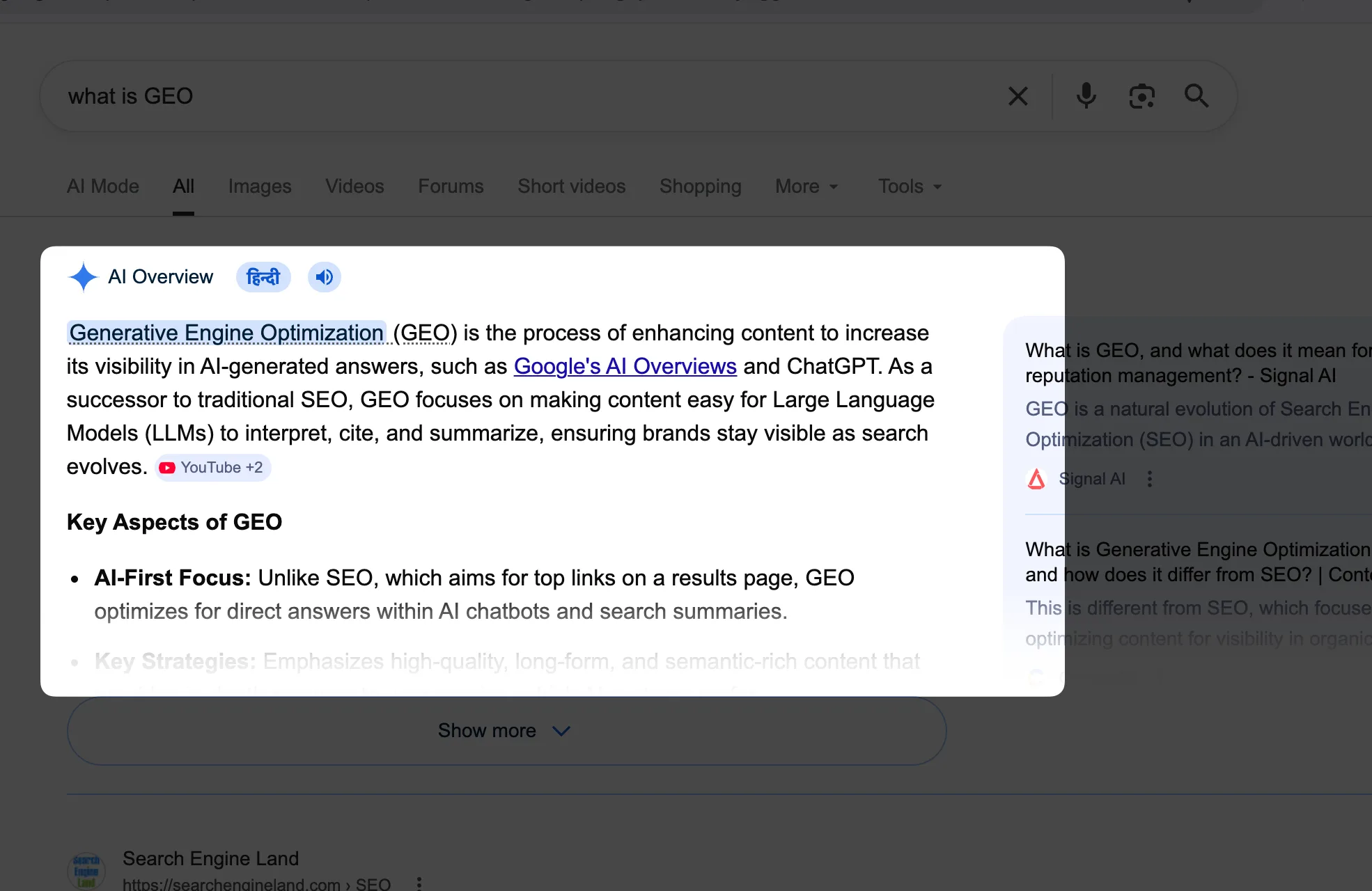
Before AI Overviews, ranking on Google meant appearing in a list. Users clicked links. Traffic moved. The equation was predictable.
AI Overviews broke that equation. Google now synthesizes an answer from multiple sources at the top of the page, and users get what they need without clicking anything. Zero-click rates for AI Overview queries sit between 80 and 83% — four out of five users never visit a source page.
The only path to traffic recovery is being one of the 6 to 8 sources cited in the overview itself. Cited brands earn traffic. Non-cited brands don't, regardless of their organic rank.
The second disruption is deeper: AI Overviews use fundamentally different ranking logic than traditional search.
Domain authority correlation dropped to r=0.18 — its lowest ever. Structural quality, semantic completeness, and entity density now predict citation probability more accurately than link counts do.
The 7 Ranking Factors That Drive AI Overview Citations
1. Semantic Completeness (r=0.87 Correlation)
Semantic completeness is the strongest predictor of AI Overview inclusion, with an r=0.87 correlation. Content scoring 8.5/10 or higher on semantic completeness is 4.2x more likely to appear.
The practical definition: a complete answer to the query exists within a single, standalone passage on your page. Google calls this the "Island Test" — can the passage stand alone and still fully answer the question, without requiring context from surrounding text?
Target passage length: 134 to 167 words per key answer block. Structure each block using inverted pyramid order: answer first, supporting details second, background context last. Avoid pronouns that reference earlier sections. Each answer block should work as an extractable unit.
2. Multi-Modal Content Integration (r=0.92 Correlation)
Multi-modal content shows the highest correlation of all seven factors at r=0.92. Text-only pages have an 8.3% selection rate. Pages with text plus images jump to 21.2% — a 156% gain. Add video and the selection rate reaches 28.1%. Full multi-modal content with schema markup hits 34.6%.
The reasoning: AI Overviews generate summaries that include visual context. Pages with images, diagrams, and annotated screenshots provide richer extraction material than text-only pages.
Add at least one original image per major section. Use descriptive alt text that names the concept explicitly. Charts showing original data perform especially well because they give AI a visual fact to reference.
3. Real-Time Factual Verification (r=0.89)
Google tiers its trust signals: Tier 1 sources (peer-reviewed journals, government .gov domains, original research) carry the most weight. Tier 2 (established tech and business publications) comes next. Tier 3 (recognized specialists with verifiable credentials) rounds out the hierarchy.
For every major claim in your article, name a source. "Studies show" carries no weight. "According to a 2025 SE Ranking study of 7,000 queries..." carries significant weight. Specificity is what triggers trust.
4. E-E-A-T Authority Signals (r=0.81)
96% of AI Overview content comes from sources with verified E-E-A-T signals. Content without clear expertise, experience, authoritativeness, and trustworthiness signals gets filtered before the model even evaluates structure or length.
The highest-ROI E-E-A-T implementations: author bios with named credentials (+78–89% visibility), security certificates and clean site infrastructure (+78%), and original research with transparent methodology (+89–132%). Cross-platform presence — brand mentions on third-party publications, review platforms, and community sites — adds another layer.
Author bio pages matter more than most SEO teams realize. If your content doesn't have a named author with a credential-bearing bio page, fix that before adjusting any other structural element.
5. Entity Knowledge Graph Density (r=0.76)
Pages with 0–5 named entities per 1,000 words have a 6.2% AI Overview selection rate. Pages with 15–20 entities hit 29.8% — a 381% improvement. The sweet spot is 15 to 20 well-connected entities per 1,000 words.
Entities in this context mean named people, tools, platforms, companies, concepts, and locations that connect your topic to Google's Knowledge Graph.
For an article about AI Overviews, entities include: Google AI Overviews, Search Generative Experience, E-E-A-T, Google Search Console, Core Web Vitals, structured data, schema markup, and specific tool names.
Name entities fully on first mention. Link to authoritative sources for the most significant entities (Google's official documentation, Wikipedia). Include entities in H2 and H3 headings where they fit naturally.
6. Optimal Passage Length and Structure
Target 134 to 167 words per answer block. Content answering a query in under 40 words is too thin. Content exceeding 300 words per block is too diffuse for extraction.
H2 and H3 headings should mirror the phrasing of search queries. "How does Google AI Overviews select sources?" performs better than "Selection Criteria."
7. Structured Data and Schema Markup (73% Boost)
The highest-impact schema types for AI Overviews: FAQPage (directly maps Q&A pairs), HowTo (steps-based content), Article with author attribution, and Speakable (marks passages as voice-extract-ready).
Schema tells Google's AI precisely what each content block means — answer, step, FAQ response, or expert quote. Without it, the model has to infer structure. With it, extraction becomes mechanical and reliable.
5 Content Structure Tactics That Move You Into the Cited Pool
Front-Load Every Section With a Direct Answer
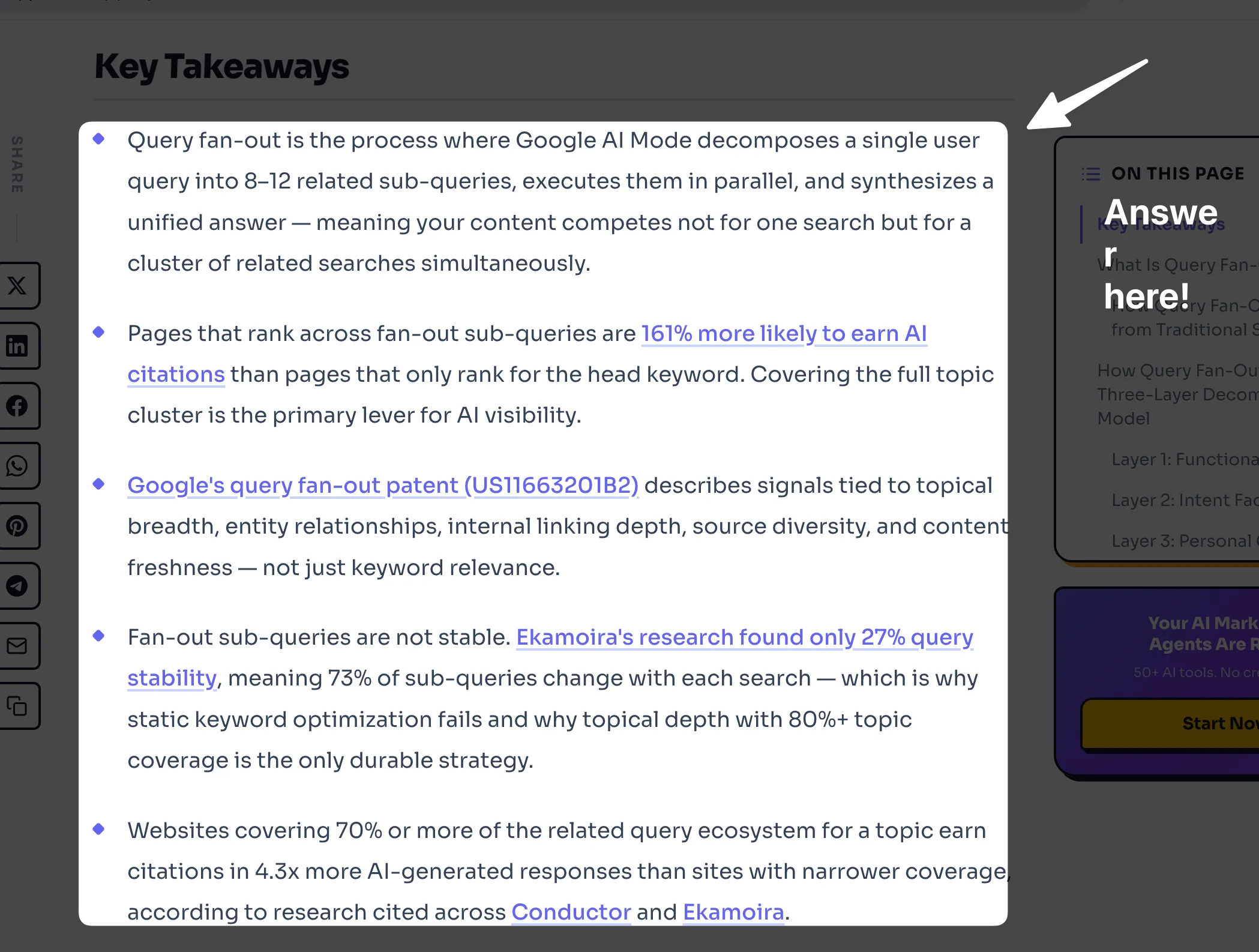
Open every H2 section with 1–2 sentences that answer the heading directly. Do not begin with context, background, or qualifications. Answer first.
This matches the inverted pyramid structure that AI extraction algorithms favor. The first 40–60 words of each section are disproportionately likely to be pulled into an AI Overview. Write those words as if they're the entire answer — because for many users, they will be.
Use FAQ Sections With Real Questions
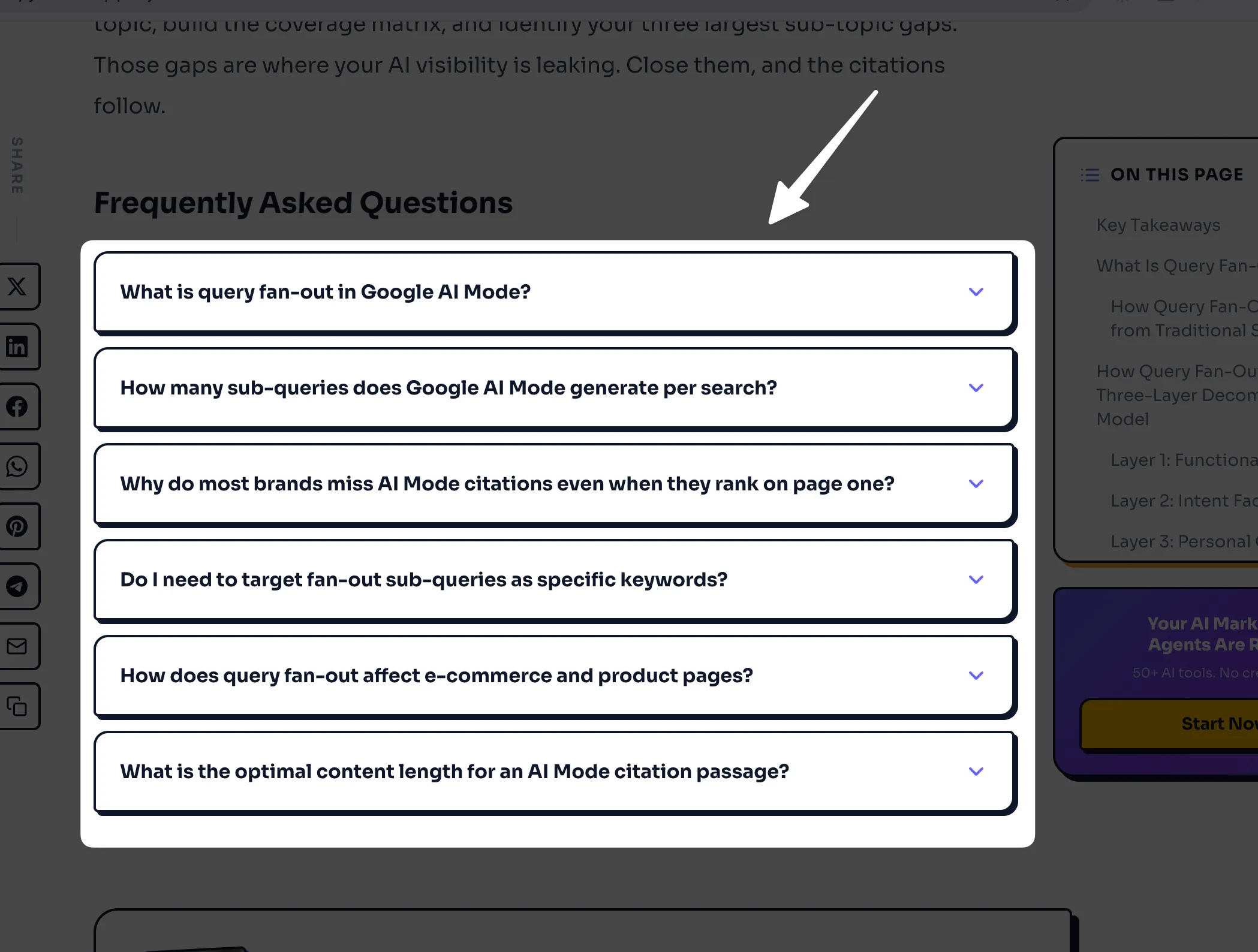
Embed 4 to 6 FAQs using question-based H3 headings. Source these from Google's "People Also Ask" boxes, not from invented questions. Real queries from PAA boxes match the exact phrasing users type — and the phrasing the AI model uses to decide which content answers a query.
Apply FAQPage schema to the entire FAQ section. This creates explicit Q&A pairs that the model can extract and cite as discrete units.
Keep Content Fresh
23% of featured AI Overview content is less than 30 days old. AI Overviews have a measurable freshness bias — especially for fast-moving topics like AI itself. Set a quarterly update schedule for every article you want to maintain AI Overview presence on.
When you update a page, change the publish date and add at least one new data point or statistic. A meaningful update, not a cosmetic one.
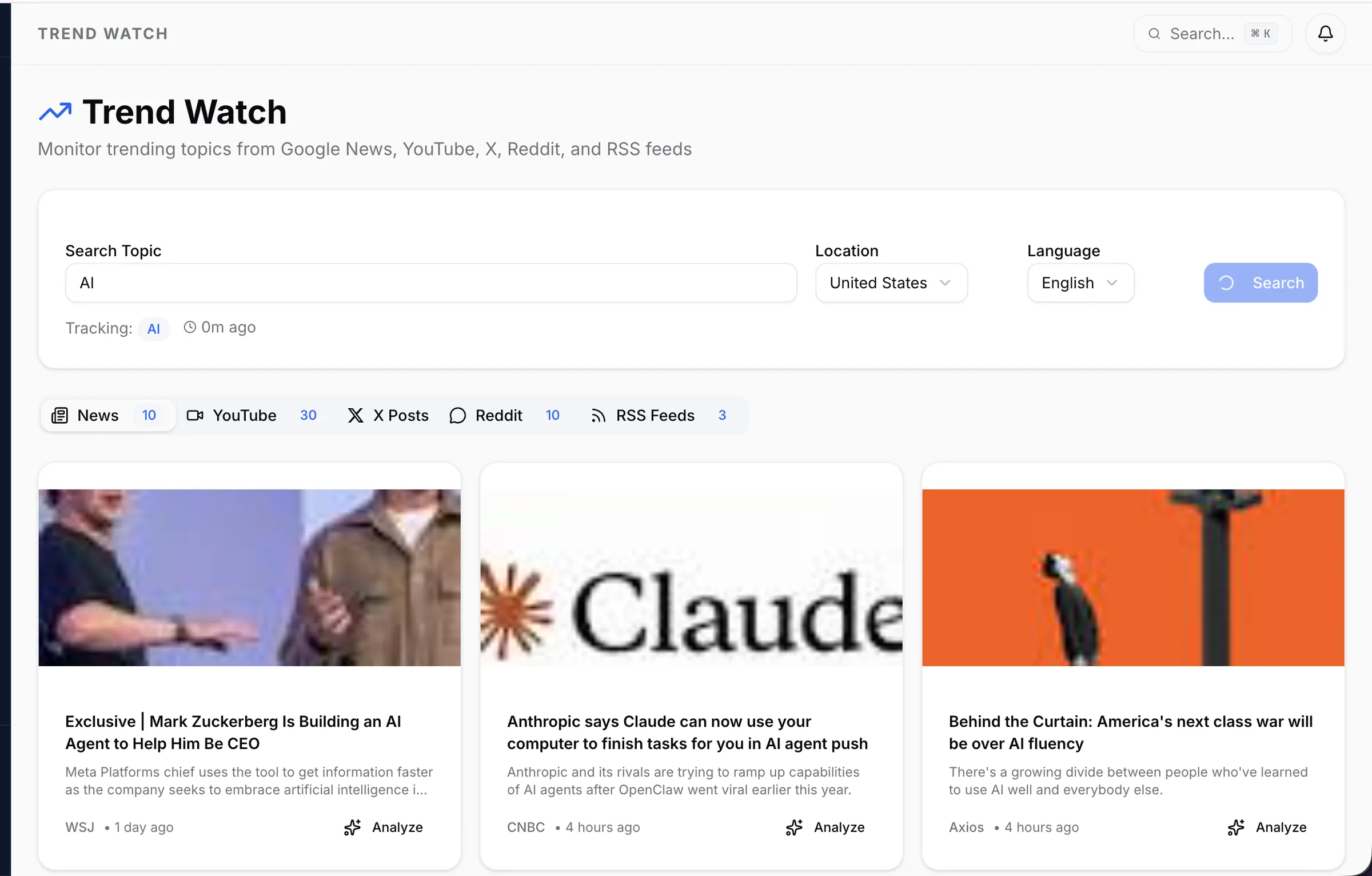
Find latest content ideas on Copyrocket AI's Trend watch;
Write for Extractability, Not Just Readability
Every sentence should follow subject → verb → object order.
Avoid passive constructions, ambiguous pronouns, and nested qualifications. "Google's AI Overviews appear on 31% of queries" is extractable.
"The overviews, which have been growing since their introduction, are now showing up quite frequently across many different types of search" is not.
Short paragraphs of 2 to 4 sentences perform better than dense blocks. AI models parse and extract content more reliably from structurally clean text.
Build Information Gain Into Every Page
Pages that simply repeat what the top 10 results already say contribute to consensus — and Google's AI already synthesizes that consensus.
Pages that introduce original data, novel angles, or first-hand experience contribute to synthesis. Synthesis-contributing content earns citations; consensus-repeating content doesn't.
Original data is the highest-value signal. Proprietary research, original surveys, case study results, or unique benchmark data transforms your page from a secondary aggregator into a primary source.
The GSC Blind Spot: How to Actually Track AI Overview Performance

Most teams checking Google Search Console believe they can see AI Overview performance. They can't — not clearly. Google includes AI Overview data in Search Console totals under the "Web" search type but doesn't provide a separate filter. You see impressions and clicks, but can't isolate which came from AI Overview citations versus standard organic results.
This means a page earning citations could be improving while its standard organic CTR declines — and your dashboard would show the combined result as a flat line or slight drop. Without a secondary tracking layer, you're optimizing blind.
The recommended three-tier tracking approach: first, pull Search Console data for your target keywords and watch for CTR patterns that suggest AI Overview cannibalization (below-average CTR at above-average impressions is the signature signal).
Second, manually query your target keywords monthly and document which sources Google cites. Third, use a dedicated AI visibility tool to automate citation tracking at scale across your full keyword set.
Track Your AI Overview Visibility with CopyrocketAI
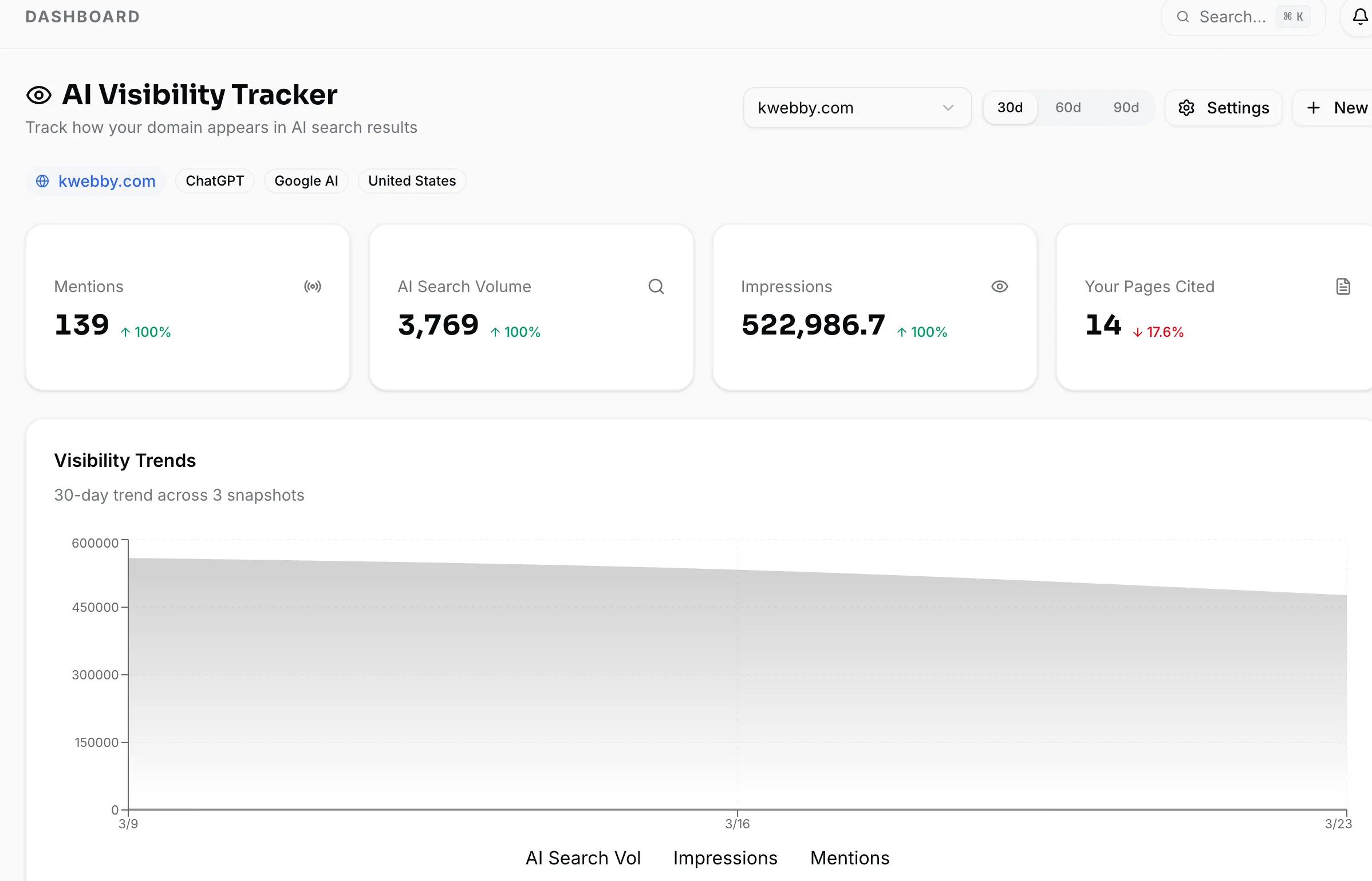
CopyrocketAI gives you four tools built specifically for the monitoring layer that Search Console can't provide.
AI Visibility tracks how often your domain appears in Google AI Overviews across your tracked keywords — with competitor comparison so you can see exactly who's taking the citation slots you're missing.
Keyword Tracker monitors your keyword rankings across both traditional and AI search, with 12-month trend data showing whether your optimizations are moving the needle. Keyword Research surfaces question-based and conversational keywords that have high AI Overview trigger rates, so you target the queries where the opportunity is largest.
Site Audit scans your technical health — page speed, Core Web Vitals, crawlability, schema markup implementation — and flags the specific issues most likely to block AI Overview inclusion.
Together, these four tools close the loop between optimization and measurement. You can implement every structural tactic in this guide and still lose ground if you're not tracking whether your content is being cited.
Try these tools free at CopyrocketAI →
Final Thoughts
AI Overviews aren't a temporary feature — they're Google's primary interface for informational queries, and their coverage is growing every month. The brands building citation-worthy content now are building a durable traffic advantage over those treating it as optional.
Start with your highest-traffic informational pages. Apply the Island Test to every H2 section — if a passage can't stand alone, restructure it. Add author attribution and E-E-A-T signals if they're missing. Submit your schema markup and verify your Core Web Vitals. Then set up a tracking system that separates AI Overview performance from standard organic data.
Optimization without measurement is guesswork. Measure first, optimize second, and iterate on what the data shows.
Frequently Asked Questions

Written by
Raman Singh
Raman Singh is a highly skilled marketing professional who serves as the head of marketing at Copyrocket AI. With years of experience in the field, Raman has developed a deep understanding of all asp
View all postsYour AI Marketing Agents
Are Ready to Work
Stop spending hours on copywriting. Let AI craft high-converting ads, emails, blog posts & social media content in seconds.
Start Creating for FreeNo credit card required. 50+ AI tools included.
Related Articles
 General
NotebookLM For Coders: Turn Docs Into Faster Code
Code work often fails for a simple reason. You do not have the right context at the right time. You read docs in one tab, skim tickets in another tab, and then...

 General
How to Optimize for AI Search in 2026: The Complete Guide
AI search has shifted from experimental feature to primary search method for millions of users. ChatGPT Search, Google AI Overviews, Perplexity, Claude, and Gem...
 General
Claude Opus 4.6 Review: Here's What New!
Claude Opus 4.6 from Anthropic draws attention because teams want an AI model that writes better code, follows instructions, and stays consistent across long se...