
Schema Markup Strategies That Actually Improve AI Visibility in 2026

Raman Singh
Raman Singh is a highly skilled marketing professional who serves as the head of marketing at Copyrocket AI

AI search results in 2026 reward pages that explain entities with clear facts. Schema markup helps that process because it gives machines a stable map of what your page is about. Many teams still treat structured data as a “rich results” tool only. That view is now too small. Google AI Overviews schema, SGE structured data, and other AI systems use the same signals to understand entities, connect sources, and pick citations.
This article explains schema markup strategies 2026 that improve AI visibility schema outcomes. You will learn how Schema.org works for generative engine optimization, which schema types matter most for AI answer citation optimization, and how to build entity depth schema that reduces ambiguity. You will also get JSON-LD implementation rules, schema nesting best practices, and a validation workflow with schema validation tools like Rich Results Test and Schema.org validator.
Next, you will get a measurable framework, before-and-after JSON-LD examples, and industry blueprints for SaaS, ecommerce, and local service sites.
Key Takeaways
Schema markup does not “rank” AI Overviews by itself, but it improves eligibility, extraction, and entity understanding for AI search optimization.
There is no special “AI schema” in 2026. Standard Schema.org types power GEO schema markup and LLM visibility SEO.
Article schema, FAQ schema, HowTo schema, Product schema, Organization schema, Person schema, Breadcrumb schema, WebPage schema, WebSite schema, Publisher schema, and Author schema form a strong base for AI visibility.
Entity depth schema improves disambiguation. It links Product → Brand → Organization → Founder → Person with canonical entity IDs and sameAs social profiles.
JSON-LD implementation must match visible content, stay consistent across templates, and avoid spammy markup that breaks structured data eligibility.
Validation needs two passes. Use Rich Results Test for Google eligibility and Schema.org validator for vocabulary and graph errors.
A testing method that tracks AI Overview inclusion, citation frequency, and entity recognition over time turns schema work into measurable GEO.
How AI systems use schema in 2026 (and what schema can and cannot do)
Does schema markup directly improve AI Overview rankings or mainly improve eligibility and understanding?
Schema markup mainly improves eligibility and understanding.
It helps systems parse entities, relationships, and page purpose. It can increase the chance that AI systems select your page as a source because the content becomes easier to extract and verify.
It does not act as a direct “AI Overview ranking boost” in the way people describe classic ranking factors.
A practical way to say it for AI answer citation optimization is this:
Schema improves machine understanding of entities and page intent.
Schema improves structured data eligibility for certain enhanced results.
Schema can improve extraction quality for summaries and citations.
Schema does not replace content quality, links, or trust signals.
Next, you need a realistic view of AI Overviews coverage, because visibility depends on query type.
Current prevalence of AI Overviews and why verticals matter
Public tracking studies from multiple SEO tool providers in 2024 and 2025 reported wide variance in AI Overviews presence by query set.
Most datasets showed AI Overviews appearing more often on informational queries than on transactional queries.
Many reports placed overall presence in the rough range of low to mid percentages across broad query samples, with higher rates in health, education, and general “how-to” topics, and lower rates in some ecommerce head terms.
You should treat these numbers as directional, not absolute. Google changes triggers often. The stable lesson for generative engine optimization is simple:
Informational content needs strong Article schema, FAQ schema, and HowTo schema.
Product and brand pages need Product schema plus brand entity markup.
Every site needs Organization schema, WebSite schema, and WebPage schema to anchor identity.
Next, you need to clear up the biggest confusion: “AI schema.”
Is there an “AI schema” in 2026?
There is no separate “AI schema” standard in 2026 that replaces Schema.org. LLMs and AI search systems read many formats, but Schema.org remains the shared vocabulary that publishers can control. That is why GEO schema markup work still starts with standard types and properties.
You will see new features like speakable schema 2026 discussions and changing FAQ eligibility 2026 rules. Those changes do not create a new schema language. They change how platforms use existing markup.
A clean approach for AI search optimization uses:
Schema.org vocabulary in JSON-LD implementation
A connected graph that defines entities once and reuses IDs
Visible content that matches the markup
Next, you need to focus on the schema types that most often support AI extraction and citations.
Which schema types are most likely to help content get pulled into AI answers in 2026?
For SGE structured data and Google AI Overviews schema behavior, the most useful types tend to be the ones that describe content purpose and key entities:
Article schema for editorial pages, guides, and research
FAQ schema for Q&A blocks that match real user questions
HowTo schema for step-based tasks with clear inputs and outputs
Product schema for ecommerce and product-led pages
Organization schema and Person schema for identity and E-E-A-T structured data
WebPage schema and WebSite schema for site-level context
Breadcrumb schema for hierarchy and disambiguation
Next, you need a framework that makes entity clarity measurable. That is where entity depth schema helps.
Entity depth schema: a measurable framework that improves entity clarity
What is 'entity depth' in schema markup and how do you implement it?
Entity depth schema is the number of meaningful entity layers you define and connect in your structured data graph. Depth is not “more markup.” Depth is “more correct relationships.” It reduces ambiguity and improves knowledge graph optimization because systems can connect your page to known entities.
Use this simple framework:
Depth 1: Page entity
WebPage schema with name, url, description, and about
Depth 2: Primary topic entity
Article schema or Product schema with mainEntityOfPage
Depth 3: Publisher and author identity
Publisher schema, Organization schema, Author schema, Person schema
Depth 4: Brand and corporate relationships
brand entity markup, parentOrganization, founder, employee, owns
Depth 5: External identifiers
sameAs social profiles, Wikidata, Wikipedia, Crunchbase, official profiles, canonical entity IDs
A depth score helps you audit pages. Many sites stop at depth 2. Pages that reach depth 4 or 5 often show better entity linking structured data and fewer misattributions in AI summaries.
Next, you need to implement depth with schema nesting best practices, not with duplicated blobs.
Before and after JSON-LD: flat markup vs nested entity markup
Flat markup example (common problem). It names a product but does not define the brand entity.
{
  "@context": "https://schema.org",
  "@type": "Product",
  "name": "Acme Analytics",
  "description": "Analytics platform for teams",
  "url": "https://example.com/acme-analytics"
}
Nested entity markup example (better entity depth). It defines Product → Brand → Organization → Founder → Person and uses IDs.
{
  "@context": "https://schema.org",
  "@graph": [
    {
      "@type": "Organization",
      "@id": "https://example.com/#org",
      "name": "Acme, Inc.",
      "url": "https://example.com/",
      "sameAs": [
        "https://www.linkedin.com/company/acme",
        "https://en.wikipedia.org/wiki/Acme",
        "https://www.wikidata.org/wiki/Q123456"
      ]
    },
    {
      "@type": "Person",
      "@id": "https://example.com/#founder-jordan-lee",
      "name": "Jordan Lee",
      "jobTitle": "Founder",
      "worksFor": { "@id": "https://example.com/#org" },
      "sameAs": [
        "https://www.linkedin.com/in/jordanlee"
      ]
    },
    {
      "@type": "Brand",
      "@id": "https://example.com/#brand-acme",
      "name": "Acme",
      "owner": { "@id": "https://example.com/#org" }
    },
    {
      "@type": "Product",
      "@id": "https://example.com/acme-analytics/#product",
      "name": "Acme Analytics",
      "url": "https://example.com/acme-analytics",
      "brand": { "@id": "https://example.com/#brand-acme" },
      "manufacturer": { "@id": "https://example.com/#org" }
    }
  ]
}
This structure supports disambiguation markup because each entity has a stable ID. It also supports knowledge graph optimization because external sameAs links reduce confusion.
Next, you need to choose schema types based on page intent, not based on what looks impressive.
Schema types that improve AI visibility: what to use and where to use it
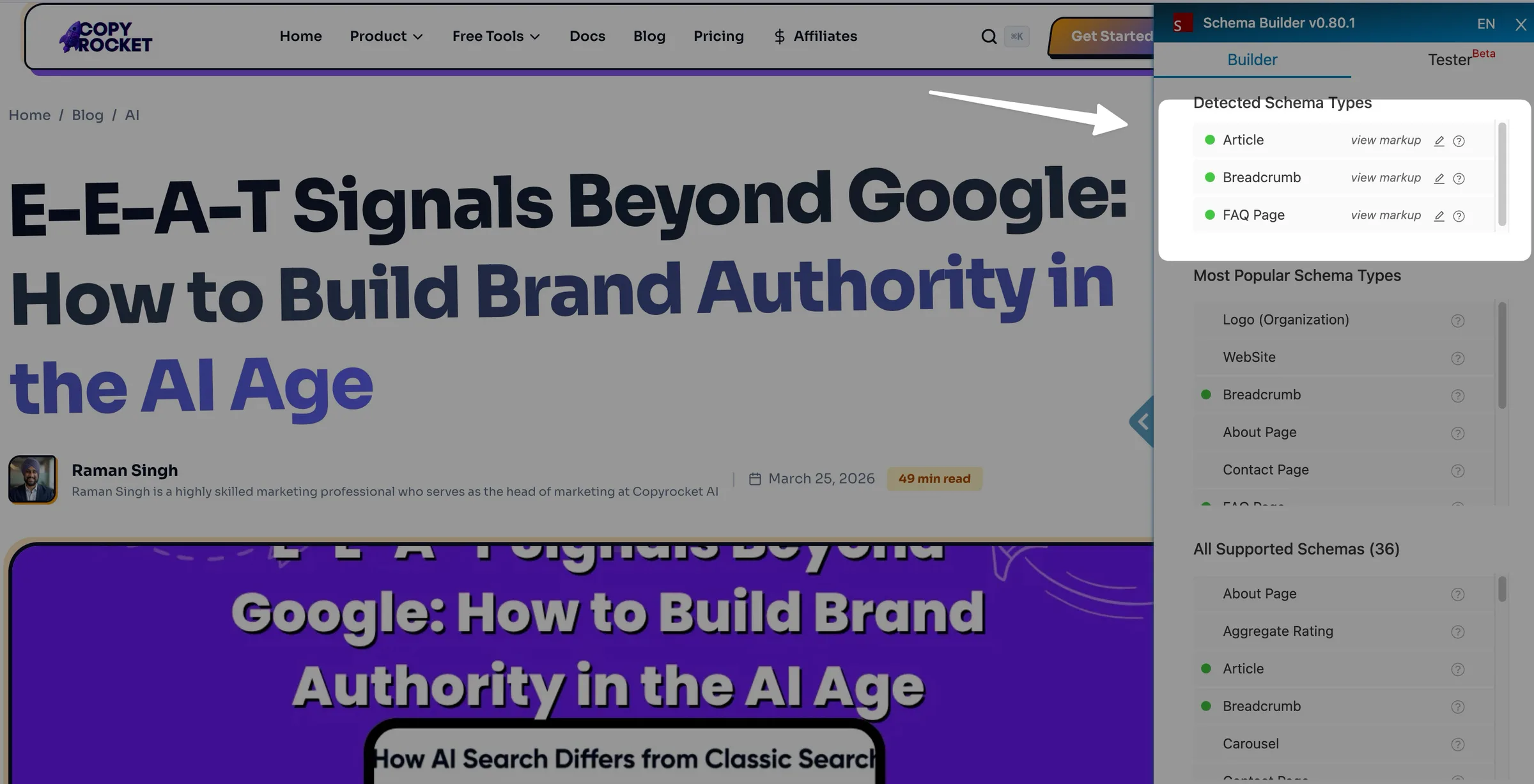
You can also build and test using Schema.org Chrome plugin here and you can detect on your site as below;
Article schema, Author schema, Publisher schema, and E-E-A-T structured data
Article schema helps AI systems identify the page as a source document. It also supports author and publisher clarity, which supports E-E-A-T structured data signals.
Use these practices:
Use Article schema with headline, datePublished, dateModified, and mainEntityOfPage
Use Author schema with a Person entity that has a stable @id
Use Publisher schema that points to your Organization schema
Add sameAs social profiles for the author and publisher when you have official profiles
Keep the markup aligned with visible content. If the page shows an author name and bio, the schema should match it. If the page has no author, do not invent one.
Next, you should add FAQ and HowTo only when the content truly fits.
FAQ schema and HowTo schema for content chunking for LLMs
FAQ schema and HowTo schema help content chunking for LLMs because they create clean question-answer and step structures. They also help NLP content structure because each block has a clear role.
Use FAQ schema when:
The page includes real questions as headings
Each answer is short, direct, and matches the visible text
The questions reflect search demand and support AI search optimization
Use HowTo schema when:
The page describes a task with steps
Each step has a clear action and outcome
You can list tools, supplies, time, and warnings when relevant
FAQ eligibility 2026 can change. Google has limited FAQ rich results in the past. Even when rich results do not show, the structured data can still help extraction and understanding. That is why you should treat FAQ schema as an AI visibility schema tool, not only a SERP feature tool.
Next, you need Product schema for transactional pages and brand pages.
Product schema, Organization schema, and brand entity markup for ecommerce and SaaS
Product schema helps AI systems identify what you sell and how it differs from similar items. Organization schema anchors your brand entity markup and supports entity linking structured data.
For ecommerce:
Use Product schema with name, image, description, sku, brand, and offers
Use aggregateRating and review only when you show reviews on the page
Use merchantReturnPolicy and shippingDetails when accurate and visible
For SaaS:
Treat the software as a Product when you have a product page
Add brand and manufacturer links to your Organization schema
Use WebPage schema with about pointing to the Product entity
Next, you need site-wide schema that supports navigation and page identity.
WebSite schema, WebPage schema, and Breadcrumb schema for disambiguation
WebSite schema and WebPage schema help systems understand the site and the page role. Breadcrumb schema helps hierarchy and reduces ambiguity for similar pages.
Use these rules:
Use one WebSite schema entity with a stable @id like
/#websiteUse WebPage schema on each page with a stable @id like
/page/#webpageUse Breadcrumb schema that matches visible breadcrumbs
Connect WebPage to WebSite with isPartOf
This structure supports disambiguation markup because it tells systems where the page sits in the site. It also supports canonical entity IDs because each entity has a stable URL-based identifier.
Next, you need to implement JSON-LD correctly, or the best plan fails.
JSON-LD implementation rules that prevent eligibility loss and extraction errors
JSON-LD placement, consistency, and spam avoidance
JSON-LD implementation works best when it is stable and predictable.
Follow these rules:
Place JSON-LD in the page source so crawlers can fetch it without user actions
Keep markup consistent with visible content, especially names, prices, authors, and dates
Use one connected graph with @graph when you have multiple entities
Reuse entity IDs across pages for Organization schema and key Person schema entities
Avoid marking up content that users cannot see
Avoid stuffing keywords into name or description fields
Many structured data failures come from mismatch. A common example is a Product offer price in schema that differs from the visible price due to currency switching or A/B tests. That mismatch can break structured data eligibility and reduce trust.
Next, you need to know the most common errors and how often they happen.
Common JSON-LD errors and typical failure patterns
Across large site audits, teams often see repeated patterns:
Missing required properties for eligible rich results
Invalid values for fields like date formats and URLs
Duplicate entities with different IDs for the same Organization
Review markup that does not match visible reviews
FAQ markup that includes promotional content instead of answers
Many SEO platforms report that a significant share of pages with structured data still contain at least one warning or error. The exact rate varies by site type, but the pattern is stable: templates drift, and schema breaks quietly.
Next, you need a validation workflow that catches both Google eligibility issues and Schema.org graph issues.
Validation and debugging workflow (tools, steps, and fixes)
What are the top schema validation steps before publishing?
Use this workflow before you ship changes:
Run Rich Results Test on the URL or code snippet to check structured data eligibility and Google-specific requirements
Run Schema.org validator to check vocabulary correctness and graph structure
Check Search Console enhancements reports after deployment for new errors
Spot-check rendered HTML to confirm the JSON-LD matches visible content
Confirm canonical URLs and @id values match your canonical setup
This workflow supports AI search optimization because it reduces silent failures that block extraction.
Next, you need to know what each tool is best at.
Rich Results Test vs Schema.org validator: what each one catches
Rich Results Test focuses on Google features. It tells you if your markup qualifies for certain rich results and shows missing required fields for those features.
Schema.org validator focuses on Schema.org correctness. It catches:
Invalid types and properties
Broken references in @graph
Bad value types, like arrays vs strings
Misused fields that Google might ignore without warning
Use both. Many teams use only Rich Results Test and miss graph-level issues that affect LLM visibility SEO and knowledge graph optimization.
Next, you need to connect schema to how you write and format content, because AI extraction depends on both.
Align schema with NLP-friendly content structure for better AI extraction
Content chunking for LLMs and NLP content structure
Schema works best when the page uses a clear structure. AI systems extract answers from text blocks. Schema can label those blocks, but the text still needs clean formatting.
Use these writing patterns:
Use short headings that state the topic in plain words
Put definitions in the first paragraph under a heading
Use Q&A blocks that match FAQ schema questions
Use step blocks that match HowTo schema steps
Keep each paragraph focused on one idea
This approach supports content chunking for LLMs because each section becomes a clean unit. It also supports AI answer citation optimization because the system can quote a short, complete statement.
Next, you need entity linking structured data that reduces ambiguity across similar names.
Entity linking structured data with sameAs and canonical entity IDs
Entity confusion is common in AI answers. Two brands can share a name. Two people can share a name. sameAs social profiles and authoritative IDs reduce that risk.
Use these rules:
Use stable @id values for your Organization schema and key Person schema entities
Add sameAs links only to official profiles you control or to widely accepted reference pages
Prefer identifiers that stay stable, like Wikidata IDs, official social profiles, and verified listings
Keep the sameAs list short and accurate
This is the core of entity linking structured data. It supports topical authority entities because it ties your content to a known entity node.
Next, you need to avoid common beliefs that waste time or create risk.
Schema markup myths that hurt AI visibility
Many schema markup myths spread because people confuse correlation with cause.
Common myths:
“More schema always wins.” Extra markup can create conflicts and errors.
“FAQ schema guarantees AI citations.” It helps structure, but content quality and trust still decide.
“You can mark up anything.” Markup must match visible content and policy rules.
“Schema replaces on-page clarity.” Schema supports clarity, but it cannot fix vague writing.
A safe rule is simple: use schema to describe what is true on the page, and connect it to real entities.
Next, you need practical blueprints and a testing method that proves impact.
Practical Tips and Examples: blueprints, nesting patterns, and a testing method
Industry schema blueprints with recommended nesting patterns
Use these blueprints as starting points. Keep schema nesting best practices and reuse IDs.
SaaS blueprint
WebSite schema + Organization schema site-wide
Product schema on product pages
Article schema on guides and docs pages
Author schema + Person schema for expert content
FAQ schema on pricing and onboarding pages with real questions
Nesting pattern: Product → brand (Brand) → owner (Organization) → founder (Person)
Ecommerce blueprint
Product schema with offers, shippingDetails, and return policy when visible
Organization schema with sameAs social profiles
Breadcrumb schema on category and product pages
FAQ schema on shipping, sizing, and warranty pages
Nesting pattern: Product → brand (Brand) → manufacturer (Organization)
Local service blueprint
Organization schema with serviceArea when accurate
WebPage schema for each service page with about pointing to the service
Article schema for educational posts that support service intent
FAQ schema for service questions and pricing models
Nesting pattern: Organization → founder (Person) → area served context in page content
Next, you need a method to measure AI visibility schema outcomes over time.
An original testing methodology for AI visibility (GEO tracking)
Track AI visibility like you track rankings, but use AI-specific outputs.
Use this method:
Pick a fixed keyword set by intent
Informational queries for Article and FAQ pages
Task queries for HowTo pages
Transactional queries for Product pages
Record baseline data weekly
AI Overview inclusion presence for each query
Citation frequency for your domain
Which page URL gets cited
Track entity recognition signals
Brand name accuracy in AI answers
Author name accuracy when cited
Product name consistency across answers
Run controlled schema changes
Add entity depth schema to a test group
Keep content edits minimal during the test window
Compare outcomes after four to eight weeks
Change in citation frequency
Change in which pages get cited
Change in entity accuracy
Many teams see a pattern where nested entity markup improves extraction consistency compared to flat markup. The biggest gains often show up as fewer wrong attributions and more stable citations, even when classic rankings do not move.
Next, you need a final checklist that prevents the most common launch mistakes.
Pre-publish checklist for AI visibility schema
Use this checklist before you push updates:
Confirm the page has one clear primary entity
Confirm schema matches visible content word for word on names, prices, and authors
Confirm Organization schema uses one stable @id across the site
Confirm sameAs social profiles point to official pages
Confirm FAQ schema questions appear as headings on the page
Confirm HowTo schema steps match visible steps
Run Rich Results Test and fix all errors
Run Schema.org validator and fix graph issues
Check structured data eligibility changes in Search Console after launch
Next, you can wrap the work into a simple plan that teams can repeat.
Final Thoughts
Schema markup strategies 2026 work best when they describe real content, connect real entities, and stay consistent across your site. There is no AI-only schema language in 2026. Standard Schema.org types still power GEO schema markup, SGE structured data, and LLM visibility SEO. The advantage comes from entity depth schema, entity linking structured data, and clean JSON-LD implementation that passes validation.
Use Article schema, FAQ schema, and HowTo schema for AI-friendly extraction. Use Organization schema, Person schema, Publisher schema, and Author schema for E-E-A-T structured data and brand identity. Then measure results with a citation and entity accuracy tracking method. That workflow turns schema from a checkbox into a repeatable AI visibility system.
Frequently Asked Questions

Written by
Raman Singh
Raman Singh is a highly skilled marketing professional who serves as the head of marketing at Copyrocket AI. With years of experience in the field, Raman has developed a deep understanding of all asp
View all postsYour AI Marketing Agents
Are Ready to Work
Stop spending hours on copywriting. Let AI craft high-converting ads, emails, blog posts & social media content in seconds.
Start Creating for FreeNo credit card required. 50+ AI tools included.
Related Articles
 General
NotebookLM For Coders: Turn Docs Into Faster Code
Code work often fails for a simple reason. You do not have the right context at the right time. You read docs in one tab, skim tickets in another tab, and then...

 General
How to Optimize for AI Search in 2026: The Complete Guide
AI search has shifted from experimental feature to primary search method for millions of users. ChatGPT Search, Google AI Overviews, Perplexity, Claude, and Gem...
 General
Claude Opus 4.6 Review: Here's What New!
Claude Opus 4.6 from Anthropic draws attention because teams want an AI model that writes better code, follows instructions, and stays consistent across long se...