
E-E-A-T Signals Beyond Google: How to Build Brand Authority in the AI Age

Raman Singh
Raman Singh is a highly skilled marketing professional who serves as the head of marketing at Copyrocket AI

AI Overviews and other AI answers pick a few sources and skip the rest. This shift moves the goal from ranking to getting cited, quoted, and recommended. E-E-A-T signals now shape brand authority in the AI search era.
AI answers compress choices into one response. A weak brand can turn invisible even with frequent publishing. You need clear trust signals, clear entities, and clear brand mentions that AI systems can verify.
In this playbook, you will learn how AI selects sources for AEO (answer engine optimization) and generative engine optimization. You will learn which off-site signals matter for SGE optimization, including Digital PR, unLinked brand mentions, and thought leadership. You will learn how to keep entity SEO consistent across knowledge graph entities, and how content and technical trust support E-E-A-T signals. You will also get a 30-day GEO strategy action plan.
Next, the article gives practical steps you can use to build topical authority and brand authority for AI citations.
Key Takeaways
E-E-A-T signals beyond Google show public proof of trust. People and machines can verify this proof in reviews, news, forums, databases, and expert profiles. These E-E-A-T signals support brand authority in the AI search era.
AI Overviews and other answer systems cite brands that show clear proof. AI systems prefer sources with clear authors, clear ownership, strong editorial rules, and reliable citations. This focus makes AEO (answer engine optimization) and SGE optimization depend on verifiable facts, not page rank alone.
Entity SEO improves brand recognition in AI answers. Consistent names, bios, product terms, and SameAs links help systems connect your brand to knowledge graph entities. This clarity supports generative engine optimization and a GEO strategy.
Brand mentions matter, even without links. Linked Brand mentions and unlinked brand mentions can confirm brand authority across the web. Digital PR and thought leadership can increase these mentions and raise citation chances in AI Overviews.
Topical authority increases coverage and citation eligibility. A focused topic cluster with clear definitions, FAQs, comparisons, and primary-source citations helps AI systems match your pages to specific questions. This approach supports entity SEO and AEO.
Proof beats volume in the AI search era. First-hand data, named experts, update dates, correction logs, and clear policies reduce error risk for AI systems and readers. These signals improve E-E-A-T signals and support long-term brand authority.
What “E-E-A-T Signals Beyond Google” Means in the AI Age (And Why It Matters)
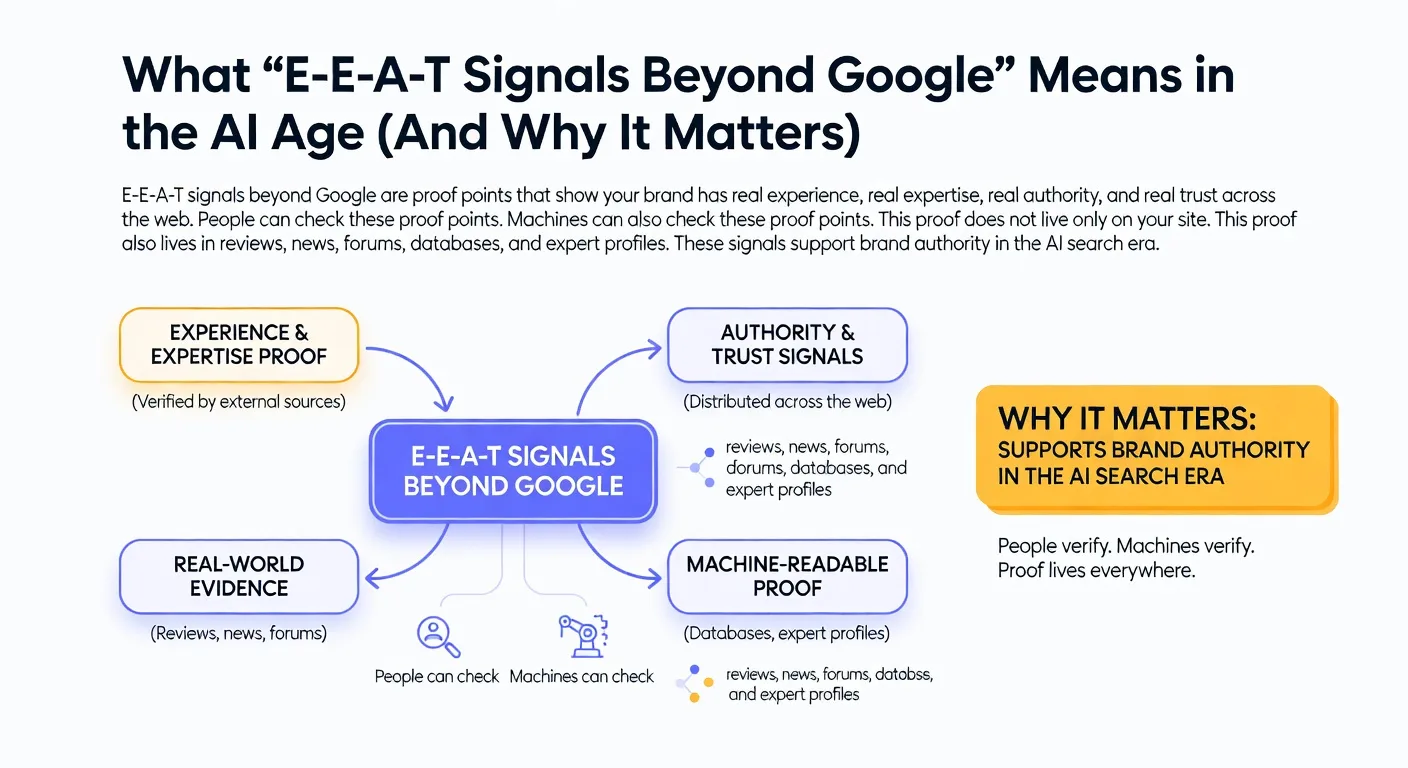
E-E-A-T signals beyond Google are proof points that show your brand has real experience, real expertise, real authority, and real trust across the web. People can check these proof points. Machines can also check these proof points. This proof does not live only on your site. This proof also lives in reviews, news, forums, databases, and expert profiles. These signals support brand authority in the AI search era.
Why this matters in the AI search era
AI systems pull answers from sources they trust. AI systems also repeat brands they recognize. Your authority can affect inclusion in AI Overviews and other answer systems. Your rank still matters, but your inclusion can matter more.
AI Overviews can cite a small set of sources for a topic. Your brand needs signals that earn a citation.
Zero-click behavior can reduce site visits. Users can get answers on the results page.
Users trust third-party proof. Users often trust reviews and independent coverage more than brand claims.
A simple definition you can use
E-E-A-T signals beyond Google are public, verifiable signals that confirm who you are and why people should trust you. These signals also help systems connect your brand to knowledge graph entities and other entity SEO references.
Real-world example: niche brand vs content farm
A niche payroll SaaS publishes a salary report with original data. A known CFO writes the report. Industry sites cite the report. Podcasts interview the CFO. Review sites show consistent ratings and pricing. AI Overviews cite the brand for “payroll benchmarks” and “salary ranges.”
A content farm publishes generic posts with no author proof and no citations. The site has thin pages and recycled claims. Third-party sites do not mention the brand. AI systems skip the site because the web shows weak trust signals.
Key components of E-E-A-T signals beyond Google
Area | What it shows | Clear signals to publish |
|---|---|---|
Experience | You did the work and you can prove it. | You publish original product or service data. You share photos, demos, or field notes. You show outcomes with dates and context. |
Expertise | You have the right skills and training for the topic. | You list author and reviewer credentials. You assign specialist authors to specialist topics. You cite primary sources and trusted references. You use expert review for high-risk topics. |
Authoritativeness | Other people and groups recognize your brand or experts. | You earn mentions in industry media. You earn unlinked mentions in articles and forums. You earn citations from associations, universities, or standards bodies. You earn invitations for talks, panels, and interviews. You publish insights that others quote. |
Trust | You use clear policies, accurate claims, and safe user handling. | You publish contact and ownership details. You publish refund, shipping, and privacy policies. You collect reviews on third-party platforms. You use secure checkout and secure account access. You fix errors and update claims. |
Entity clarity | Systems match your brand to the right knowledge graph entry. | You use one brand name format across profiles. You keep founders, location, and category consistent. You keep product names and descriptions consistent. You link profiles to the same official site and social accounts. |
Distribution footprint | Your brand shows up where AI systems collect signals. | You earn news coverage and PR placements. You appear on podcasts and video interviews. You join forums and Q&A sites with expert posts. You list in knowledge bases and directories. You share research in repositories and public datasets. You appear on partner sites and integration listings. |
Experience
Experience shows first-hand work and first-hand proof.
You show original data from your product or service.
You show photos, demos, or field notes.
You show real outcomes with dates and context.
Expertise
Expertise shows skill and training that match the topic.
You list credentials for authors and reviewers.
You use specialist authors for specialist topics.
You cite primary sources and respected references.
You use peer review or expert review for high-risk topics.
Authoritativeness
Authoritativeness shows that others recognize your brand or your experts.
You earn brand mentions in industry media.
You earn unlinked brand mentions in articles and forums.
You earn citations from associations, universities, or standards bodies.
You earn invitations for talks, panels, and interviews.
You publish thought leadership that others quote.
Trust
Trust shows clear policies, accurate claims, and safe user handling.
You publish clear contact details and ownership details.
You publish refund, shipping, and privacy policies.
You collect reviews on third-party platforms.
You use secure checkout and secure account access.
You correct errors and update claims.
Entity clarity
Entity clarity helps systems match your brand to the right knowledge graph entities.
You use one brand name format across profiles.
You keep founders, location, and category consistent.
You keep product names and descriptions consistent.
You connect profiles to the same official site and social accounts.
Distribution footprint
Distribution footprint shows presence in places where AI gathers signals.
News coverage and Digital PR placements
Podcasts and video interviews
Forums and Q&A sites with expert participation
Knowledge bases and directories
Research repositories and public datasets
Partner sites and integration listings
Practical examples of “proof” by business type
SaaS
You publish a benchmark report with original data and a clear method.
You publish security pages, uptime history, and incident notes.
You earn analyst notes, partner listings, and integration directory pages.
You earn brand mentions from user communities and review sites.
You support AEO (answer engine optimization) with clear FAQs and cited claims.
Local service business
You show license numbers, insurance proof, and staff certifications.
You show before-and-after photos with job details and dates.
You earn reviews on major platforms with consistent NAP details.
You earn local news mentions and community partner mentions.
You support entity SEO with consistent business facts across listings.
Ecommerce brand
You show product testing, materials proof, and safety certificates.
You show real product photos and usage demos.
You publish clear shipping, returns, and warranty terms.
You earn unlinked brand mentions from creators and forums.
B2B services
You publish case studies with named roles, metrics, and timelines.
You publish expert bios with past work and speaking history.
You earn citations from industry bodies and event sites.
You earn digital PR coverage for research and insights.
You build topical authority with focused topic clusters and consistent expert authors.
How this connects to AI visibility goals
These signals support generative engine optimization and a clear GEO strategy. These signals also support SGE optimization and AI Overviews inclusion. You build brand authority with proof that other sites repeat and verify. You also build E-E-A-T signals that systems can map to entities and trust sources.
How AI Overviews and Chatbots Choose Which Brands to Cite or Recommend
AI Overviews and chatbots answer questions by pulling facts from sources, ranking those sources, and then writing a short summary. A citation works as a fast trust signal. The system uses it to show where a claim came from in the AI search era.
How AI search differs from classic search
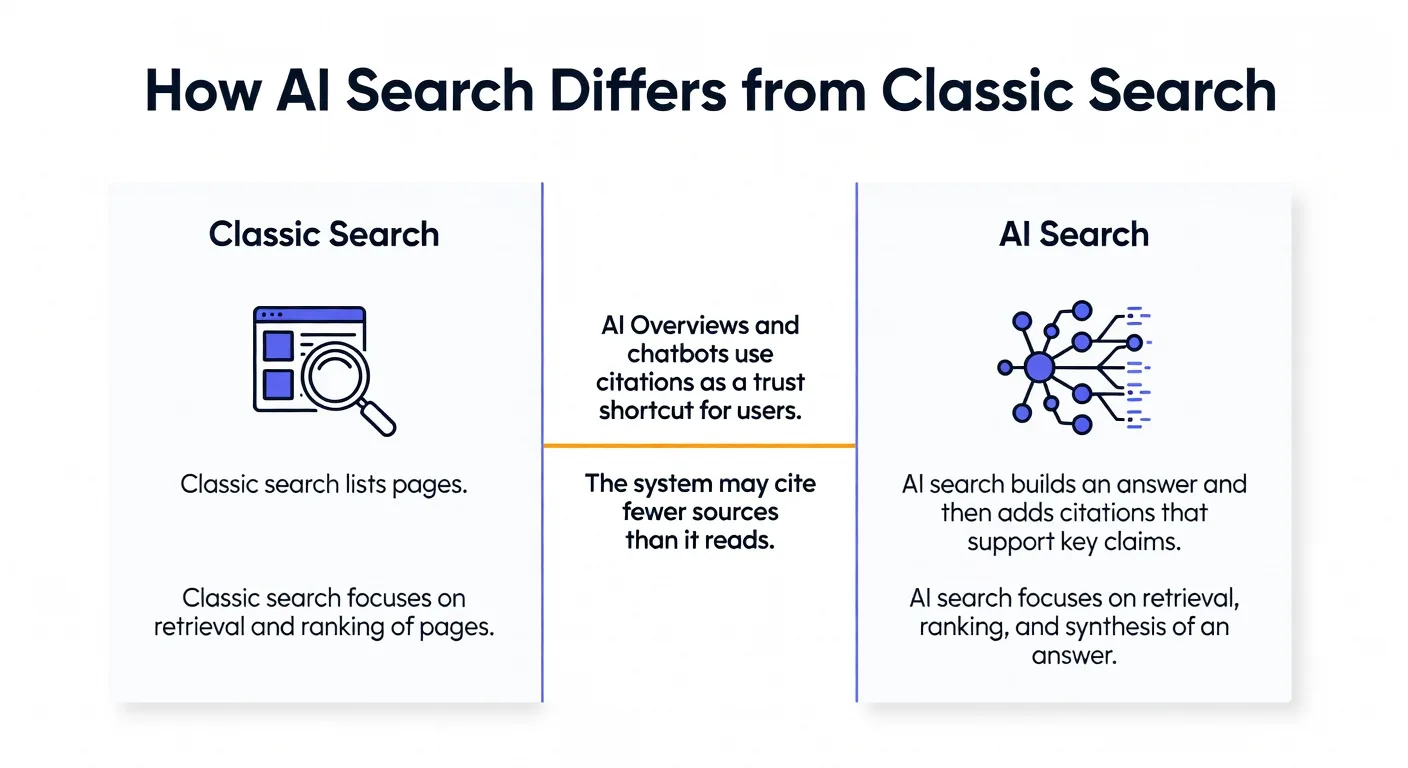
Classic search lists pages. AI search builds an answer and then adds citations that support key claims.
Classic search focuses on retrieval and ranking of pages.
AI search focuses on retrieval, ranking, and synthesis of an answer.
AI Overviews and chatbots use citations as a trust shortcut for users.
The system may cite fewer sources than it reads.
Source types AI systems often prefer
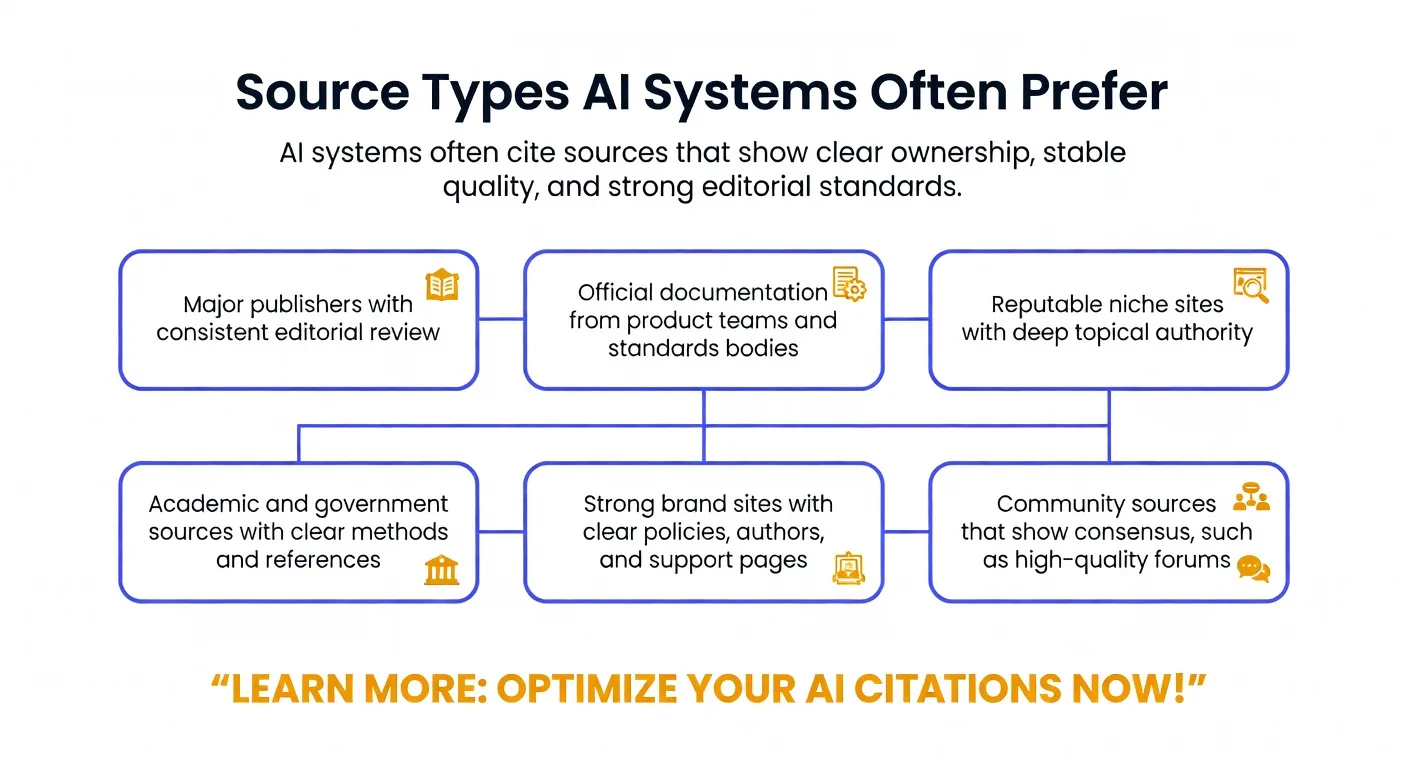
AI systems often cite sources that show clear ownership, stable quality, and strong editorial standards.
Major publishers with consistent editorial review
Official documentation from product teams and standards bodies
Reputable niche sites with deep topical authority
Academic and government sources with clear methods and references
Strong brand sites with clear policies, authors, and support pages
Community sources that show consensus, such as high-quality Q&A threads
Selection factors that drive citations and recommendations
AI systems pick sources that match the question and reduce the risk of errors.
Source reputation and historical reliability
The system favors sources that show accurate past coverage and low correction risk.
Topical relevance and coverage depth
The system favors pages that answer the exact question and cover key subtopics.
Freshness for time-sensitive topics
The system favors recent updates for prices, laws, product changes, and breaking news.
Consensus across multiple sources
The system favors claims that match several independent sources.
Entity recognition and disambiguation
The system favors content that uses clear names, definitions, and context for entities.
Entity SEO helps the system connect your brand to the right topic and category.
Structured data and machine-readable context
The system favors pages that use schema and clear page structure.
Knowledge graph entities help the system map people, brands, products, and locations.
Citation eligibility checklist for writers
Use this checklist before you publish.
I state the main claim in the first 1 to 2 paragraphs.
I define key terms and I name the exact entity I mean.
I cite primary sources for facts, data, and quotes.
I show author identity, credentials, and a real bio page.
I add a last updated date for pages that need freshness.
I include original evidence when possible, such as data, screenshots, or test notes.
I use clear headings that match common questions.
I add schema markup where it fits, such as Organization, Person, Product, FAQ, and Article.
I avoid unsupported claims and I remove vague language.
I match the page intent to the query intent.
Example: Why Brand A gets cited and Brand B does not
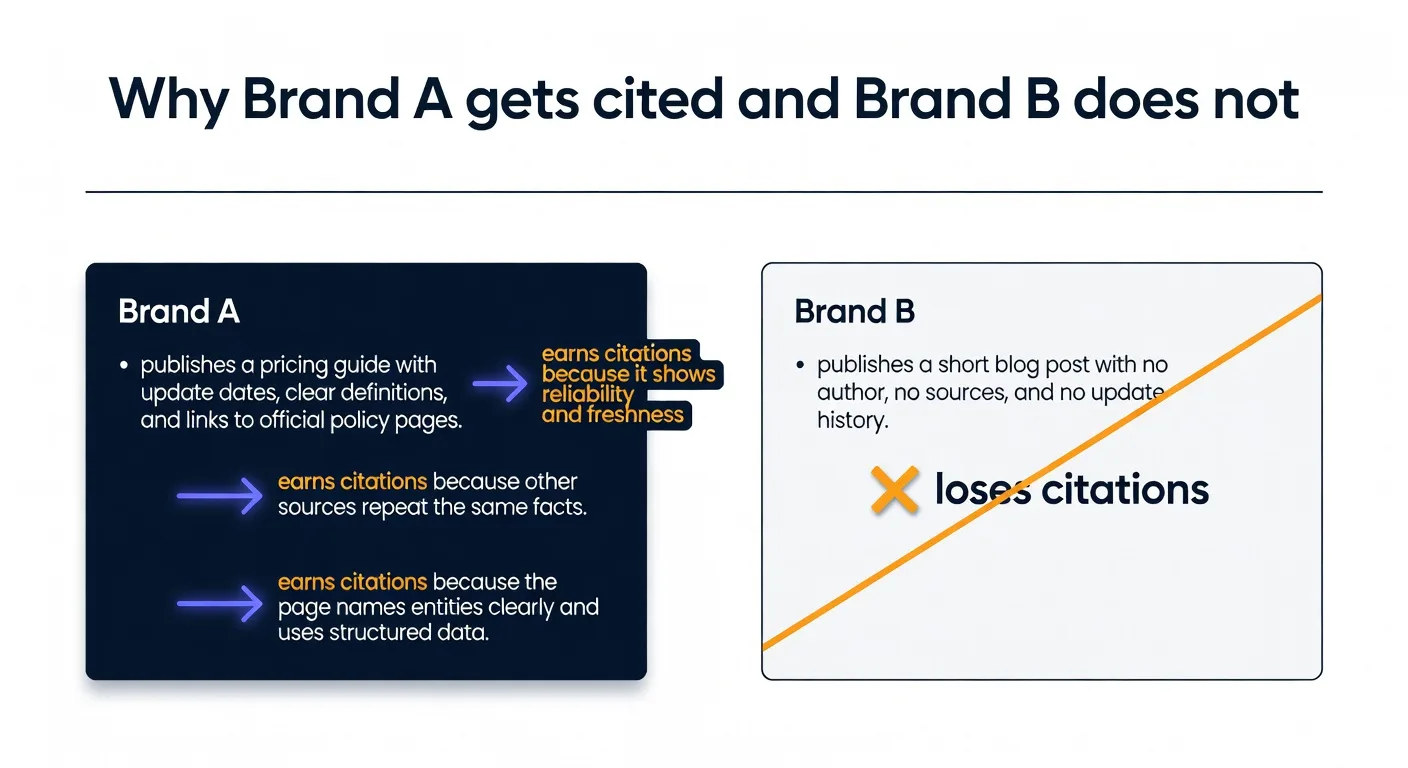
Brand A publishes a pricing guide with update dates, clear definitions, and links to official policy pages. Brand B publishes a short blog post with no author, no sources, and no update history.
Brand A earns citations because it shows reliability and freshness.
Brand A earns citations because other sources repeat the same facts.
Brand A earns citations because the page names entities clearly and uses structured data.
Brand B loses citations because the system cannot verify claims.
Brand B loses citations because the page lacks author identity and source support.
E-E-A-T signals beyond Google that influence AI answers
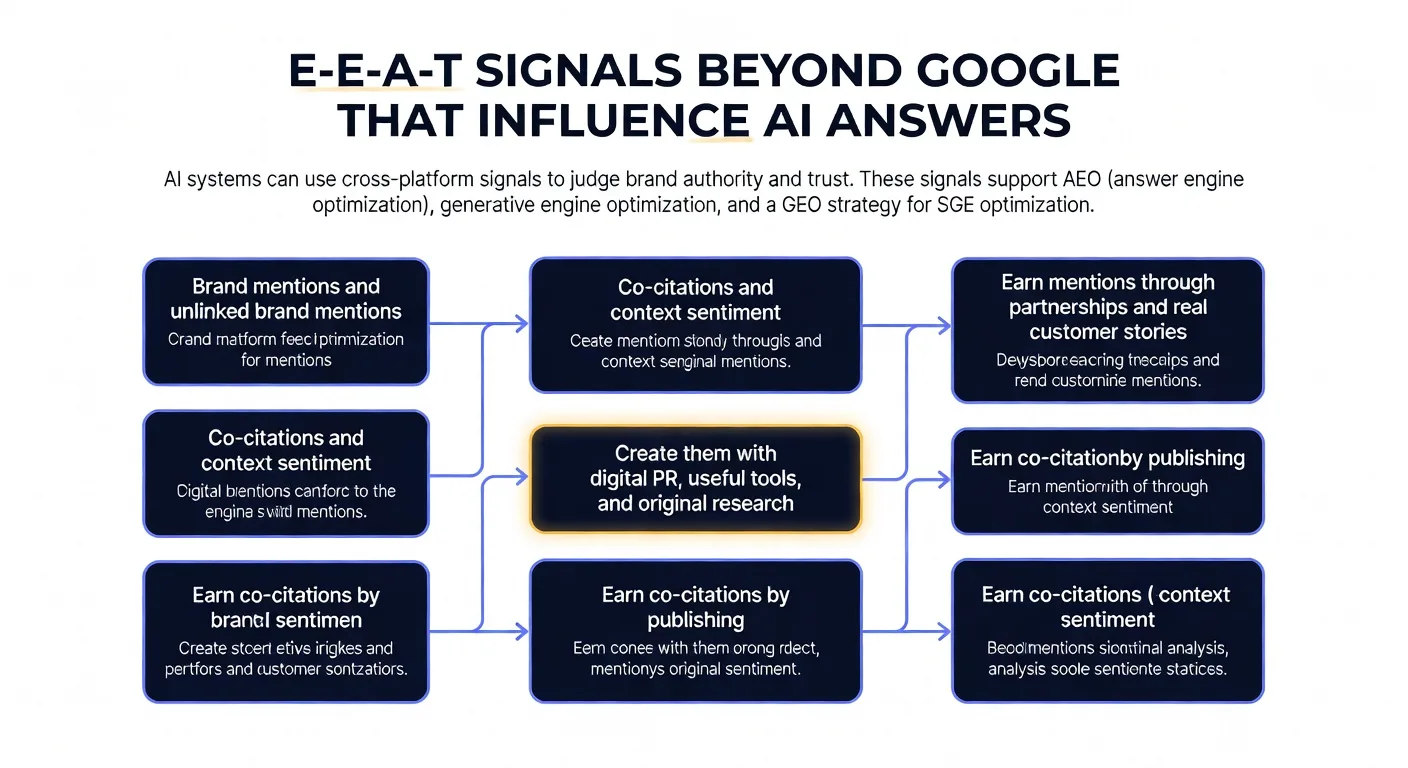
AI systems can use cross-platform signals to judge brand authority and trust. These signals support AEO (answer engine optimization), generative engine optimization, and a GEO strategy for SGE optimization.
Brand mentions and unlinked brand mentions
Create them with digital PR, useful tools, and original research.
Earn mentions through partnerships and real customer stories.
Co-citations and context sentiment
Earn co-citations by publishing shared standards, benchmarks, and comparisons.
Improve sentiment by fixing product issues and responding in public channels.
Reviews and ratings on major platforms
Ask real customers for reviews after support closes.
Reply to negative reviews with specific fixes and timelines.
Wikipedia, Wikidata, and knowledge graph entities (where applicable)
Use public sources and neutral language.
Add citations from independent coverage and avoid promotional edits.
News coverage and press releases picked up by credible outlets
Share real announcements, data, and customer impact.
Pitch stories with facts, not slogans.
Expert profiles and consistent author identity
Use the same author name, bio, and headshot across platforms.
Link to credentials, talks, and published work.
Community references in forums, Q&A, and Reddit (when relevant)
Answer questions with evidence and clear steps.
Disclose affiliation and avoid scripted promotion.
Citations in industry reports, podcasts, YouTube, and newsletters
Offer experts for interviews and provide verifiable data.
Publish show notes, transcripts, and source links.
Thought leadership and topical authority
Publish repeatable frameworks, case studies, and clear definitions.
Keep a consistent content focus so the system can map your expertise.
Brand mentions across trusted sites
Track mentions and correct factual errors with polite outreach.
Support editors with sources and clear proof.
E-E-A-T vs Brand Authority vs Topical Authority: What’s the Difference?
Term | Simple definition | Main focus | Common signals | Best use case |
|---|---|---|---|---|
E-E-A-T signals | A quality and trust framework for content and creators. | Proof that a real expert created accurate content. | Author bio, credentials, first-hand experience, citations, editorial standards, updated dates. | You need trust for sensitive topics or high-risk decisions. |
Brand authority | Public recognition and trust in the brand entity. | Proof that people and publishers trust the brand. | Brand mentions, unlinked brand mentions, reviews, awards, digital PR, partnerships, branded search demand. | You need stronger trust at the market level. |
Topical authority | Depth and breadth of coverage in a topic cluster. | Proof that you cover a topic fully and consistently. | Topic clusters, internal links, entity SEO, knowledge graph entities, consistent definitions, FAQs, comparisons. | You need better visibility for many related queries. |
E-E-A-T signals: trust in the content and the creator
E-E-A-T signals show who wrote the content and why the reader should trust it.
They also show what the writer did and what sources support the claims.
Example
A clinic publishes a guide on migraine treatment.
A doctor writes the guide.
The page lists the doctor’s license and hospital role.
The page cites clinical guidelines and peer-reviewed studies.
The page includes an updated date and a review process.
Good fit
Health, finance, legal, safety, and high-cost purchases.
Brand authority: trust in the brand entity
Brand authority shows that the market recognizes the brand and trusts it.
It often grows through consistent delivery, public proof, and third-party coverage.
Example
A cybersecurity firm earns coverage in industry publications.
Analysts quote the firm in reports.
Customers leave detailed reviews.
Partners publish case studies that name the firm.
Journalists create brand mentions, including unlinked brand mentions.
Good fit
Competitive categories where many sites publish similar content.
Topical authority: trust in your coverage of a topic
Topical authority shows that you cover a topic with depth and scope.
It grows when you publish connected pages that answer related questions.
Example
An ecommerce site sells espresso machines.
The site publishes guides on grind size, water temperature, and milk steaming.
The site publishes comparisons of machine types.
The site links guides to product pages and back to guides.
The site uses entity SEO to keep terms consistent, like “portafilter” and “PID controller.”
Good fit
Categories with many long-tail searches and many user questions.
How they work together in AI answers
AI Overviews and other AI search era features often favor entities with clear identity and strong proof.
AEO (answer engine optimization) and generative engine optimization work best when you build all three areas.
Topical authority helps the system find complete coverage for a query set.
E-E-A-T signals help the system trust the page and the author.
Brand authority helps the system trust the entity behind the content.
Example
A B2B SaaS brand publishes a full cluster on “SOC 2 compliance.”
The cluster includes definitions, checklists, templates, and pricing comparisons.
A security lead writes the content and lists credentials.
Digital PR earns brand mentions from security blogs and podcasts.
The brand becomes a stronger candidate for citations in AI Overviews.
Decision tree: If your issue is X, prioritize Y
If you get traffic but low trust, prioritize E-E-A-T signals.
If you rank for a few pages but miss many related queries, prioritize topical authority.
If you publish strong content but competitors get cited and quoted more, prioritize brand authority.
If AI Overviews cite others for your main topics, prioritize GEO strategy with entity SEO plus digital PR.
If you need more direct answers and featured snippets, prioritize AEO (answer engine optimization) with clear Q&A sections and consistent entities.
If you need stronger visibility in SGE optimization tests, prioritize knowledge graph entities and consistent brand mentions.
Examples by business type
Local business (dentist, plumber, law firm)
You build E-E-A-T signals with licenses, service area proof, and real case examples.
You build brand authority with reviews, local news coverage, and community brand mentions.
You build topical authority with service pages plus FAQs for each service.
Example
A family dentist publishes “Invisalign vs braces,” “teeth whitening safety,” and “cost guide.”
The dentist signs the pages and lists credentials.
Local media mentions the practice after a charity event.
Ecommerce (consumer products)
You build topical authority with buying guides, comparisons, and care guides.
You build E-E-A-T signals with testing notes, sourcing details, and clear return policies.
You build brand authority with product reviews, creator coverage, and digital PR.
Example
A skincare brand publishes ingredient explainers and routine builders.
A chemist reviews the content.
Beauty sites publish brand mentions and link to lab testing pages.
B2B SaaS
You build topical authority with use cases, integrations, and workflow guides.
You build E-E-A-T signals with expert authors, security pages, and data sources.
You build brand authority with thought leadership, webinars, and analyst mentions.
Example
A payroll platform publishes a cluster on “multi-state payroll compliance.”
A compliance lead writes the pages.
HR publications cite the platform in trend reports.
Media site (publisher, newsletter, niche blog)
You build topical authority with consistent coverage and strong internal linking.
You build E-E-A-T signals with bylines, editorial policy, and corrections.
You build brand authority with syndication, citations, and recurring brand mentions.
Example
A tech newsletter publishes weekly explainers on AI policy.
The editor lists sources and updates articles after policy changes.
Other sites quote the newsletter and mention the brand name.
Mapping Signals to Outcomes (Rankings vs Citations vs Conversions)
Clear author credentials → higher AI citation likelihood, higher human trust, higher conversion rate for high-risk offers, more partnership opportunities
First-hand experience proof → higher AI citation likelihood, higher human trust, higher conversion rate, more media quotes
Editorial policy and corrections page → higher AI citation likelihood, higher human trust, higher partnership opportunities
Consistent entity SEO terms → higher rankings, higher AI citation likelihood, higher click quality
Topic cluster depth → higher rankings, higher AI citation likelihood, higher assisted conversions
Internal links across the cluster → higher rankings, higher AI citation likelihood, higher page-to-page conversion rate
External citations to primary sources → higher AI citation likelihood, higher human trust, higher partnership opportunities
Brand mentions → higher AI citation likelihood, higher human trust, higher partnership opportunities
Unlinked brand mentions → higher AI citation likelihood, higher brand authority, higher partnership opportunities
Digital PR placements → higher AI citation likelihood, higher brand authority, higher conversion rate through trust
Thought leadership by named experts → higher AI citation likelihood, higher human trust, higher partnership opportunities
Reviews and ratings → higher local rankings, higher human trust, higher conversion rate
Case studies with numbers → higher human trust, higher conversion rate, higher partnership opportunities
Knowledge graph entities alignment → higher AI citation likelihood, better entity understanding, stronger brand authority signals
Prioritize by funnel stage and resources
Awareness stage
Prioritize topical authority and entity SEO.
Publish clusters that match common questions.
Add clear definitions and short answers for AEO (answer engine optimization).
Consideration stage
Prioritize E-E-A-T signals and comparison pages.
Add expert bylines, sources, and update dates.
Publish “X vs Y” pages and buyer guides.
Decision stage
Prioritize brand authority proof and conversion assets.
Publish case studies, reviews, pricing clarity, and security pages.
Run digital PR to increase brand mentions in trusted outlets.
If you have limited resources
Start with one topic cluster that matches revenue.
Add E-E-A-T signals to the top 10 pages by traffic or leads.
Run one digital PR campaign that targets one clear story and one clear audience.
If you have a larger team
Build a GEO strategy that connects topical authority, E-E-A-T signals, and brand authority.
Track citations in AI Overviews and track brand mentions over time.
Expand clusters into adjacent topics to grow topical authority.
Build Brand Authority Beyond Google: Multi-Platform Presence That AI Can Verify
AI systems compare signals across many sites. A brand wins trust when the same facts appear on the platforms that its audience uses. This approach builds brand authority faster than publishing more blog posts with the same ideas.
Why “being everywhere that matters” beats “publishing more blog posts”
A blog can show expertise, but it can also stay isolated. A multi-platform presence creates E-E-A-T signals that AI systems can confirm through repetition and consistency.
A blog post can claim expertise.
A webinar recording can show expertise in real time.
A review profile can show customer outcomes.
A GitHub repo can show working code.
A podcast interview can show third-party validation.
Brand mentions across sites can strengthen entity SEO and knowledge graph entities.
Example:
A cybersecurity firm publishes one guide on its site.
The same firm also appears in an industry webinar, earns reviews on Trustpilot, and gets cited in a newsletter.
AI Overviews and other AI search era features can connect these signals and treat the firm as a known entity.
Choose priority platforms by audience category
Pick platforms that match buyer intent and proof needs. Do not pick platforms based on trend.
Professional platforms
Use these platforms when buyers evaluate expertise and credibility.
LinkedIn company page and executive profiles
Industry communities and forums
Webinars and virtual events
Example:
A B2B analytics tool posts a case study on its site.
The founder shares the same results on LinkedIn with screenshots.
A partner webinar hosts a live demo and Q&A.
Consumer and local platforms
Use these platforms when buyers compare options and rely on reviews.
Google Business Profile
Yelp
Trustpilot
Niche directories for your category
Example:
A local clinic keeps the same phone and hours on Google Business Profile and Yelp.
Patients leave reviews that mention the same service names used on the clinic site.
Developer and technical platforms
Use these platforms when buyers need proof of implementation and support.
GitHub
Stack Overflow
Product documentation sites
Example:
A developer tool publishes docs with clear versioning.
The team answers Stack Overflow questions with links to the same docs pages.
Knowledge and reference platforms
Use these platforms when AI systems need stable reference data.
Wikipedia (only if you meet eligibility rules)
Wikidata
Crunchbase (if relevant)
Authoritative directories in your industry
Example:
A company has a Crunchbase profile that matches its legal name and founding year.
Wikidata lists the same founders and official website.
Media platforms
Use these platforms when you need reach and repeat citations.
YouTube
Podcasts
Newsletters
PR wires (use with caution)
Example:
A founder appears on three podcasts and shares one original dataset.
Hosts link to the dataset page, which creates repeat brand mentions.
Audit your current presence
Run a simple audit to find gaps and conflicts that weaken entity SEO.
Search your brand name in quotes.
Search key people names in quotes.
Search product names in quotes.
Search old brand names if you rebranded.
Record every profile and mention you find.
Record conflicts in name, logo, tagline, category, address, phone, and URL.
Record missing profiles on priority platforms.
Record unlinked brand mentions that do not point to your site.
Example audit query set:
"[BRAND NAME]"
"[FOUNDER NAME] [BRAND NAME]"
"[PRODUCT NAME]"
"[OLD BRAND NAME]"
Minimum viable footprint checklist for small brands
Start with a small set of profiles that AI can verify and users can trust.
Official website with clear About, Contact, and Team pages
Google Business Profile (if you serve a local area)
LinkedIn company page
One review platform that fits your market (Yelp, Trustpilot, or niche)
One knowledge profile that fits your market (Crunchbase or an authoritative directory)
One media channel you can maintain (YouTube or a newsletter)
Consistent author profiles for founders and writers
Entity Building: Consistent Brand Identity Across the Web
An entity is a uniquely identifiable brand with stable attributes. AI systems connect facts to entities. Your job is to keep those facts consistent across every profile and mention.
What an entity means for SEO and GEO
Entity SEO focuses on identity, not just keywords. A GEO strategy and AEO (answer engine optimization) work better when AI systems can match your brand to one clear entity.
An entity includes:
A single official name
A stable website
Known people connected to the brand
Clear categories and offerings
Consistent contact and location data
Standardize entity data step by step
Use one source of truth document. Update it first, then update every platform.
Step 1: Define your core attributes
Set one approved value for each attribute.
Brand name
Logo file and usage rules
Tagline
Founders and executives
Location and service areas
Phone number
Primary category
Product names and product descriptions
Example:
Brand name: [BRAND NAME INC.]
Public name: [BRAND NAME]
Product name rule: Use “[PRODUCT NAME]” and never “[PRODUCTNAME]”.
Step 2: Align your canonical profiles
Pick your main profiles and treat them as canonical references.
Official website About page
LinkedIn company page
Google Business Profile (if local)
Crunchbase or industry directory profile
Keep these pages accurate first. Then update smaller listings.
Step 3: Add SameAs links and consistent profile links
SameAs links help AI connect profiles to one entity. Use the same set of links across your site and key profiles.
Link from your site to your main social profiles
Link from profiles back to your official site
Use the same URL format each time
Example:
Use https://www.example.com as the main site URL everywhere.
Do not mix example.com and www.example.com across profiles.
Step 4: Standardize executive and author bios
AI systems connect people to brands. Keep bios consistent across platforms.
Use the same title format
Use the same company name format
Use the same short credential line
Use the same headshot style
Example bio pattern:
“[NAME] is [TITLE] at [BRAND NAME]. [NAME] has [X] years of experience in [FIELD]. [NAME] has spoken at [EVENT] and published in [PUBLICATION].”
Common entity conflicts and fixes
Rebrands and name changes
Problem:
Old name still appears on directories and press pages.
Fix:
Update top profiles first.
Add a short “Formerly known as [OLD NAME]” line on the About page for a set period.
Request updates on major directories and high-traffic mentions.
Similar names in the same category
Problem:
AI mixes your brand with another brand that has a similar name.
Fix:
Use a distinctive tagline and category line across profiles.
Add location and founding year where relevant.
Build more brand mentions that include your full name and product name.
Multiple locations and inconsistent NAP data
Problem:
Different addresses and phone numbers appear across listings.
Fix:
Assign one phone per location.
Use one standard address format.
Remove duplicate listings and merge profiles where possible.
Off-Site Signals That Matter Most: Mentions vs Reviews vs PR vs Backlinks
Off-site signals help AI systems decide if your brand deserves trust and visibility. The best signal depends on your business model and your current reputation.
Which off-site signals matter most, and when
Use this practical hierarchy for generative engine optimization and SGE optimization planning.
Practical hierarchy by impact and difficulty
High impact signals
These signals often move brand authority and AI visibility the most.
Authoritative mentions and citations on trusted sites
Credible reviews with steady volume and steady velocity
Expert endorsements from known people in your category
Reputable backlinks from relevant publications and partners
Example:
A SaaS brand earns a mention in a respected industry newsletter.
The mention includes the product name and a clear use case.
The brand also earns reviews that repeat the same use case language.
Medium impact signals
These signals help entity association and discovery.
Directory listings on relevant sites
Social proof in active communities
Community references in forums and groups
Example:
A niche directory lists your product with the correct category and URL.
Users reference your brand in a community thread about tools.
Low and fragile signals
These signals can fail quality checks and can harm trust.
Low-quality guest posts on unrelated sites
Paid link schemes
Spammy press releases
Scenario-based recommendations
New brand with no awareness
Focus on signals that create first visibility and clear entity links.
Build a minimum viable footprint on priority platforms
Earn a small set of authoritative mentions through digital PR
Collect early reviews from real customers on one main platform
Encourage brand mentions in communities where your buyers ask questions
Example:
A new accounting app publishes a benchmark report.
A finance newsletter cites the report and names the app.
Early users leave reviews that mention the same features.
Established brand with weak reputation
Focus on review quality and public proof of fixes.
Audit reviews and identify repeated complaints
Publish a public change log for key fixes
Ask satisfied customers for updated reviews after fixes
Earn third-party mentions that reference the improvements
Example:
A local service brand improves response time.
The brand posts updated service standards on its site.
Customers mention the faster response time in new reviews.
Niche expert brand with limited distribution
Focus on citations and thought leadership in the right places.
Publish original research or a clear methodology page
Offer expert quotes to journalists and analysts
Target a small set of high-trust publications
Build topical authority through repeat coverage of one topic cluster
Example:
A niche materials firm publishes test results with methods.
Trade media cites the results and quotes the lead engineer.
Unlinked brand mentions still matter
Unlinked brand mentions can still strengthen entity association. AI systems can read text and connect names even without a hyperlink.
Actions:
Track unlinked brand mentions with alerts.
Request a link when it makes sense, but keep the mention even if the site declines.
Encourage consistent naming in quotes and citations.
Example:
A podcast show notes page lists your brand name but no link.
AI systems still connect the mention to your entity if other attributes match.
Digital PR and Becoming a Cited Source
Digital PR builds repeat citations. The goal is durable references that writers reuse. This approach supports AI Overviews, AEO (answer engine optimization), and brand authority.
What digital PR means in the AI search era
Digital PR works best when you publish assets that writers can cite and verify.
Good outcomes:
Repeat citations of your data or definitions
Brand mentions that include your category and use case
Quotes that connect your experts to a specific topic
Pitch framework writers can use
Use a simple structure that makes the story easy to publish.
Angle: State the topic and why it matters now.
Data: Provide one clear data point or dataset.
Contrarian insight: Share one claim that challenges a common belief.
Expert quote availability: Offer a named expert with credentials.
Assets: Provide links to charts, images, and a short summary.
Example pitch:
Angle: “Small retailers lose revenue from stockouts more than from discounts.”
Data: “[PLACEHOLDER] survey of 312 retailers.”
Contrarian insight: “Discounts do not fix inventory errors.”
Expert: “[NAME], [TITLE], [CREDENTIAL].”
Assets: “Chart pack, methodology page, and calculator.”
PR assets to create
Create assets that writers can cite without extra work.
Benchmarks and scorecards
Calculators and simple tools
Templates and checklists
Glossaries with clear definitions
“State of the industry” reports
Support assets:
Media kit
Founder bio
Headshots
Brand fact sheet with verified numbers
Build journalist relationships and an expert commentary pipeline
Consistency matters more than volume. Provide fast, accurate responses.
Channels:
Qwoted
Featured
Direct outreach to writers who cover your topic
Operating rules:
Respond within the writer’s deadline.
Provide one clear quote and one supporting fact.
Link to a primary source or your methodology page.
Keep claims specific and testable.
Mini case study outline: From zero mentions to recurring citations in 90 days
Use this outline to plan and report results.
Goal: [PLACEHOLDER]

Target topics: [PLACEHOLDER]

Target publications: [PLACEHOLDER]

Asset created: [PLACEHOLDER]

Outreach volume: [PLACEHOLDER]

Response rate: [PLACEHOLDER]

Mentions earned: [PLACEHOLDER]

Unlinked brand mentions earned: [PLACEHOLDER]

Citations that repeated: [PLACEHOLDER]

Impact on branded search and referrals: [PLACEHOLDER]

Next 90-day plan: [PLACEHOLDER]
Content Quality Tactics That AI and Humans Trust
Quality comes from proof, clarity, and safety. AI systems reward content that readers can verify and use. This supports E-E-A-T signals and topical authority.
What “quality” means beyond word count
Quality includes:
Verifiability
Originality
Usefulness
Clarity
Safety
Example:
A pricing guide that lists assumptions and data sources beats a longer guide that lists opinions.
Content standards checklist
Use this checklist for every page.
Add first-hand experience proof
Photos
Screenshots
Experiments
Methodology notes
Show clear authorship and credentials
Cite primary sources where possible
Add updated timestamps with meaningful change logs
Balance claims with limitations and context
Remove vague claims like “best” without proof
Example change log entries:
“Updated pricing table for [MONTH YEAR].”
“Replaced secondary citation with primary study link.”
“Added test results for [DEVICE] and [VERSION].”
Guidance for YMYL-adjacent topics
Health, finance, and legal topics need stricter controls. Readers face real risk if content is wrong.
Rules:
Add clear disclaimers that state scope and limits
Avoid promises and guarantees
Cite primary sources and official guidance
Update pages on a fixed schedule
Example:
A finance article states: “This article gives general information. A licensed advisor should review your situation.”
Expert Authorship and Editorial Process
A clear editorial process makes trust scalable. It also improves consistency across pages, authors, and updates. This supports thought leadership and brand authority.
Set up an editorial workflow
Build a workflow that produces accurate pages on a repeat schedule.
Topic selection tied to audience questions and AI query patterns
Choose topics that match real questions and search behavior.
Collect questions from sales calls and support tickets
Review community threads in your category
Review Search Console queries and on-site search logs
Map topics to AEO (answer engine optimization) needs
Example:
Question: “How do I compare [TOOL A] vs [TOOL B]?”
Output: A comparison page with a feature table and test notes.
SME interviews and quote capture
Capture expert input in a reusable format.
Record the interview
Extract short quotes with clear claims
Store quotes with date and context
Link each quote to a source or internal doc
Example:
“We measured latency on three devices using [METHOD].”
Fact-checking and source grading
Grade sources for reliability.
Prefer primary sources
Use official documentation for product claims
Use peer-reviewed research for scientific claims
Avoid anonymous claims and recycled summaries
Editorial review for clarity and bias
Editors should enforce simple language and clear structure.
Check subject-verb-object sentences
Remove vague adjectives
Replace opinions with evidence
Add limitations where needed
Legal and compliance review when needed
Use review for regulated topics and sensitive claims.
Pricing and guarantees
Health and safety claims
Financial claims
Legal advice risk
Author page requirements
Each author page should help readers verify identity and expertise.
Include:
Credentials and relevant experience
Publications and speaking history
Associations and memberships
Conflict-of-interest disclosures
Contactability and accountability details
Example author page elements:
“Role: [TITLE] at [BRAND NAME]”
“Experience: [X] years in [FIELD]”
“Published in: [PUBLICATION LIST]”
“Contact: [EMAIL OR FORM LINK]”
“Disclosure: [PLACEHOLDER]”
Trust and Reputation Management: Reviews, Third-Party Validation, Transparency
AI systems and people use public consensus to judge trust. Reviews, brand mentions, and third-party validation act as E-E-A-T signals. These signals can influence AI Overviews, SGE optimization, and other AI search era answers. A strong reputation also builds brand authority and topical authority.
Why reputation can affect rankings and citations
AI tools often cite sources that show clear trust signals. Users also pick brands that show proof.
AI systems look for repeated, consistent praise across sites.
AI systems prefer brands with clear policies and visible support.
Users trust brands with recent reviews and fair responses.
A weak review profile can reduce citations even if content ranks.
Example: A clinic publishes accurate medical content. A user still avoids it if review sites show unresolved complaints. An AI answer can also avoid citing it if other clinics show stronger third-party validation.
Review strategy that stays ethical and policy-compliant
You should collect reviews in a fair way. You should follow platform rules.
You ask every customer, not only happy customers.
You ask soon after service, while the experience stays fresh.
You use one standard message for all customers.
You avoid incentives if a platform bans incentives.
You avoid review gating and review filtering.
You keep proof of consent and outreach timing.
Example message:
“Thanks for choosing [BRAND]. Please share your experience on [PLATFORM]. Your feedback helps other customers.”
Where to focus review acquisition by industry
You should focus on sites that your buyers and AI systems already trust.
Local services: Google Business Profile, Yelp (where relevant), Nextdoor (where relevant)
Healthcare: Google Business Profile, Healthgrades, Zocdoc, RateMDs (market-dependent)
Legal: Google Business Profile, Avvo, Justia, FindLaw (market-dependent)
SaaS and B2B: G2, Capterra, TrustRadius, Gartner Peer Insights
Ecommerce and retail: Google, Trustpilot, Bazaarvoice (if you use it), marketplace reviews (Amazon, Etsy)
Hospitality: Google, TripAdvisor, Booking.com
Home services: Google, Angi, Thumbtack (market-dependent)
How to request reviews without gating
You should make the request simple and equal for all customers.
You send one link to one platform per message.
You place review links on receipts and follow-up emails.
You train staff to ask with the same script.
You avoid “Are you happy?” screens that route unhappy users away.
You avoid asking for a specific star rating.
Example flow:
You complete the job.
You send a follow-up email with one review link.
You send one reminder after [X] days if the customer does not respond.
How to respond to negative reviews to increase trust
A good response can raise trust even when the rating stays low. You should respond fast and stay calm.
You thank the reviewer.
You restate the issue in plain words.
You offer a clear next step.
You move private details to a private channel.
You post an update if you resolve the issue.
Example response:
“Thanks for the feedback. You reported a late delivery on [DATE]. We want to fix this. Please contact [SUPPORT EMAIL] with your order number. We will review the case and reply within [TIME].”
Third-party validation sources to pursue
Third-party validation supports entity SEO and knowledge graph entities. It also supports generative engine optimization and AEO (answer engine optimization).
Industry certifications and compliance listings
Awards from credible trade groups
Partner directories from vendors and platforms
Verified case studies with named clients and measurable outcomes
Testimonials with identity verification
Conference speaker pages and podcast guest pages
University, nonprofit, or government references (when real and relevant)
Digital PR placements that include brand mentions and links
Unlinked brand mentions on credible sites that still confirm brand authority
Example: A cybersecurity firm earns ISO 27001 certification. It also appears in a vendor partner directory. These sources give AI systems clear external proof.
Transparency requirements that support trust
You should show ownership, policies, and support. You should keep these pages easy to find.
About page depth with company history and leadership
Ownership and legal entity details
Editorial policy for content standards and review steps
Corrections policy with a clear change log method
Customer support visibility with hours and contact channels
Refund and returns policy with clear conditions
Privacy and security pages with data handling details
Security and Compliance claims with proof links
Example: A finance site lists its editors, its fact-check process, and its corrections workflow. AI systems can treat it as a clearer source.
Handling Brand Risk: Misinformation, Controversy, and “AI Hallucinations”
AI answers can state false claims about a brand. A false claim can spread fast through screenshots, reposts, and citations. This can reduce trust, reduce conversions, and damage brand authority.
How incorrect AI answers harm brand trust
A wrong answer can change buyer decisions. A wrong answer can also trigger compliance risk.
A user reads a false price and abandons checkout.
A user reads a false policy and files a complaint.
A journalist repeats a false claim and creates lasting brand risk.
A regulator flags a claim that your brand did not make.
Example: An AI answer says your supplement treats a disease. That claim can create legal risk and customer harm.
Steps to mitigate misinformation and AI errors
You should reduce ambiguity and increase consistent signals across channels.
You publish “source of truth” pages for brand facts and policies.
You keep the same brand name, address, and phone across profiles.
You update listings and social bios when facts change.
You use clear, repeated phrasing for key claims.
You build third-party validation that confirms key facts.
You train support teams to use the same approved language.
Publish authoritative “source of truth” pages
You should create pages that answer common brand questions with exact facts.
Brand facts page with legal name, brand names, and ownership
Pricing page with current plans, fees, and effective dates
Policy pages for refunds, shipping, warranties, and cancellations
Security and compliance page with scope and proof links
Example: A SaaS company lists plan limits, add-on costs, and billing rules on one page. The page includes a “Last updated” date.
Maintain consistent public statements across platforms
You should align your statements across all public surfaces.
Website pages
Google Business Profile
App store listings
Social profiles
Press pages and media kits
Partner directory profiles
Example: Your website says “24/7 support,” but your Google profile says “Mon–Fri.” You should fix the mismatch.
Monitor and document incorrect claims, then publish clarifications
You should treat AI errors as trackable incidents.
You log the query, date, tool, and screenshot.
You capture the cited sources if the tool shows citations.
You publish a clarification page or FAQ update.
You request corrections on platforms that allow it.
You share the clarification with support and sales teams.
Example: If an AI answer claims you operate in a country where you do not operate, you add a service area statement on your Contact page and your About page.
Escalation guidance for regulated industries
You should define who approves public corrections and who handles legal review.
You assign an owner for incident intake.
You set a response time target.
You route medical, legal, and financial claims to compliance review.
You keep an audit trail of changes and approvals.
Example: A healthcare provider routes any treatment claim to a clinical reviewer before it publishes a correction.
Structured Data and Technical Signals That Help Machines Understand Your Brand
Machines need clear entities and clear relationships. Technical clarity supports entity SEO, knowledge graph entities, and GEO strategy. It also helps AI tools connect your brand, your authors, and your services.
Why technical clarity matters for GEO
AI systems can misread brands when pages lack structure.
A machine can confuse your brand with a similar name.
A machine can miss author expertise if author data stays hidden.
A machine can cite outdated pages if you do not show update signals.
Example: Two companies share a similar name. SameAs links and consistent profiles reduce confusion.
Prioritized technical checklist
You should start with the items that define your brand entity.
Organization schema with:
Legal name and brand name
Logo and primary URL
Address and phone (if relevant)
SameAs links to official profiles
Person schema for authors and experts
Article schema with author and reviewer fields
Product or Service schema for key offers
Review snippets only when platform rules allow it
FAQ schema only for real FAQs that match page content
On-site trust technicals
You should keep the site stable, secure, and easy to use.
HTTPS on all pages
Basic security headers
High uptime and fast page load
Accessible design with clear headings and labels
Clear navigation to policy pages and support pages
Internal links to “source of truth” pages from key pages
Examples of what to mark up (no code)
You should mark up the items that define identity and expertise.
Organization:
Official social profiles
Wikipedia or Wikidata page if it exists and it is accurate
Crunchbase profile if it is accurate
Google Business Profile URL
Person:
Full name, role, credentials, and affiliation
Profile page URL
Links to publications or licenses when relevant
Article:
Author name and reviewer name
Publish date and update date
Topic and page description
Product or Service:
Name, category, price range, and service area
Support and refund terms link
Create “Source of Truth” Pages AI Can Reliably Use
You should build pages that state key facts in one place. These pages support AEO (answer engine optimization) and generative engine optimization. They also reduce confusion in AI Overviews and other AI answers.
Pages to build or update
You should keep these pages current and easy to find.
About
Editorial Policy
Corrections Policy
Contact
Media Kit
Pricing
Refund and Returns
Security and Compliance
Leadership
Case Studies
Writing instructions for each page
You should write in short sentences. You should use exact facts. You should add dates.
About page
You should explain who you are and what you do.
Legal entity name and brand name
Founding year and location
Mission statement in one sentence
Service area or market coverage
Leadership names with roles
Links to proof pages and profiles
“Last updated” date
Example facts:
“We operate in [COUNTRY]. We serve customers in [REGION].”
Editorial Policy page
You should explain how you create and review content.
Content goals and audience
Author requirements and reviewer requirements
Fact-check steps and source rules
Update rules and review cadence
Conflict of interest rules
Example:
“A subject expert reviews medical content before we publish it.”
Corrections Policy page
You should explain how you fix errors.
How users report errors
How you verify claims
How you publish corrections
How you label updates
Expected response time
Example:
“We add a correction note at the top of the page with the date.”
Contact page
You should show clear ways to reach you.
Support email and phone
Support hours and response time target
Mailing address if relevant
Sales contact path
Press contact path
Links to refund and privacy pages
Example:
“Support replies within [TIME] on business days.”
Media Kit page
You should help journalists and partners cite the right facts.
Brand description in 25, 50, and 100 words
Official logo files and usage rules
Leadership bios and headshots
Product screenshots and approved images
Press mentions and awards with links
Official statements on key topics
Example:
“Use this spelling: [BRAND NAME]. Use this legal name: [LEGAL NAME].”
Pricing page
You should remove ambiguity.
Current plans and prices
What each plan includes
Add-on fees and limits
Billing cycle rules
Effective date and last update date
Link to refund policy
Example:
“Plan A costs [PRICE] per month. Plan A includes [LIMIT].”
Refund and Returns page
You should state conditions in plain language.
Eligibility rules
Time windows
Steps to request a refund
Exceptions
Processing time
Contact method
Example:
“We issue refunds within [DAYS] after approval.”
Security and Compliance page
You should state what you do and what you do not do.
Data types you collect
Data storage and access controls
Encryption statements if accurate
Compliance claims with scope and proof
Incident reporting contact
Example:
“We store payment data with [PROVIDER]. We do not store full card numbers.”
Leadership page
You should show real people and roles.
Names, titles, and responsibilities
Short bios with relevant experience
Links to verified profiles
Speaking and publication links if relevant
Example:
“ [NAME] leads product security. [NAME] holds [CERTIFICATION].”
Case Studies page
You should show verified outcomes.
Client name with permission, or clear anonymization rules
Starting problem in one paragraph
Actions in bullet points
Results with metrics and time period
Client quote with name and role
Link to related service page
Example results:
“We reduced support tickets by 22% in 90 days.”
Internal linking rules for “source of truth” pages
You should link these pages from high-traffic pages.
You link Pricing from product pages and checkout pages.
You link Refunds from checkout pages and receipts.
You link Editorial Policy from blog pages.
You link Corrections Policy from the footer and from content pages.
You link Security from signup pages and enterprise pages.
Measurement: How to Track Mentions, Citations, and Visibility in AI Answers
Rankings do not equal citations. Traffic can drop while influence rises. You need a measurement plan that tracks visibility in AI answers, brand mentions, and trust signals. This plan supports digital PR and thought leadership goals.
Why classic SEO KPIs are not enough
You can rank well and still lose mindshare in AI answers.
An AI tool can answer without sending clicks.
An AI tool can cite a competitor even when you rank.
A user can trust reviews more than your page title.
Example: You rank #2 for a query. An AI Overview cites three other brands. Your traffic drops even though your rank stays stable.
A measurement framework with 3 layers
You should track visibility, trust, and business impact.
Visibility layer
You should track how often AI tools mention or cite you.
AI citations for target queries
Brand mentions in AI answers
Share of voice across a fixed query set
Linked brand mentions and unlinked brand mentions
Presence of key knowledge graph entities for your brand and leaders
Trust layer
You should track reputation health.
Average rating by platform
Review volume by month
Review recency
Sentiment trends in review text
Complaint resolution time
Percentage of reviews with a brand response
Business impact layer
You should track demand and revenue signals.
Branded search demand
Direct traffic trends
Assisted conversions
Demo requests or lead quality
Sales cycle velocity
Churn rate or refund rate (where relevant)
Specific metrics to track
You should define metrics that you can collect each month.
Count of linked mentions by site type:
News
Industry blogs
Partner directories
Review platforms
Count of unlinked brand mentions on credible sites
Citation frequency in AI tools for:
[QUERY SET]
[PRODUCT CATEGORY TERMS]
[BRAND VS COMPETITOR TERMS]
Entity consistency score:
Number of conflicting addresses, names, or phone numbers across profiles
PR pickup quality:
Relevance to your category
Credibility of the publisher
Presence of named sources and clear claims
Reporting cadence
You should use a simple schedule.
Weekly checks:
Review alerts
New mentions
AI answer spot checks for top queries
Monthly deep dive:
Share of voice trend
Citation trend
Sentiment trend
Entity consistency audit
Quarterly strategy:
Content and policy updates
Digital PR plan updates
GEO strategy and AEO updates
Tools and Methods for Tracking (Including Manual Protocols)
You need tools for monitoring and a manual protocol for AI answers. Manual checks reduce false conclusions from tool gaps.
Tool categories with free and paid options
Mention monitoring
Free options:
Google Alerts
Talkwalker Alerts
Paid options:
Ahrefs Alerts
Semrush Brand Monitoring
Brand24
Mention
PR database and outreach
Paid options:
Muck Rack
Cision
Prowly
BuzzStream
Review monitoring
Native platform tools:
Google Business Profile manager
Yelp for Business (where relevant)
Paid options:
Birdeye
Podium
ReviewTrackers
Yext (listings plus reviews)
SEO and GEO visibility
Paid options:
Semrush
Ahrefs
Sistrix (market-dependent)
AI visibility tracking:
[TOOL OPTIONS]
Entity SEO and knowledge graph tracking:
[TOOL OPTIONS]
Analytics
Free options:
Google Analytics 4
Google Search Console
Paid options:
Adobe Analytics
Amplitude (product analytics use cases)
Manual testing protocol for AI answers
You should test the same queries on a fixed schedule. You should log results in one sheet.
You define a fixed query set:
[10–50 QUERIES]
Mix of informational, commercial, and brand queries
You record test conditions:
Tool name: [AI TOOL]
Date and time
Location setting
Device type
Logged-in status
You capture evidence:
Screenshot of the full answer
Copied text of the answer
Citations and linked sources
Brand mentions and competitor mentions
You track changes over time:
First seen date
Change notes
New citations
Removed citations
You flag issues:
Incorrect brand facts
Incorrect pricing
Incorrect policy claims
Unsafe or regulated claims
Example query set items:
“What is [BRAND]?”
“Is [BRAND] legit?”
“[BRAND] pricing”
“[BRAND] refund policy”
“[BRAND] vs [COMPETITOR]”
“Best [CATEGORY] for [USE CASE]”
Fastest Actions to Improve Brand Authority for AI Search in 30 Days
You can raise brand authority in the AI search era in 30 days with focused work. This plan builds E-E-A-T signals, improves entity SEO, and increases brand mentions that AI Overviews and other answer systems can cite. Each week has clear deliverables that support AEO (answer engine optimization), SGE optimization, and generative engine optimization.
Week 1: Entity and trust foundation
You create consistent brand facts and clear ownership signals. You help systems connect your site, profiles, and people to the same knowledge graph entities.
Deliverables
You standardize brand name, address, phone, and URL across all profiles.
You publish source-of-truth pages that state brand facts in plain language.
You add author bios that show real experience and clear accountability.
Actions
You audit profiles on major platforms and industry directories.
You align these fields across every profile:
Brand name
Primary URL
Address and service area
Phone number
Category and short description
Logo and brand images
You publish or update these source-of-truth pages:
About page with company history and leadership
Contact page with consistent details
Team page with roles and credentials
Editorial policy page with review and correction steps
You add author bios to key content pages:
You list role, years of experience, and focus area.
You link to a profile page that lists publications and talks.
Example
A clinic uses “Northside Dental Group” on its site but “Northside Dentistry” on directories. You pick one name and you update every profile to match. You reduce entity confusion and you increase consistent brand mentions.
Week 2: Proof-driven content upgrades
You upgrade pages with evidence that readers and AI systems can verify. You increase topical authority by adding first-hand proof, citations, and clear editorial notes.
Deliverables
You upgrade your top pages with first-hand evidence.
You add citations to primary or high-quality sources.
You add editorial notes that explain updates and review ownership.
Actions
You pick 5–10 pages that drive leads or impressions.
You add first-hand evidence such as:
Original photos from your team
Screenshots of real workflows
Before-and-after examples with context
Short case studies with measurable outcomes
You add citations that support key claims:
You cite standards bodies, peer-reviewed research, or official documentation.
You cite your own data asset if you publish one.
You add an editorial note section:
“Reviewed by [NAME], [ROLE], on [DATE]”
“Updated on [DATE] to add [CHANGE]”
“Sources: [SOURCE LIST]”
Example
A cybersecurity firm claims “We reduce incident response time by 40%.” You add a case study that shows baseline time, new time, tool stack, and method. You add a citation to an industry benchmark report. You increase trust and you reduce doubt.
Week 3: Mentions and digital PR sprint
You earn brand mentions that support brand authority and increase citation chances. You focus on quality placements and clear attribution. You also track unlinked brand mentions and you request links when they fit.
Deliverables
You launch one data asset that writers can cite.
You pitch 20–50 targets with a clear angle.
You secure 3–5 mentions in relevant publications or communities.
Actions
You create one data asset:
Mini report with original survey results
Benchmark dataset from anonymized customer data
Simple tool or calculator
Industry glossary that defines key entities and terms
You build a pitch list:
Industry journalists
Newsletter writers
Podcast hosts
Analysts and educators
Community moderators
You write pitches that include:
One clear headline
One key data point
One chart or table
One quote from a subject expert
A link to the asset page
You track brand mentions:
You log linked mentions.
You log unlinked brand mentions and you request a link when the context supports it.
Example
A payroll company publishes “2026 Overtime Trends Report” with anonymized payroll data. A trade publication cites the report and names the company. That mention supports thought leadership and strengthens brand authority.
Week 4: Reviews and community presence
You build trust with authentic reviews and visible expertise. You show consistent answers in places where your audience asks questions. You increase E-E-A-T signals through real customer voice and expert participation.
Deliverables
You run a review acquisition campaign with clear rules.
You respond to all reviews with helpful and calm language.
You post expert answers in 2–3 communities where your audience gathers.
Actions
You set up a review request flow:
You ask after a successful outcome.
You send one follow-up reminder.
You keep the message short and specific.
You respond to reviews:
You thank the reviewer.
You address the issue with a next step.
You avoid personal data.
You contribute expert answers:
You pick 2–3 communities such as industry forums, Reddit, LinkedIn groups, or Q&A sites.
You answer questions with clear steps and sources.
You link to your source-of-truth page or a relevant guide when it fits.
Example
A SaaS founder answers “How do I set up SOC 2 evidence collection?” in a compliance community. The founder shares a checklist, cites the SOC 2 framework, and links to a guide. Readers save the post and mention the brand later.
What to avoid during the 30-day sprint
You protect trust by avoiding shortcuts that create low-quality signals.
You avoid spammy PR blasts that target unrelated sites.
You avoid fake reviews or incentives that break platform rules.
You avoid low-quality guest posts that add no expertise or proof.
You avoid vague claims with no sources.
You avoid inconsistent brand facts across profiles and pages.
Day 30 checklist: minimum outcomes
You can adjust targets by company size. You should track each item in one shared sheet.
Cleaned profiles
15–30 profiles updated with consistent brand facts
3–5 top profiles updated with fresh images and descriptions
Upgraded pages
5–10 pages updated with first-hand evidence and citations
5–10 pages updated with author bios and review notes
Mentions
3–5 new brand mentions from relevant sites or communities
5–10 unlinked brand mentions logged for follow-up
Reviews
10–30 new authentic reviews on priority platforms
100% of new reviews answered within 72 hours
Best Practices and Tips for Sustainable Brand Authority in the AI Search Era
You sustain brand authority by publishing verifiable information and by earning repeated attention from trusted sources. AI Overviews and other systems often cite sources that show clear entity data, consistent claims, and strong E-E-A-T signals. These tips support topical authority, entity SEO, and a long-term GEO strategy.
Build one signature asset per quarter
A signature asset earns citations and brand mentions. It also gives writers a reason to reference your work.
You publish one asset each quarter:
Report with original data
Tool or calculator
Public dataset
Industry glossary that defines key entities
You add a clear method section and a short summary for quick citation.
Why this works
AI systems and humans cite assets that include unique data and clear methods.
A strong asset increases brand authority through repeated references.
Example
A logistics firm publishes a quarterly “Shipping Delay Index” with method notes and a downloadable dataset.
[EXPERT QUOTE + SOURCE]
Maintain a living editorial policy and correction workflow
You show accountability through visible rules and fast corrections.
You publish an editorial policy page.
You define review roles and update frequency.
You log corrections with dates and clear change notes.
Why this works
Clear correction steps reduce trust friction.
Review notes support E-E-A-T signals for sensitive topics.
Example
A finance blog adds “Reviewed by [CFA NAME] on [DATE]” and “Correction log” on each guide.
[EXPERT QUOTE + SOURCE]
Use subject matter experts as recurring faces
You build thought leadership through consistent expert presence.
You assign 2–5 SMEs as primary authors.
You feature SMEs in:
Articles and guides
Webinars
Podcasts
Live Q&A sessions
You keep SME bios consistent across platforms.
Why this works
Repeated expert attribution helps systems connect people to knowledge graph entities.
Readers trust familiar experts who show real experience.
Example
A head of engineering hosts a monthly webinar and publishes one technical guide per month under the same byline.
[EXPERT QUOTE + SOURCE]
Prioritize distribution channels that your audience trusts
You earn stronger brand mentions when you publish where your audience already reads and shares.
You pick 2–3 primary channels:
Industry newsletters
Trade publications
Partner blogs
Community forums
You match content format to the channel:
Data charts for journalists
Checklists for communities
Short demos for social feeds
Why this works
Trusted channels create higher-quality brand mentions.
Repeated mentions support brand authority and AEO (answer engine optimization).
Example
A B2B tool shares a monthly benchmark chart with a trade newsletter that covers its category.
Create consistent brand facts and keep them updated everywhere
You reduce entity confusion by keeping facts consistent across the web.
You maintain one internal brand facts doc.
You update:
Site headers and footers
About and contact pages
Directory profiles
Social profiles
Press kit
Why this works
Consistent facts help entity SEO and knowledge graph entities alignment.
Consistency increases confidence in citations.
Example
A franchise updates store hours and service areas across all listings within 48 hours of a change.
Invest in customer experience to generate authentic reviews and advocacy
You earn reviews through real outcomes and clear follow-up.
You fix top support issues that cause negative reviews.
You ask for reviews after a successful result.
You reply to every review with a clear next step.
Why this works
Reviews show real-world performance and reduce buyer doubt.
Review volume and response quality support E-E-A-T signals.
Example
A home services company sends a review request after job completion and includes a direct link to the review page.
Document claims with sources and methodology
You support every major claim with evidence that readers can check.
You add sources for statistics and health or finance claims.
You explain your method for internal data.
You store source links in a shared library.
Why this works
Clear sources increase citation likelihood in the AI search era.
Method notes reduce confusion and improve trust.
Example
A marketing agency publishes a case study with raw inputs, time range, and attribution rules for conversions.
Common Mistakes to Avoid When Building E-E-A-T Signals Beyond Google
You can lose trust fast if you send mixed signals across platforms. These mistakes reduce brand authority, weaken entity SEO, and lower citation rates in AI Overviews and other answer systems. Each section lists the impact and a clear fix with a timeline.
You chase backlinks and you ignore mentions and reputation
What happens
You get links from weak pages that no one reads.
You miss brand mentions that shape public perception.
You lose chances for unlinked brand mentions that still influence trust.
Fix
You track brand mentions weekly.
You prioritize digital PR targets that reach your buyers.
You request links for unlinked brand mentions when the context supports it.
Timeline
Week 1: Set up mention tracking and a simple log.
Weeks 2–4: Pitch 20–50 targets and secure 3–5 mentions.
You publish AI-generated content without expert review or proof
What happens
You publish errors and vague claims.
Readers lose trust and they leave.
AI systems reduce citations when pages lack evidence and accountability.
Fix
You require SME review for key pages.
You add first-hand evidence and citations.
You add author and reviewer notes on each page.
Timeline
Week 2: Upgrade 5–10 priority pages with proof and review notes.
Ongoing: Review new posts before publication.
You keep inconsistent brand and entity data across platforms
What happens
Systems split your brand into multiple entities.
Users see conflicting facts and they doubt your credibility.
You lose brand authority signals due to confusion.
Fix
You pick one set of brand facts and you apply it everywhere.
You publish source-of-truth pages and you link to them from profiles.
Timeline
Week 1: Update 15–30 profiles and key site pages.
Monthly: Run a quick audit for changes.
You over-optimize schema or you use misleading markup
What happens
You create mismatches between page content and markup.
Platforms reduce trust in your site signals.
You risk manual actions or reduced visibility.
Fix
You match markup to visible content.
You remove claims that you cannot prove.
You test markup after each major update.
Timeline
Week 1–2: Audit markup on top pages and fix mismatches.
Quarterly: Re-test markup and update as needed.
You treat digital PR as a one-off campaign
What happens
Mentions stop after the campaign ends.
Brand authority growth stalls.
Writers forget your brand and they cite other sources.
Fix
You set a monthly PR rhythm.
You publish one signature asset per quarter.
You maintain a media list and a follow-up schedule.
Timeline
Month 1: Build the list and run one sprint.
Months 2–3: Run one smaller pitch cycle per month.
Quarterly: Publish one signature asset and promote it.
Final thoughts
AI systems cite trusted entities, so you should build E-E-A-T signals that prove identity, expertise, and trust across many platforms; brand authority grows from multi-source proof like digital PR, reviews, and consistent knowledge graph entities; clarity wins in the AI search era, so use entity SEO, AEO, and a focused GEO strategy to earn more citations, stronger trust, and steady visibility even as clicks drop, so run the 30-day plan, audit entity consistency, and publish one asset that publishers and AI systems can cite, because brand authority can act as a durable moat in the AI age.
Frequently Asked Questions

Written by
Raman Singh
Raman Singh is a highly skilled marketing professional who serves as the head of marketing at Copyrocket AI. With years of experience in the field, Raman has developed a deep understanding of all asp
View all postsYour AI Marketing Agents
Are Ready to Work
Stop spending hours on copywriting. Let AI craft high-converting ads, emails, blog posts & social media content in seconds.
Start Creating for FreeNo credit card required. 50+ AI tools included.
Related Articles
 General
NotebookLM For Coders: Turn Docs Into Faster Code
Code work often fails for a simple reason. You do not have the right context at the right time. You read docs in one tab, skim tickets in another tab, and then...

 General
How to Optimize for AI Search in 2026: The Complete Guide
AI search has shifted from experimental feature to primary search method for millions of users. ChatGPT Search, Google AI Overviews, Perplexity, Claude, and Gem...
 General
Claude Opus 4.6 Review: Here's What New!
Claude Opus 4.6 from Anthropic draws attention because teams want an AI model that writes better code, follows instructions, and stays consistent across long se...